






 Portuguese
  Spanish


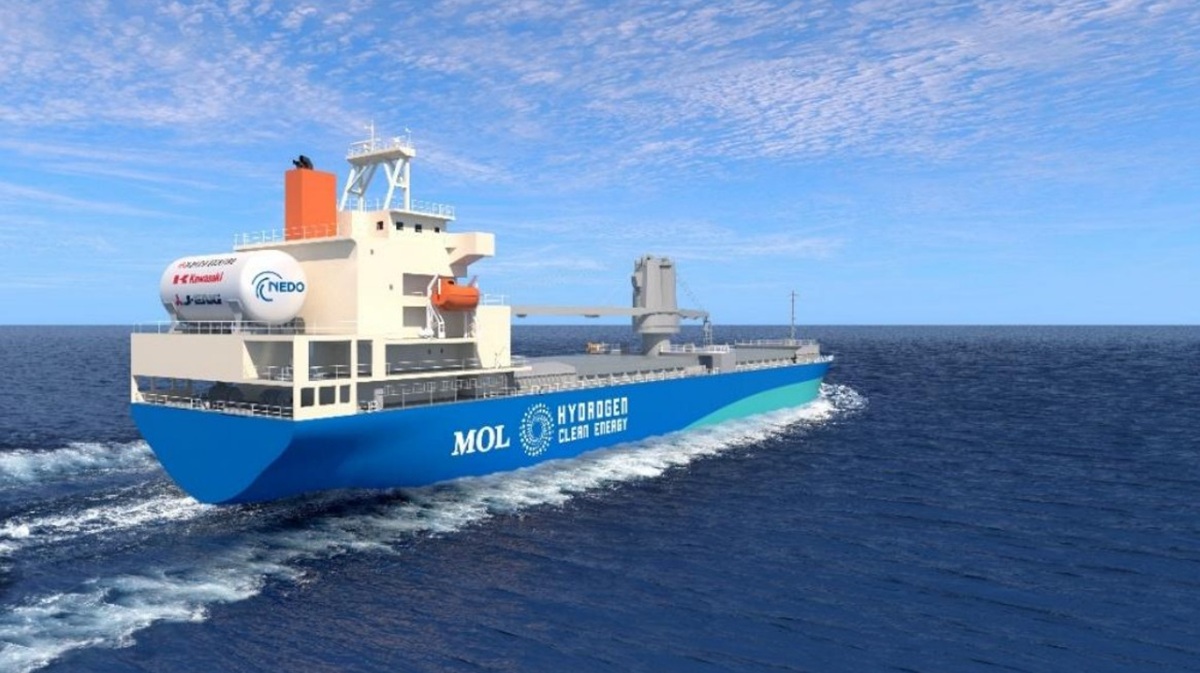


The test on land of the first hydrogen-powered engine in the world for large cargo ships achieved stable combustion in the six cylinders and more than 95% of the fuel energy at full load, with delivery scheduled for 2027 and sea tests in 2028
The hydrogen-powered engine for large cargo ships has entered a new stage of development in Japan with the start of land tests of a large two-stroke low-speed marine engine, designed for ocean-going vessels.
The campaign, led by Japan Engine Corporation and Kawasaki Heavy Industries, marked the world’s first operation of a hydrogen propulsion system designed for this type of ship.
The tested prototype, identified as 6UEC35LSGH, completed initial hydrogen co-combustion trials at J-ENG’s factory in Hyogo Prefecture. In the tests, stable combustion occurred in all six cylinders, with hydrogen accounting for more than 95% of the fuel energy at full load.
-
China Develops Custom 140-Ton Electric Mining Truck with 770 kWh Swappable Battery, Deploys 290 Units in Xinjiang’s Largest Zinc Mine

-
Meta to Launch Arena, a New Prediction App Targeting 3.56 Billion Users, Competing with Polymarket and Kalshi

-
Scientist Challenges Famous Human Evolution Theory, Argues Homo Sapiens Evolved Gradually Over Thousands of Years
-
15-Year-Old American Builds Ocean Generator with PVC Pipe and 3D-Printed Propeller for $12, Wins National Prize, Presents at White House, and Makes Forbes 30 Under 30 List




Hydrogen-powered engine advances for large vessels
During the testing campaign, the 6UEC35LSGH maintained reliable performance and showed significant reductions in greenhouse gas emissions compared to conventional diesel operation. The result reinforces the potential of the hydrogen-powered engine to accelerate the decarbonization of the maritime industry.
The development was conducted by J-ENG in collaboration with Kawasaki Heavy Industries, responsible for supplying the liquefied hydrogen fueling system. The project is part of the Green Innovation Fund initiative by the Organization for the Development of New Energies and Industrial Technologies, aimed at developing next-generation ships.
A consortium formed by Mitsui OSK Lines, MOL Dry Bulk, Onomichi Shipbuilding, and ClassNK also supports the program.
The engine is expected to be delivered in January 2027 to equip a 17,500 gross ton multifunctional cargo ship, currently under construction at the Onomichi shipyard.
Delivery in 2027 and sea tests in 2028
Real-scale sea tests are scheduled for the fiscal year 2028. In this initial phase, the project uses hydrogen as the main fuel and a small amount of heavy fuel oil as pilot ignition, in a configuration chosen to ensure redundancy in the first commercial applications.
Future versions are already planned with a focus on combustion with 100% hydrogen. The expectation is that this evolution will expand the use of the hydrogen-powered engine in more complex maritime operations, especially in larger ocean transport.
The latest stage of the project strengthens Japan’s strategy to export both hydrogen-powered ship technology and the associated fueling systems. This initiative is part of a broader effort to reduce emissions in the maritime sector through the use of alternative fuels, such as ammonia and hydrogen.
Global goals and challenges for hydrogen propulsion
Maritime decarbonization remains a priority in the goals of the International Maritime Organization, which aims for a reduction of at least 20% in greenhouse gas emissions by 2030 and net zero emissions by around 2050.
In this context, hydrogen appears as a zero-carbon fuel alternative when produced from renewable sources.
Still, the advancement of technology faces obstacles related to fuel storage, fueling infrastructure, and engine safety.
Despite these hurdles, the Japanese industry has sought to take a leading position in the sector through coordinated development among companies and public initiatives.
The most recent test by J-ENG and Kawasaki Heavy Industries occurs after previous land demonstrations conducted by the same consortium. In October 2025, Kawasaki Heavy Industries and Yanmar Power Solutions tested four-stroke hydrogen engines at medium speed using the same liquefied hydrogen supply platform.
The two-stroke model from J-ENG was directed towards the main propulsion of larger vessels intended for open sea, a segment where the adoption of hydrogen is progressing more slowly than in smaller and short-distance applications.
The company reported that it will continue to improve combustion control and durability under variable loads, with the expectation that the hydrogen-powered engine will provide essential data for the commercial deployment of these systems in the 2030s.
More information at https://global.kawasaki.com/news_260330-1e-b1.pdf






