





 Portuguese
  English
  Spanish
  5 min of reading
  0 comments


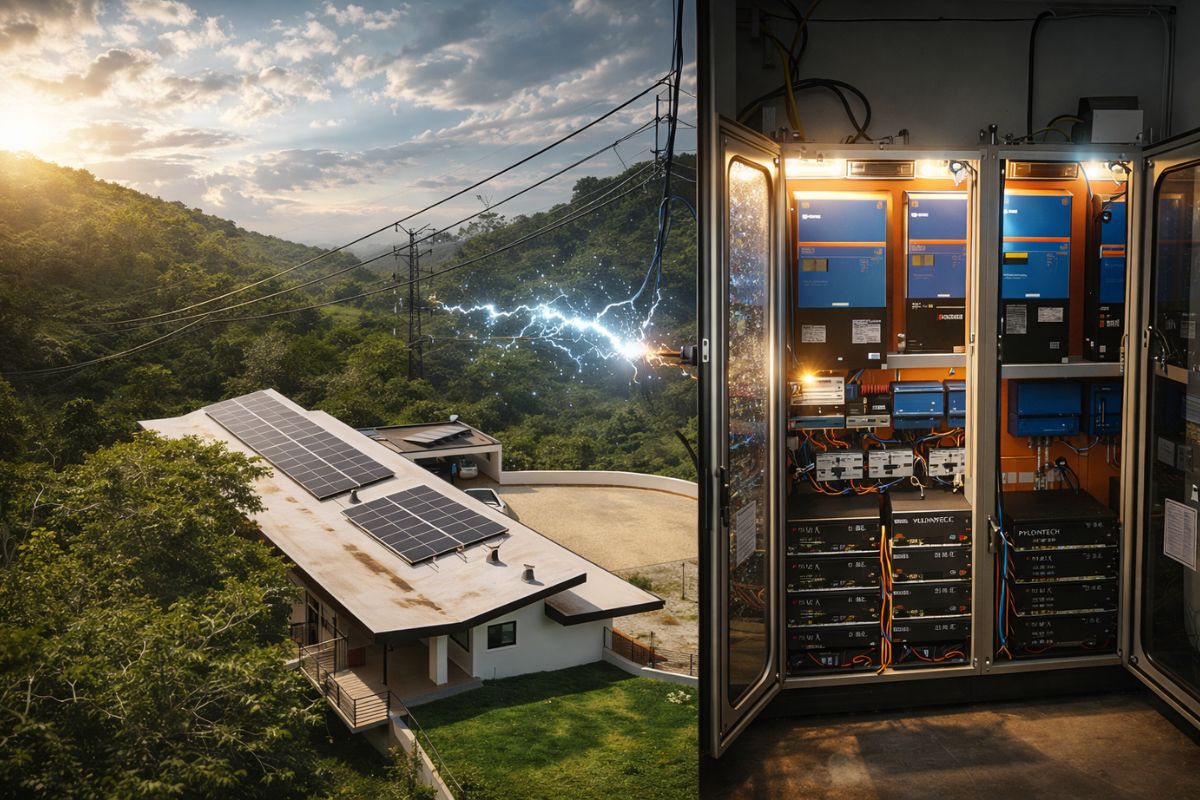
With an off-grid hybrid solar system, Victron integrates a Fronius on-grid inverter, 30 kWh in Pylontech batteries, and 15 kVA three-phase, limiting injection into the grid and helping to escape from wire B
Living in the interior of São Paulo and dealing with blackouts can become routine, but a well-configured off-grid hybrid solar system can keep the house running at the exact moment of the outage. In practice, the transition to battery is quick, and the system continues to deliver energy to the loads.
The proposal shown in the project is simple to understand and difficult to execute without planning: having energy even without the utility company, maintaining active solar generation during the day, using storage and control to avoid headaches and extra costs.
Blackout test: 16 to 20 ms for the system to take over

The test is straightforward: the main circuit breaker is turned off to simulate the utility company’s outage. Result: the light does not flicker and, in about 16 to 20 ms, the system takes over the battery. The monitoring shows a network failure indication with the message “grid lost,” and the flow shows the battery sustaining the loads.
-
Satellite images show heavy clouds and a cold front advancing: a cyclone brings storms from RS to SP, winds of up to 100 km/h, and an alert from Inmet, today with a risk of hail; Recife remains flooded.

-
China has started testing humanoid robots to control its border with Vietnam, and the company behind the project already plans to deliver 10,000 units by 2027 to expand their use across the country.

-
A cave in Morocco reveals jaws, teeth, vertebrae, and a femur dating back 773,000 years that may belong to archaic humans close to the ancestors of Homo sapiens, potentially changing what was known about the origin of our lineage in Africa.

-
Artemis 2 returns in extreme mode: the Orion capsule reenters at over 30,000 km/h, faces 2,700°C, experiences communication blackout, and navigates a narrow corridor, relying on the thermal shield and parachutes to land safely in the ocean.

The strongest point here is the quick switch, which prevents equipment from restarting, reduces impact on lighting, and keeps the house powered at the moment of the blackout.
How the system behaves without the grid

Even with the grid disconnected, energy continues to flow to the residence: the battery sends power to the loads, and the solar continues to contribute. An important detail of the project is the integration with on-grid inverters, with a Fronius that remains connected even without energy from the utility company.
In practice, this means continuity of generation during the day and more stability for the loads when the grid goes down.
Pylontech Batteries: 30 kWh of storage to secure the loads
The storage of the project is done with Pylontech batteries: there are six units, each with 5.12 kWh, in the UF5000 model, totaling 30 kWh of capacity. Their function is clear: to store energy in direct current and allow the inverters to deliver alternating current to the house when power is lacking.
On cloudy or rainy days, when generation drops, this battery bank becomes the “lung” of the system, holding consumption for longer.
Three-phase configuration: 15 kVA in three inverters

The residence is three-phase, with three phases. Therefore, the system uses three inverters, each connected to one phase, working together. In the project, there are three 5 kVA inverters, totaling 15 kVA in total.
This architecture is essential for a three-phase house because the goal is to keep the phases active and the loads supplied even when the utility company goes down.
MPPT controller and Lynx bus to organize the energy
In the harvesting and charging part, the project uses a Victron MPPT charge controller, connected to eight 55 W panels. The purpose of the MPPT is to capture energy from the panels and charge the batteries directly.
The Lynx Distributor 1000 bus acts as a connection interface, linking the positive and negative of the batteries with the inverters. It organizes the “electrical heart” of the system and facilitates current distribution among the components.
Manual transfer switch, circuit breakers, and surge protection devices: safety and maintenance
The system includes a manual transfer switch with battery and grid positions. In practice, this allows connecting the house directly to the grid when maintenance is needed, turning off the Victron system without leaving the residence without power.
In the electrical set, there are the main circuit breaker of the input standard, the system input circuit breaker, the three-phase circuit breaker, and the output circuit breaker that feeds the main panel of the house. The neutral is common, and there are surge protection devices for protection against surges and lightning strikes, reinforcing the safety of the arrangement.
Flow inversion: how to limit injection into the grid

A sensitive point in many projects is flow inversion, when generation exceeds consumption and energy is injected into the grid. In the example, monitoring showed 11 kW being injected with a consumption of 4 kW, within a system approved for 15 kW of solar energy.
If the utility company limits this injection, for example to 5 kW, the Victron allows parameterization and limits the injection to 5 kW, keeping the system prepared to meet grid requirements.
Wire B and GD2: when storing is more beneficial than injecting
With approved systems entering GD2, the discussion about wire B pricing arises. The logic mentioned is objective: many times it is more beneficial to store energy in the battery during the day and use it at night, rather than injecting it into the grid and then being taxed.
In this scenario, the differential is flexibility: deciding when to store, when to consume, and when to inject with a focus on reducing costs and increasing autonomy.
Peak shaving: savings during peak hours and demand control
The same type of solution can be applied in commerce and industry. The idea of peak shaving is to store energy when the rate is cheaper and discharge it during peak hours, typically cited as between 6 PM and 9 PM, to avoid using energy from the utility company during the most expensive period.
Additionally, for group A customers, there is a demand limit: if exceeded, there may be fines. With storage, it is possible to control the power peak and reduce the electricity bill costs.
Where to find solutions and how to talk to distributors
For those interested, the guidance presented is to seek Victron Energy through VCON, which has a website with the “where to buy” option, directing to national distributors. The recommendation is to contact distributors to present the demand and evaluate the ideal project.
And you, would you install an off-grid hybrid solar system to avoid suffering from blackouts and also reduce costs with wire B, or would you prefer to remain dependent on the grid?








Seja o primeiro a reagir!