






 Portuguese
  Spanish


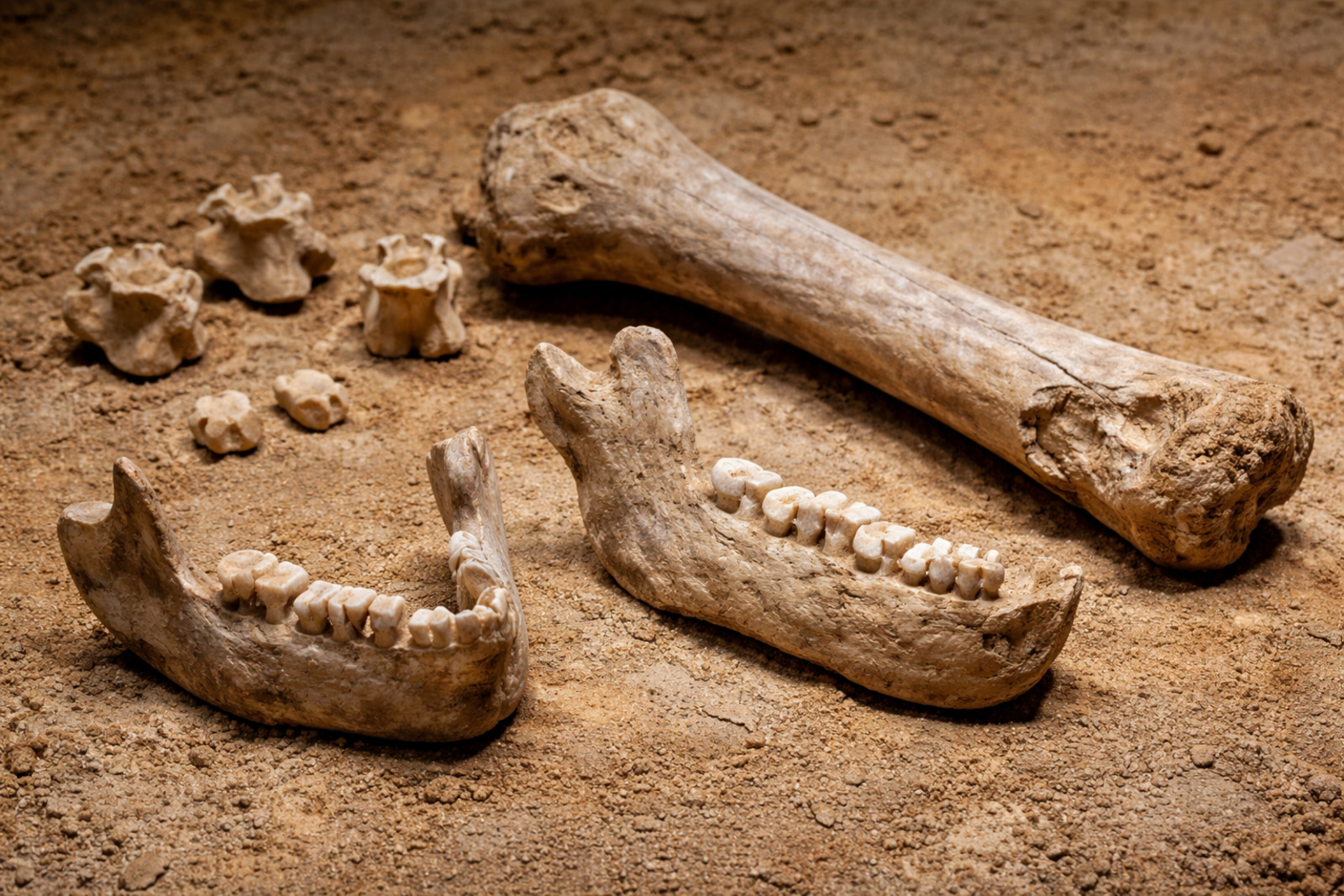


Fossils of 773 thousand years found in cave in Casablanca reveal archaic humans close to the lineages that preceded the emergence of Homo sapiens
Fossilized bones and teeth of 773,000 years, found in a Moroccan cave in Casablanca, deepen the understanding of the origin of Homo sapiens in Africa by revealing archaic humans close to the ancestral populations of the human species.
Fossils from Casablanca broaden the picture
The remains include lower jaws of two adults and a child, as well as teeth, a femur, and some vertebrae.
The researchers consider it appropriate to interpret the set as an evolved form of Homo erectus.
-
China Develops Custom 140-Ton Electric Mining Truck with 770 kWh Swappable Battery, Deploys 290 Units in Xinjiang’s Largest Zinc Mine

-
Meta to Launch Arena, a New Prediction App Targeting 3.56 Billion Users, Competing with Polymarket and Kalshi

-
Scientist Challenges Famous Human Evolution Theory, Argues Homo Sapiens Evolved Gradually Over Thousands of Years
-
15-Year-Old American Builds Ocean Generator with PVC Pipe and 3D-Printed Propeller for $12, Wins National Prize, Presents at White House, and Makes Forbes 30 Under 30 List




This archaic human species emerged about 1.9 million years ago in Africa and later spread across Eurasia. The described fossils exhibit a combination of primitive and modern traits.
This mosaic helps fill a gap in the fossil record of hominins, between about one million and 600 thousand years ago.
For the researchers, the discovery repositions the period in the evolutionary history of Homo sapiens.
Close link to human lineages
The researchers assess that the fossils may represent an existing African population just before the evolutionary separation of the lineages that would give rise to Homo sapiens in Africa and Neanderthals and Denisovans in Eurasia.
Jean-Jacques Hublin stated that caution is needed when treating them as the last common ancestor, but said they are close to the populations from which the later African and Eurasian lineages emerged.
For Hublin, the fossils show primitive and derived characteristics, consistent with evolutionary differentiation at that time. At the same time, they reinforce an African ancestry for the lineage of Homo sapiens.
The oldest known fossils of Homo sapiens, about 315,000 years old, were also found in Morocco, at Jebel Irhoud. The new discovery broadens this picture.

Age and preservation were decisive
The age of the fossils from the Hominid Cave was determined based on the magnetic signature of the sediments surrounding them.
This data was essential to assess how this population fits into the human family tree.
Hublin stated that establishing the age was essential for the interpretation of the material. Over time, the fossils were buried by fine sediments, while the entrance of the cave was sealed by a dune.
This process allowed for the preservation of the remains. In the same cave, hundreds of stone artifacts and thousands of animal bones were also found, broadening the context in which these fossils were analyzed.
Similarities with fossils from Spain
The human fossils from the Hominid Cave are the same age as the remains discovered in Gran Dolina, near Atapuerca, in Spain. This site represents the archaic human species called Homo antecessor.
According to Hublin, the similarities between Gran Dolina and Grotte à Hominidés are intriguing and may reflect intermittent connections across the Strait of Gibraltar. He stated that this hypothesis deserves investigation.
Bodies similar to ours
The hominins of this period had body proportions similar to ours, although they had smaller brains.
The jawbone of the child, who was about a year and a half old, was complete, while an adult jawbone was almost complete.
The other adult jawbone was incomplete. One of them was more robust than the other, suggesting that one could belong to a man and the other to a woman. The largest of the fossils found was the femur of an adult.
These people were capable of hunting, but lived in a dangerous landscape, with carnivores lurking. The femur shows bite marks and teeth, indicating consumption by a carnivore, possibly a hyena, in that environment.
Hublin stated that only the femur provides clear evidence of modification by carnivores. Still, the absence of marks on the jawbones does not mean that other parts of the bodies were not consumed by hyenas or other carnivores.
With information from Reuters.






