





 Portuguese
  English
  Spanish
  10 min of reading
  0 comments


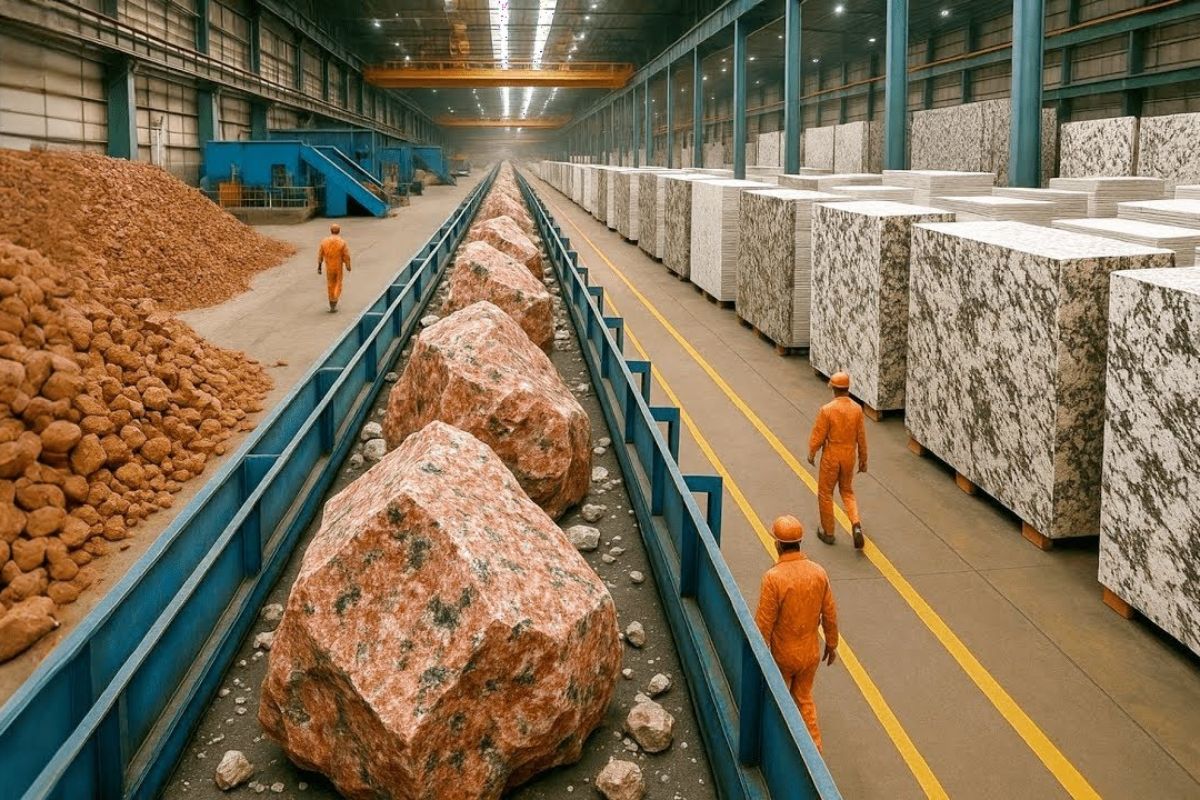
From Newly Released Colossal Granite Blocks in Open Pit Quarries to Polished Finishing, the Path Involves Drilling, Measured Explosives, Diamond Wire Cutting, Multiple Saws, Constant Water Flow, Continuous Polishing, Sealing, and Laser Inspection Until Each Slab is Packed for Monumental Works in Cities Around the World.
The colossal granite blocks begin their story hidden beneath layers of earth and time, the result of molten magma that cooled slowly over millions of years. When they finally come to light, they do not arrive as “beautiful stone”: they come as heavy, crystalline raw mass, with veins and minerals that only reveal themselves after a slow, noisy, and calculated process.
The transformation is industrial and choreographed. Between quarry, yard, factory, and shipping, the colossal granite blocks undergo extreme cuts, continuous water consumption for cooling and dust control, inline polishing, and precision checks. In the end, they become uniform slabs, ready for countertops, stairs, floors, and panels, with traceability and tight tolerances.
The Stone That Is Born of Magma and Becomes City Surface

Granite is born from molten magma that cools slowly, preserving traces of pressure, heat, and time in its mineral structure.
-
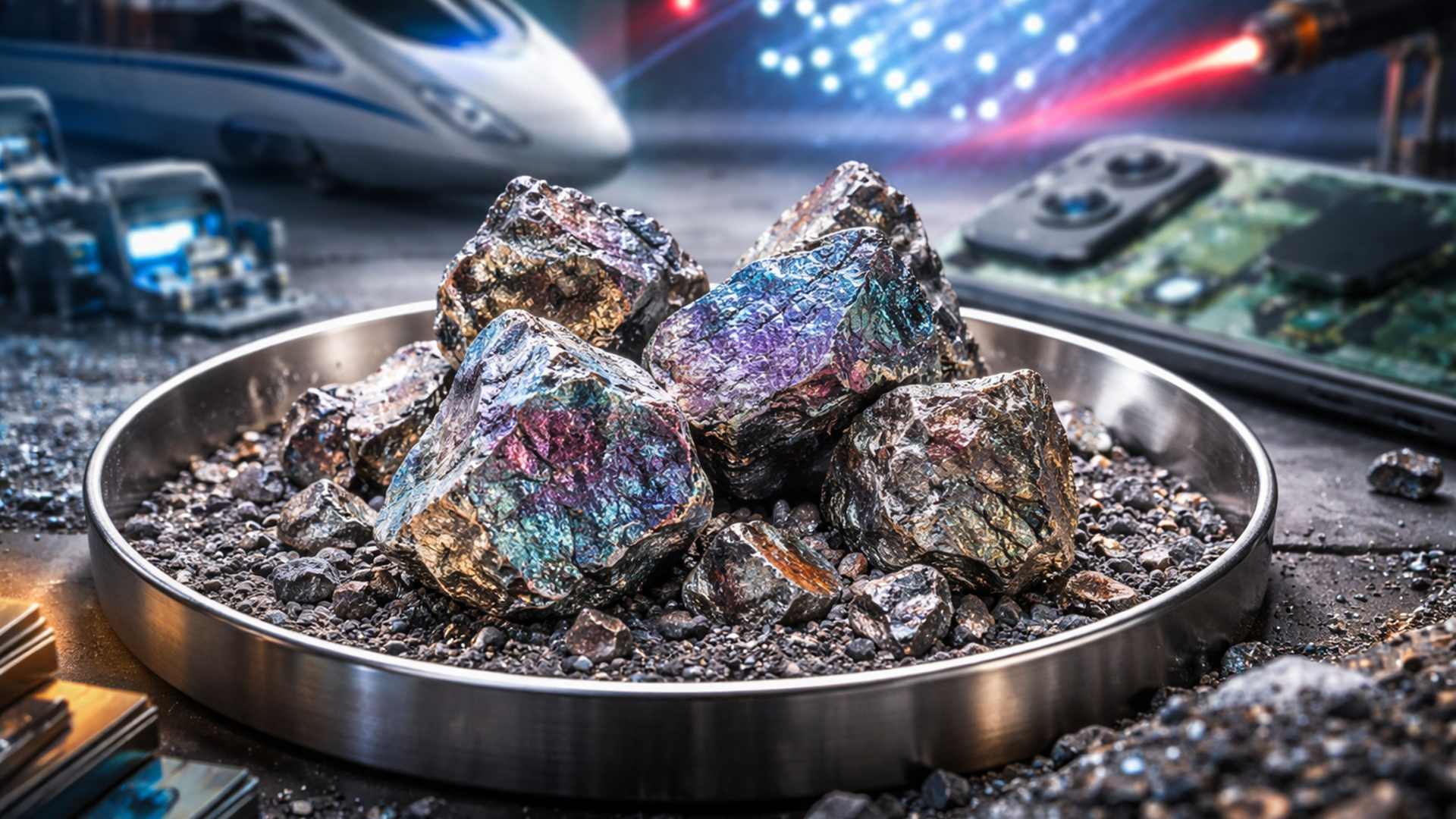
Rare earths are in everything, from cell phones to bullet trains, and what almost no one realizes is why they have become the target of such a delicate global war.
-
Brazil extracts 26.3 million tons of ore from what was previously treated as waste, transforming residues into wealth, producing over 3 million tons of sand, and demonstrating how national mining is relearning to generate value.

-
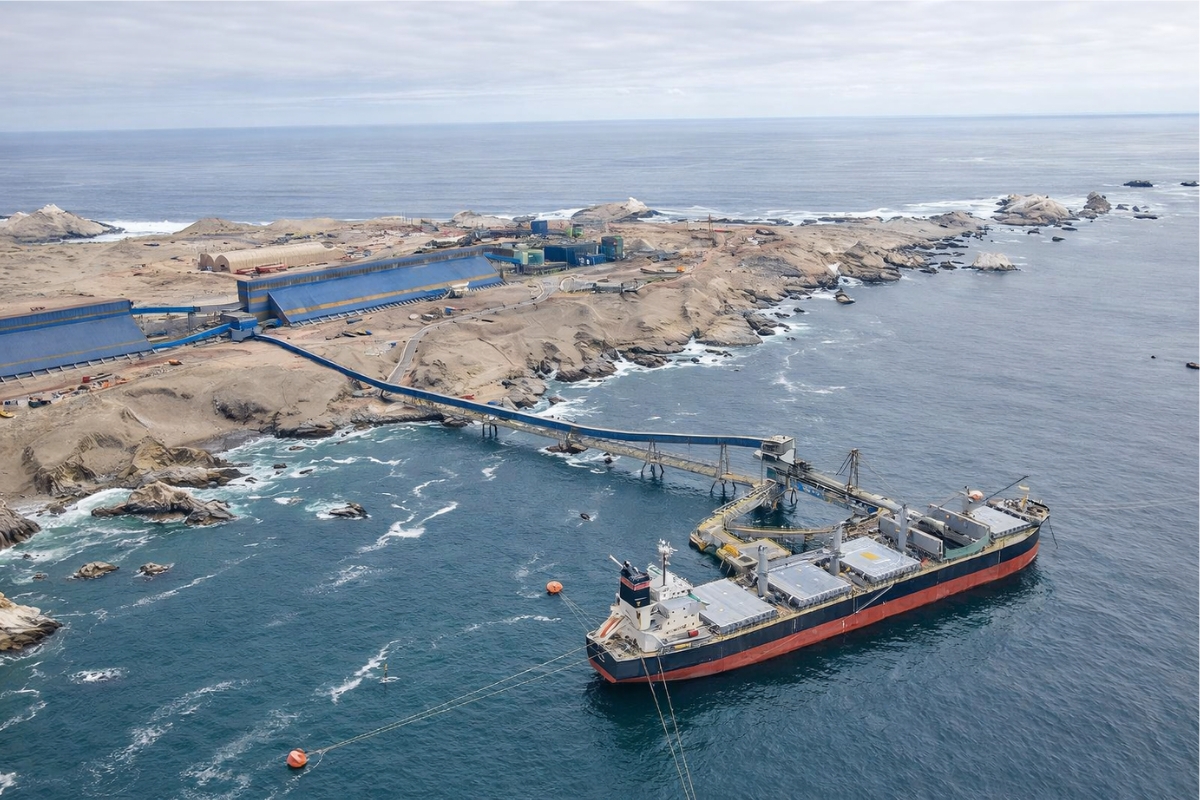
A $3.5 billion megaproject in Latin America pumps desalinated seawater at 1,050 liters per second over 194 km to keep a copper supermine in the Andes operational for another 20 years.
-
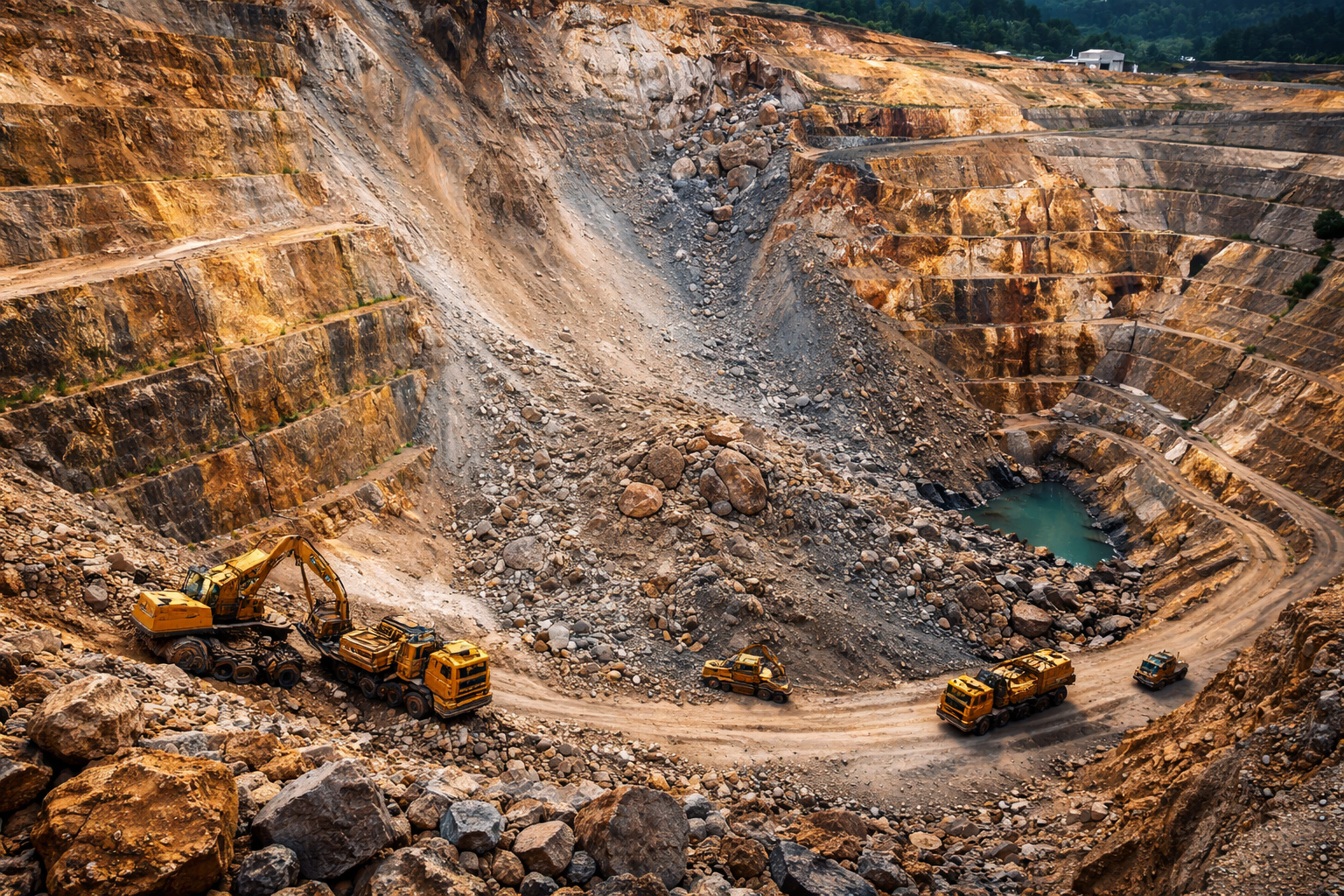
A hidden mine in the Andes valued at nearly R$ 1 trillion is starting to attract global attention, containing copper, gold, and silver, and raises an intriguing question: why do Argentina and Chile need to act together to exploit this gigantic wealth?

For this reason, it carries its own visual signature: quartz, mica, and feldspar forming crystalline patterns that, in the raw state, remain hidden beneath the roughness and dust of cutting.
Over millennia, the human relationship with this stone has oscillated between art, architecture, and symbolic power.
The same material that appears associated with monumental works, from a temple like Bradesvara in India to Mount Rushmore in the United States, now reappears in a daily urban vocabulary: facades, interiors, floors, and stairs.
However, before it becomes a finish, it needs to be extracted and tamed.
Open Pit Quarries: Removing Layers and Reaching the Granite Bed

The practical journey begins in open pit quarries, where colossal rock formations remain hidden beneath dozens of meters of earth, sand, and loose stones.
The first effort is not to cut stone; it is to remove what covers the stone.
The ground needs to be leveled to allow for markings, drilling, and movement of heavy machinery.
When the surface layer is removed, drilling teams enter with a carefully calculated grid pattern.
The points are marked, deep holes are drilled, and then loaded with a measured amount of explosives.
The goal here is not to “blast” the granite: it is to separate large blocks without fracturing the core.
A sequence of controlled detonations occurs in seconds.
The echo traverses the valley as huge slabs detach and slide down the quarry walls.
Then, with the dust settled, excavators and heavy trucks remove debris and expose intact blocks.
It is at this point that the colossal granite blocks begin to exist as separate units, with defined faces and industrial destiny.
Extreme Cuts: From Diamond Wire to Giant Blades
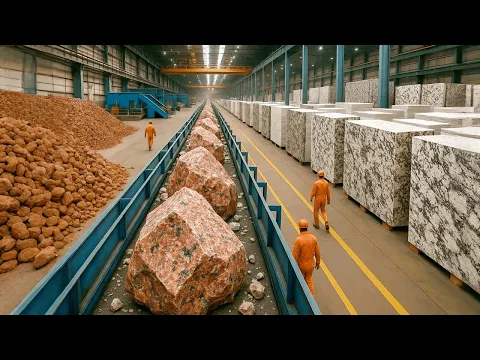

With the bed exposed, direct cutting on the face of the rock defines blocks with standardized measurements.
The parallel lines mark each extraction, with blocks that can measure over 4.5 meters wide and about 1.8 meters tall, weighing dozens of tons.
Two paths often appear. One uses diamond wire, a steel cable coated with synthetic diamond beads that spins continuously at high speed.
The cut progresses through the dense stone with less risk of cracks, precisely because the action is constant and controlled.
The other path involves giant blade saws, with segments of diamond tips along the edges and slow back-and-forth movement.
In larger quarries, these blades can reach several meters, working as a continuous “scar” that separates the block firmly, not with impact.
In both cases, the logic is the same: control energy and direction of the cut so that the beauty of the granite is not destroyed by internal fracture.
The diamond wire is not “fast” in the common sense. It is efficient in the industrial sense: it cuts without breaking what gives value.
Water as a Tool and Protection: Cooling, Cleaning, and Containing Silica
An invisible element for those who only see the finished stone dominates the entire process: water.
It cools the surface, removes dust, carries the abrasive sludge, and reduces the formation of fine silica particles in suspension, associated with lung diseases.
During a single shift, consumption can reach 1000 to 2000 gallons, with recovery and recycling of a large part of the volume.
Water is not only used to “avoid burning the blade”. It supports the stability of the cut and reduces occupational risk by keeping the environment less laden with dust.
Even when the cut shifts from the wall to bridge saws and multiple saws, water remains the silent gear.
Without this constant flow, subsequent polishing also loses consistency, as micro-damages and saw marks multiply.
When the Block Falls: Pressure, Wedges, and Tons in Controlled Descent
After the cut lines are completed, workers insert steel wedges or hydraulic jacks to separate the piece from the wall.
The separation is done with precise pressure release. The result is brutal: a stone weighing dozens of tons falls to the bottom of the quarry, with an impact that echoes through the valley.
A standard block can weigh between 20 and 50 tons, but there are reported cases of 80 to 100 tons, requiring heavy-duty cranes for lifting and moving.
This difference in scale defines logistics, time, and cost, and affects how extraction is planned.
Here, the word “slow” takes on another meaning.
It is not slowness from lack of technology; it is slowness by necessity for control. In a crystalline stone, a pressure error can cost the whole block.
Transport and Storage: Slow Convoys and Millimetric Balance
Once the block is separated, the fine cutting and preparation for transport phase begins.
Giant bridge saws, with blades embedded with diamond, divide the block into smaller, standardized pieces, facilitating loading and processing.
Water continues to flow, washing the abrasive paste and keeping the cut clean.
The colossal granite blocks are then taken to a storage area within the quarry. Specialized trucks with low beds and reinforced structures handle steep terrain.
Giant cranes on tracks lift the blocks off the ground, with chains and steel straps secured at balance points to prevent spinning or slipping.
All of this movement may seem exaggerated until one remembers the obvious: a block that spins out of control does not forgive.
From there, the convoy proceeds slowly through winding quarry roads and mountain passes.
This marks the beginning of the long transition of the colossal granite blocks to the factory environment.
In the Factory: Stability, Multiple Blades, and Parallel Cuts
Upon arrival, heavy cranes position the block on reinforced cutting platforms, anchored in concrete foundations to eliminate vibration.
Steel structures and hydraulic clamps lock the block in place, because any instability becomes a flaw in the slab.
The heart of this stage is the multiple blade saw, with 40 to 80 parallel steel blades, each over three meters long and edges coated with industrial diamonds.
The forward and backward motion is constant. The blades lower at a few millimeters per minute, a pace designed to prevent fractures within the crystalline structure.
Vibration and pressure sensors monitor resistance in real-time, adjusting cutting force according to the block’s mineral density.
And water once again plays a dual role: it cools, removes sludge, reduces wear, and suppresses silica dust in the air.
A complete cycle can take 15 to 24 hours, depending on size and hardness.
In the end, the block becomes dozens of uniform slabs, with thickness noted between 3/4 and 1 1/4 inches, each weighing several hundred pounds.
This stage defines commercial value: only what is flat, uniform, and crack-free continues.
Modeling and Standardization: Uniform Thickness and Tight Tolerances
After being classified and inspected, the material proceeds to modeling, a phase that determines the standard dimensions of each slab.
The cut here aims at final application: countertops, stairs, wall panels, and floors.
The thickness usually ranges between half an inch and just over an inch, varying depending on the intended use.
The process relies on large diamond circular saws, equipped with multiple parallel blades.
Each blade can reach three meters in diameter, embedded with synthetic diamonds for durability and precision.
A high-pressure water system operates continuously to reduce friction, remove sludge, and prevent edge burns or microcracks.
Laser sensors and hydraulic drives control spacing and thickness with a tolerance of less than 1 millimeter along the slab.
The result is repeatability: transforming a several-ton block into dozens of slabs with consistent measurements, ready for line polishing.
Industrial Polishing: From Coarse Grain to Shine That Reveals Veins
Cut, the slab is still rough, covered in stone dust. It then enters an automated polishing line, which can stretch for dozens of meters and operate 24 hours a day.
The slab passes through grinding and polishing heads, each with a function: leveling, smoothing, refining, and finally, mirroring.
In the initial phase, coarser grains remove saw marks and irregularities, leaving the surface flat.
Next, finer grain heads, often coated with industrial diamonds, refine the surface by removing minimal layers with each pass.
Sensors control pressure and rotation speed to protect the crystalline structure from microfractures.
Water keeps the system stable, washing away sludge and reducing friction.
It is filtered and recirculated through sedimentation tanks, decreasing waste and keeping the workspace cleaner.
As the slab advances, the shine emerges as a technical revelation: quartz, mica, and feldspar crystals begin to reflect light, and the veins transition from “suspicion” to design.
It is here that the colossal granite blocks change identity.
The same mass that thundered down in the quarry now responds to millimetric pressure, repeated dozens of times, until reaching a mirrored finish.
Sealing and Curing: The Invisible Barrier That Prolongs Finishing
With the shine achieved, a step often underestimated by those who only see the final result comes in: the protective transparent coating.
This is a sealer designed to prolong longevity and preserve the finishing.
The product penetrates the microscopic pores of the granite, forming a barrier against water, oil, and weak acids.
The application can occur via automatic sprayers or low-pressure rollers, depending on the scale. Sensors monitor coverage to ensure uniformity, without defects or stains.
Subsequently, the slabs cure under controlled temperature and humidity, allowing the sealer to set and reach maximum clarity.
At the end of the curing process, visual inspection is rigorous: high-intensity lighting reveals scratches, hazy stains, and subtle variations in hue.
The polishing is only considered final when the surface exhibits depth and uniformity.
Laser Inspection: 3D Map, Microcracks, and Cut of What Does Not Serve
Once polished and cleaned, the slabs enter laser inspection, a stage dedicated to absolute precision before packing.
Scanning sensors project beams onto the surface, capturing millions of data points and creating a detailed 3D map of each slab.
The software analyzes flatness, thickness, and parallel alignment of the faces, identifying minimal deviations.
The laser inspection also detects microcracks, air pockets, or surface deformations invisible to the naked eye. Anything that does not meet standards is marked and removed. What passes goes on to packing.
This sorting changes the narrative about “natural” material.
Granite may have geological origins, but the final product that reaches the construction site is an industrial component, selected by parameters and tolerances.
Packing and Traceability: Protecting Edges, Locking Slabs, and Identifying Origin
The packing area is where the stone is ready, but still vulnerable.
Each slab can weigh between 400 and over 1000 pounds, so movements are made by specialized robotic elevators or hydraulic gantry cranes.
The machines use vacuum suction cups to lift the slabs vertically, reducing the risk of scratches, chips, and damage to edges.
The slabs are positioned on sturdy steel pallets or reinforced wood.
Between them, rubber pads or foam spacers are added, maintaining constant spacing to avoid cracks during transport.
A surrounding steel structure locks the set, metal strips tighten, and a protective polyethylene film shields against dust and moisture.
Each shipment receives a traceability label: type of stone, dimensions, batch number, quarry of origin, and final destination.
Depending on the order, it follows in a sealed container or a padded wooden box for international transport.
When loading is complete, the colossal granite blocks are no longer blocks.
They are numbered slabs, selected, protected, and ready to become part of structures meant to last.
What Changes in Cities: Why the Process Redefines Modern Construction
The impact of granite on cities is not just aesthetic.
The described chain imposes a logic of standardization and predictability: repeatable dimensions, flat surfaces, stable finishing, and selection by quality.
This allows applying the material on an urban scale, in projects that require repetition and consistency.
At the same time, the process is “brutal” by definition. There is controlled detonation, the fall of dozens of tons, diamond saws working for hours, water circulating non-stop, inline polishing, and sorting through laser inspection.
This combination creates a modern paradox: a material born of geological time becomes a precision product, ready to integrate into urban routines.
In the open pit quarries, extraction requires separating without fracturing. In the factory, it requires cutting without vibrating. In the finishing, it requires revealing without scratching.
In control, it requires measuring the invisible.
The result is a stone that, despite its age, responds to contemporary demands: tolerance, traceability, and repeatability.
The journey of the colossal granite blocks has no shortcuts. It begins buried beneath earth and ends stacked on pallets, with protected edges, batch label, and defined destination.
Between these extremes, what determines value is control: diamond wire that cuts without cracking, water that cools and protects, polishing that reveals minerals, and laser inspection that eliminates error before it becomes an issue on site.
If you work with construction, design, or maintenance, it’s worth observing how these stages influence deadlines, waste, and finishing standards on site.
And the question that remains, simple and direct:
Would you trust more in a coating made to last decades or in a finishing that prioritizes only immediate shine?







-

-

-

-

-

-

46 pessoas reagiram a isso.