





 Portuguese
  English
  Spanish
  3 min of reading
  0 comments


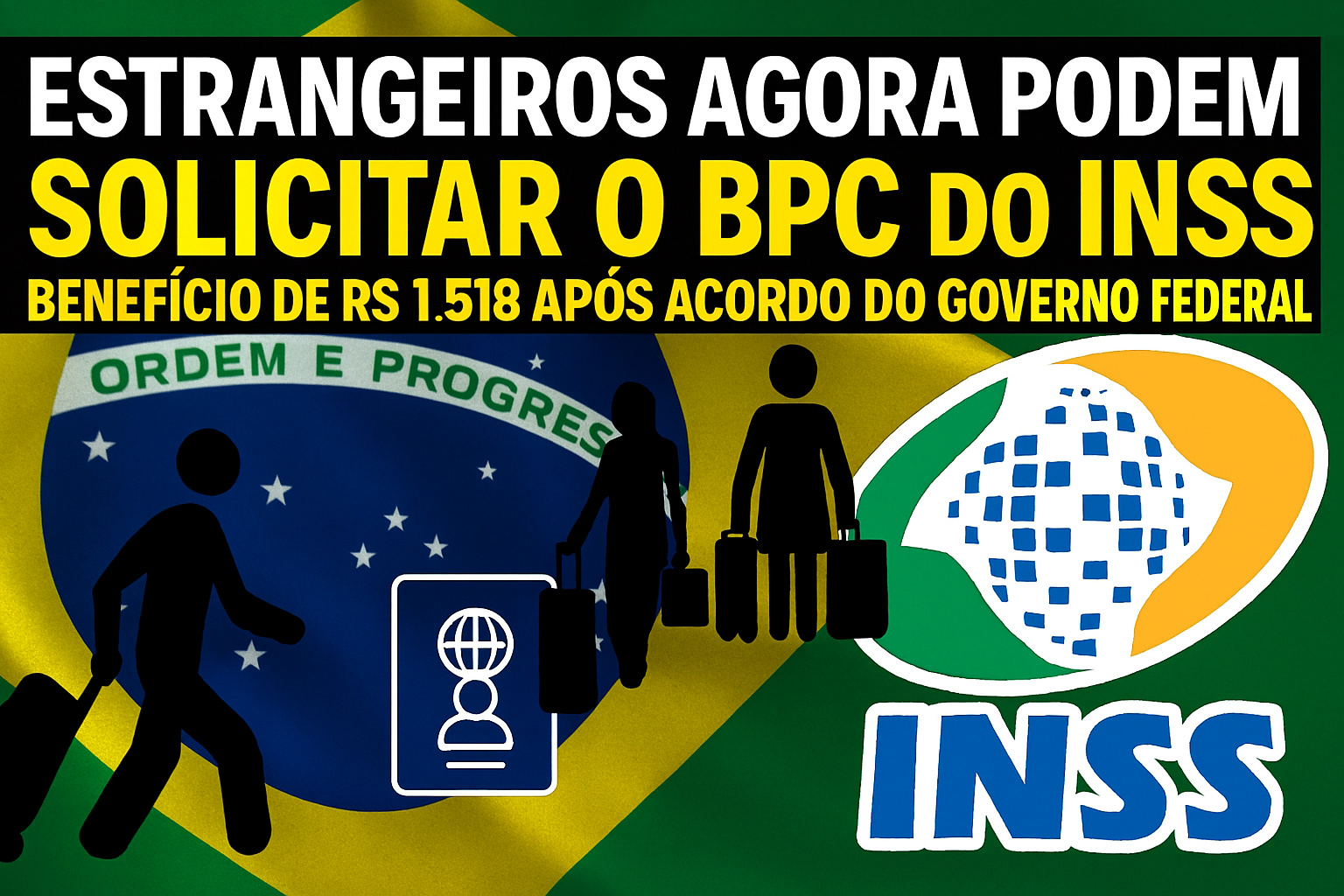
Federal Government Signs Agreement in August 2025 and Facilitates Access for Migrants to the BPC of the INSS Worth R$ 1,518, Guaranteeing Citizenship and Less Bureaucracy.
On August 5, 2025, the Federal Government signed a technical cooperation agreement that promises to transform the lives of thousands of immigrants in vulnerable situations in Brazil. The measure, signed by the National Social Security Institute (INSS) in conjunction with the Public Defender’s Office of the Union (DPU), the Ministry of Development and Social Assistance (MDS), and the Advocacy General of the Union (AGU), facilitates access for foreigners to the Continued Payment Benefit (BPC-LOAS), paid monthly in the amount of R$ 1,518.00.
The decision was celebrated because it eliminates bureaucratic hurdles and recognizes migration documents as valid for the benefit request. This directly impacts populations such as the Venezuelans — who already number over half a million refugees in Brazil — and the Angolans, who also represent a significant portion of immigrants seeking decent conditions in the country.
The BPC-LOAS and Its Role in Social Protection
The BPC-LOAS is guaranteed by the Federal Constitution and regulated by the Organic Law of Social Assistance (LOAS). It ensures one minimum wage per month to the elderly aged 65 and over and people with disabilities in vulnerable situations.
-
With the arrival of Law 11.788, internships are now recognized as professional experience.

-
The Brazilian Civil Code states that a property owner has the right to cut the roots of a neighbor’s tree that invade their land, as long as it does not harm the tree itself. The owner must notify the neighbor before taking such action.
-
Engineer is sentenced to repay R$ 148 thousand after holding public positions in three municipalities in Rondônia with incompatible schedules, and the decision is upheld by the Court of Justice.

-
Chamber approves project that creates mandatory Life Insurance for police officers, firefighters, guards, and traffic agents.

Unlike retirement, it does not require contributions to the INSS, but rather proof of per capita income below 1/4 of the minimum wage.
In 2025, this amount corresponds to R$ 1,518.00, an essential sum for families facing extreme financial hardships.
What Changes with the Agreement
The agreement signed in August 2025 establishes that, from its judicial approval, foreigners may present as valid documents for requesting the benefit:
- The National Migration Registration Card (CRNM);
- The Provisional National Migration Registration Document, used by asylum seekers.
The formal acceptance of these documents, including in digital format, represents an important milestone, as previously the lack of bureaucratic recognition prevented thousands of legitimate requests.
The Impact for Venezuelans and Angolans
According to data from the UNHCR (United Nations Refugee Agency), Brazil has already welcomed over 500,000 Venezuelans since 2015, most in extreme poverty. The Angolans, in turn, migrated in large numbers since the 1990s when the civil war in the country forced thousands to seek refuge in Brazil.
With the change, these groups will have real and simplified access to the BPC, ensuring minimum conditions for survival and greater dignity in the social integration process.
The Statement from the President of the INSS
The president of the INSS, Gilberto Waller Júnior, emphasized during the announcement that the measure represents “less bureaucracy and more citizenship”. For him, the recognition of migration documents is a step forward that aligns Brazil with international commitments to social protection and human rights.
The agreement will still be submitted for judicial approval. After approval, the Union and INSS will have 90 days to implement the changes, a deadline that may be extended for technical reasons. This means that by the end of 2025, migrants and refugees will be able to apply for the benefit with the new documentation.
Requirements Remain in Effect
Despite the simplification, the other legal requirements remain:
- Be 65 years or older (elderly) or prove long-term disability;
- Household per capita income below 1/4 of the minimum wage;
- Be registered in the CadÚnico and prove social vulnerability.
In other words, the agreement does not create a new right, but ensures facilitated access for those who already had legal provisions to request the BPC.
Brazil, a signatory to international human rights treaties, reaffirms its stance of welcoming and social protection with this measure. For Venezuelans, Angolans, and other migrants arriving in extreme difficulty, the BPC can be the starting point for a more dignified life.
The decision also marks a step forward in combating bureaucracy and strengthens the social protection network in a country that, according to the government, still faces great socioeconomic inequalities.









-

-

-

3 pessoas reagiram a isso.