





 Portuguese
  English
  Spanish
  8 min of reading
  4 comments


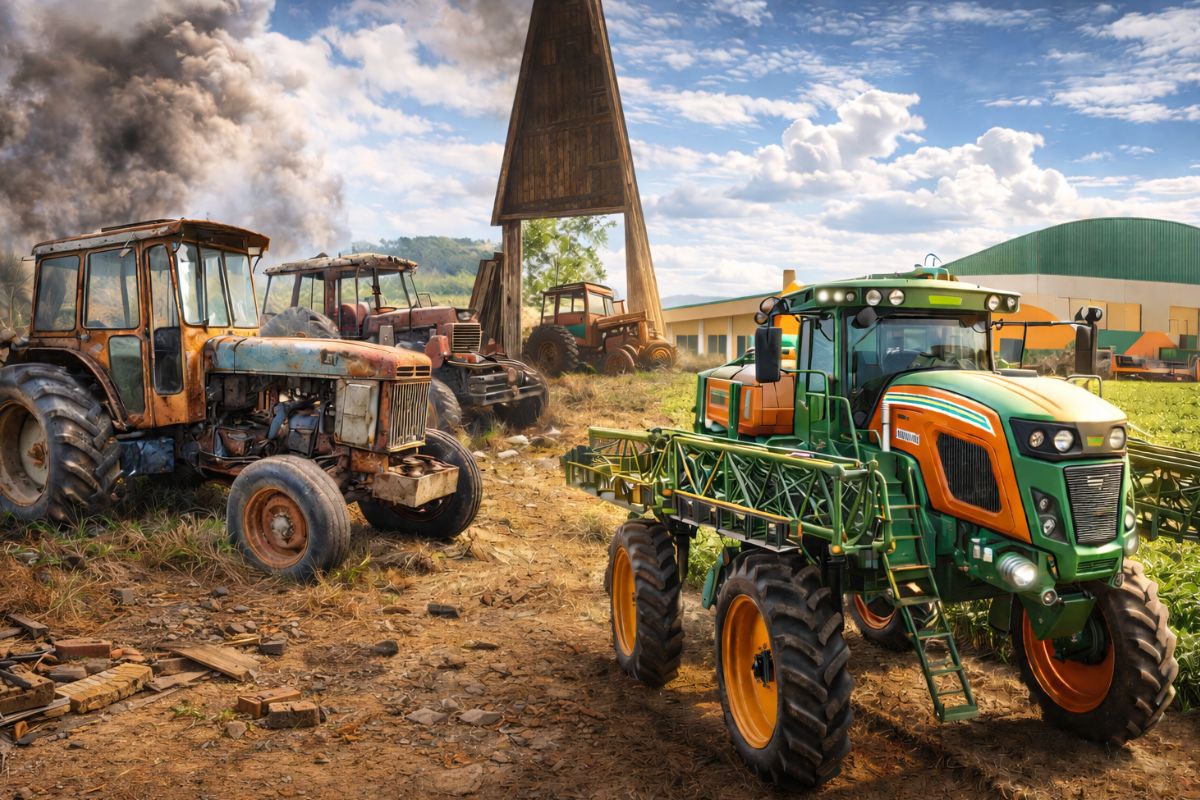


While CBT and Malves remain only in memory, Stara agricultural machines emerged from a small workshop in the rural region of Rio Grande do Sul, weathered crises in the agricultural machinery industry, invested in precision agriculture, created credit for agricultural machines, and today operates connected even through Starlink.
Brazil almost became a global reference in fully national agricultural machines. Brands like CBT and Malves once dominated entire crops but succumbed to economic crises, exchange rates, and poor financial decisions. In the midst of this competitive and unstable scenario, Stara agricultural machines emerged as an exception: it started by repairing implements, became a manufacturer, nearly went bankrupt, and was reborn by betting on technology and management.
Today, understanding this trajectory helps to see how the Brazilian agricultural machinery industry could have been an empire and why there is practically only one major national survivor operating with precision agriculture, its own agricultural machine credit, and connectivity via Starlink for the field. It is not just a story of a company; it is a portrait of how Brazilian agribusiness learned, the hard way, to rely less on foreign giants.
When Brazil Dreamed of an Empire of Agricultural Machines
For decades, Brazil saw the birth of a generation of national agricultural machine manufacturers that seemed ready to compete with multinationals. CBT became synonymous with robust and durable tractors in the countryside.
-
“No one will make us change the Pix,” says Lula after the US report.

-
Lula responds directly to Trump and says that Pix is from Brazil and will not change under pressure from anyone, after a report from the United States pointed out the Brazilian payment system as an American trade barrier.

-
Amazon has just announced a new fee on all deliveries, and your online purchases will become more expensive starting April 17, including for those buying from the United States here in Brazil.

-
He sold his share for R$ 4 thousand, saw the company become a giant worth R$ 19 trillion, and missed the opportunity of a lifetime.


The famous CBT 2400, square, noisy, and present in fields across the country, carried significant symbolism: it was proof that farmers could work with agricultural machines made here, designed for the soil and Brazilian ways of production.
At the same time, other companies entered the competition. The national industry was experiencing a moment of optimism, with incentive policies, an expanding domestic market, and farmers eager to mechanize at any cost. It seemed like a matter of time before the country solidified a true empire of its own agricultural machines.
CBT and Malves: When the Agricultural Machinery Industry Could Not Endure
CBT made its mark but did not withstand the passage of time. Management errors, changes in economic policy, and heavy competition from global giants eroded the brand’s position.
Gradually, those tractors that represented national pride became more of a memory than a real purchasing option.
Malves took a similar path but with a different specialty. It was a much smaller company, focused on motor graders and specific equipment, which even managed to export to several countries.
Even smaller, Malves proved that the Brazilian industry had the technical capacity to compete abroad.
In the end, a bank brought the company down, revealing another side of reality: it is not enough to manufacture good agricultural machines if access to credit, working capital, and financial management do not keep pace. Several national brands disappeared exactly at this breaking point between workshop, spreadsheets, and banks.
From Small Workshop to Stara Agricultural Machines
While CBT and Malves followed their paths, another story began far from the spotlight. The origins of Stara agricultural machines date back to post-war Europe.
After World War II, a family of blacksmiths and farmers, the Stapelbroeks, decided to leave the Netherlands amid economic crises and political tensions.
In April 1949, they landed in Brazil, passed through an immigrant colony in the interior of São Paulo, and, encouraged by Dutch priests, ended up in Não-Me-Toque in Rio Grande do Sul.
There, Johannes Stapelbroek noticed a very clear need. Local agriculture was beginning to develop, but there was a lack of someone to repair and adapt implements brought from abroad.
Thus, a workshop emerged focused on serving farmers in the region, adjusting European agricultural machines to function in Brazilian fields.
This workshop grew, attracted clients from neighboring cities, and formed a partnership with another immigrant. After an amicable separation, on August 29, 1960, Stara was officially born, still small, but with something that would make a difference later: a deep knowledge of what truly broke, failed, and worked with agricultural machines used in the field.
First Solutions and the Shift to Agricultural Machinery Industry
After years of repairing and adapting implements, Stara agricultural machines accumulated a type of experience that is hard to replicate. It was not office theory; it was workshop practice combined with daily interactions with farmers.
It was in this context that, in 1968, one of the brand’s first milestones was born: a steerable weeder with floating arms.
In simple terms, it was equipment capable of following the irregularities of the terrain without losing efficiency. For those who live off fields full of unevenness, this means less loss and more productivity.
From there, the company began to move from being merely a workshop into the agricultural machinery industry, albeit at a limited scale.
Sprayers, agricultural tools, and even hospital beds came during a phase when any product that kept the machines running and the payroll up to date was valuable.
By the late 1970s, demand was greater than the structure, and in 1978, Stara inaugurated a factory of about eight thousand square meters in Não-Me-Toque.
It was a clear step from family workshop to agricultural machinery industry with ambitions to grow.
Crisis, Dollar Debt, and Near End of Stara Agricultural Machines
The problem was that the timing of the expansion could not have been more challenging. The factory was financed in dollars, something common at the time. Shortly after, Brazil plunged into the hyperinflation of the 1980s, with the currency rapidly devaluing and interest rates soaring.
The debt, which initially seemed manageable, multiplied. Stara agricultural machines began to delay salaries, suppliers, and banks.
The risk of closure was real. It was at this moment that Francisco Stapelbroek, affectionately known as Chico, came on the scene.
The son of the founders, he had left to become a farmer but returned when he saw the gravity of the situation. He put his own money, coming from rural activities, to reorganize the accounts and avoid collapse.
Stara survived, but learned the hard way that no agricultural machinery industry endures without financial control and humility in expansion.
When the dust settled, the company was more cautious. And exactly for that reason, it began to focus even more on what had always made a difference: looking at the real problems faced by farmers and proposing practical solutions.
Innovation in the Field: Precision Agriculture as a Game Changer
In the 1990s, the Brazilian countryside began to change. The “owner’s eye” remained important, but it was no longer enough. Information became an input. Multinationals brought to the country combinations of GPS, sensors, and embedded electronics.
Stara agricultural machines understood that if they stayed still, they would be swallowed up. Instead of simply importing closed solutions, they began to bring precision agriculture systems to dismantle, study, and understand. From this movement, the Aquarius project was born in partnership with the Federal University of Santa Maria.
The experimental field used mapping, data, and georeferencing at a time when many producers still doubted precision agriculture. From this base emerged the Topper, an electronic controller that became the brain of various brand equipment.
With the Topper, Stara’s agricultural machines started to adjust seeds, fertilizers, and speed based on data, avoiding overlap and waste.
It was the first time a Brazilian company brought to market a precision agriculture system genuinely designed for local reality, rather than just copied from other regions.
This technological package solidified Stara’s image as an agricultural machinery industry that was not just “another metal manufacturer” but a company capable of combining steel, software, and agronomy.
When Agricultural Machines Find Credit for Agricultural Machines
As products evolved, the market changed as well. International giants started to offer not only equipment but complete financing packages.
For the producer, it was often easier to obtain credit from the manufacturer than from a traditional bank.
Realizing this, Stara agricultural machines took a strategic step and created its own financial solution, Stara Finance. In practice, this meant fully entering the universe of credit for agricultural machines, adapted to harvest conditions, climatic risk, deadlines, and the producer’s reality.
Having credit for agricultural machines in-house changed the game. The company began to better control the sales cycle, delivery, and payment, offering financing alternatives that brought farmers closer to the brand and reduced exclusive dependence on banks.
This combination of robust products, precision agriculture, and proprietary credit for agricultural machines helped Stara navigate an entire decade of growth, expanding factories, dealer networks, and presence in other South American and African countries.
Few companies in the Brazilian agricultural machinery industry managed, at the same time, to produce, finance, and technologically support the customer as Stara began to do.
Political Controversy, Public Prosecutor’s Office, and Image Reconstruction
However, not everything was just technology and expansion. In 2022, in the midst of a national election campaign, an internal company communication about potential production cuts if the economic scenario changed leaked and went viral.
The text, according to Stara agricultural machines, referred to economic projections but was interpreted by part of the public opinion as possible political pressure on workers.
The case made headlines in national portals, and the Public Labor Ministry opened an investigation.
In the end, the company reached an agreement, made preventive commitments, and paid compensation, concluding the process.
The episode made it clear that when an agricultural machinery industry grows and gains national relevance, any internal communication noise can turn into an external crisis.
After the turbulence passed, Stara resumed its preferred path: launching machines, expanding plants, and investing in connected solutions for the field.
Starlink, Connectivity, and the Future of Brazilian Agricultural Machines


In a more recent stage, Stara agricultural machines identified another significant bottleneck for the producer: the lack of internet in the middle of the fields. Without stable connectivity, part of the precision agriculture and remote monitoring resources was underutilized.
To solve this, the company partnered with Starlink. The logic is simple: if the internet does not arrive from the ground, it comes from the sky. With dedicated antennas, agricultural machines began to operate connected even in regions where mobile telephony barely works.
This opened up opportunities for remote diagnostics, software updates from a distance, real-time monitoring, and closer integration between the field and the factory.
In practice, the agricultural machinery industry began to offer not only the equipment but a digital ecosystem that accompanies the producer throughout the entire useful life of the machine.
Today, it is possible to find Stara agricultural machines in fields in the South, Midwest, in neighboring countries, and in specific markets in Africa.
It is proof that, even without becoming an “empire” with dozens of giant national brands, Brazil has managed to take at least one significant representative of its agricultural machinery industry onto the global map.
And do you see a future for more global Brazilian agricultural machines?
The story of CBT and Malves shows how Brazil came close to having several national giants and lost much of that potential.
The trajectory of Stara agricultural machines shows the other side: it is possible to emerge from a small workshop, face crises, invest in precision agriculture, create credit for agricultural machines, and reach the era of connectivity via Starlink without losing roots in the field.
Ultimately, the question remains whether the country will be able to form new brands capable of competing globally in the agricultural machinery industry or if Stara will be an exception that proves the rule.
And you, do you think Brazil can still create other agricultural machine manufacturers with a global presence, or is the game already dominated by multinationals?








Eysqueceram da Engesa, Santa Matilde,Muller y a Malves também fabricava³tratores agrícolas e não só equipamentos ⁴específicos como vcs falam
CBT quando pediu ajuda oficial foi negado.
Enquanto empresas estrangeiras recebiam terrenos incentivos fiscais por vários anos etc.
Isso que aconteceu.
O que precisa é apoio dos governantes e incentivo para a indústria nacional e taxar as estrangeiras. Mais nacionalidade.