





 Portuguese
  English
  Spanish
  4 min of reading
  0 comments


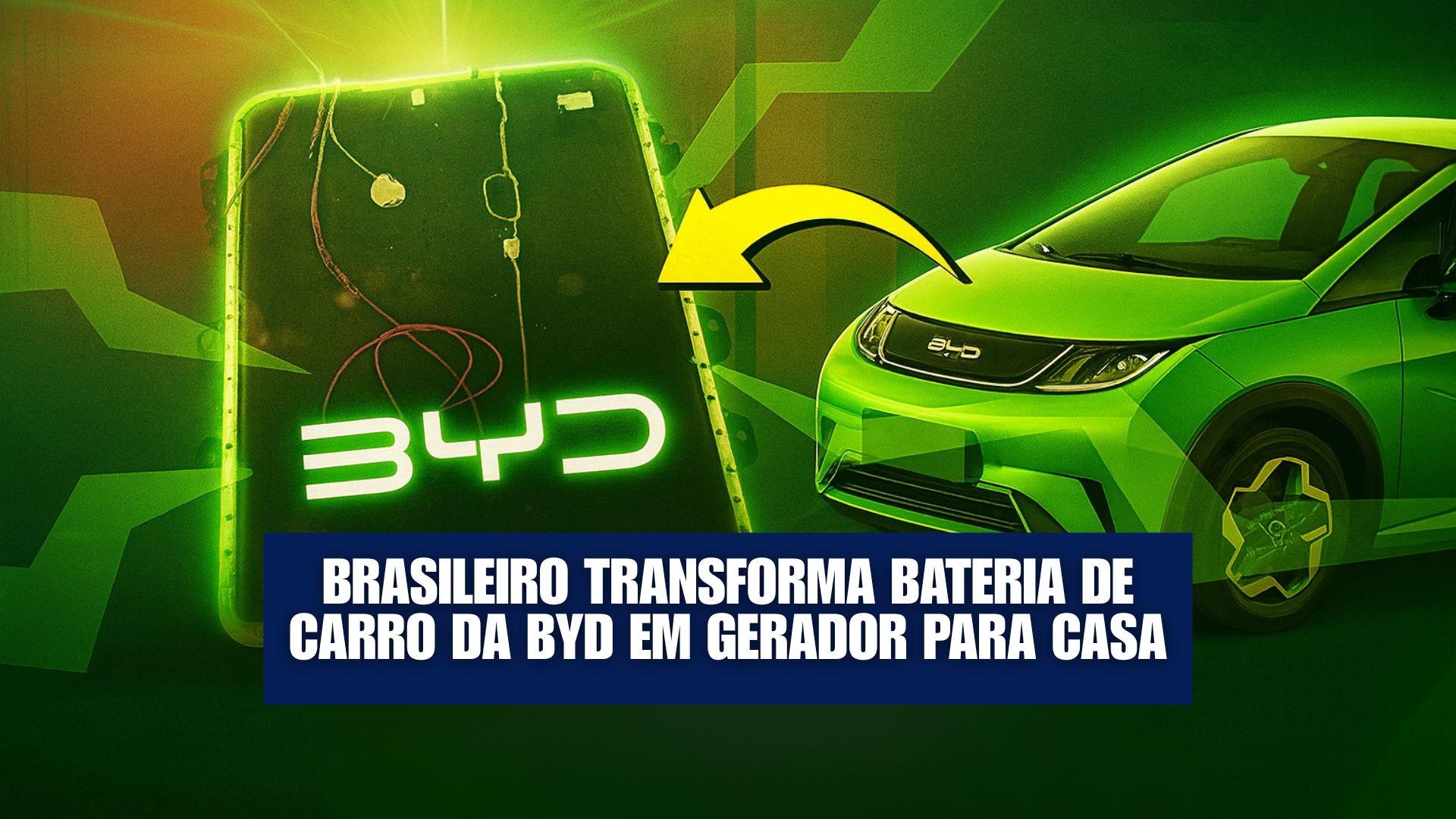
Prototype Created in Piauí Repurposes BYD Automotive Battery to Power Home, Charge Vehicle, and Operate off-Grid Using Energy from 24 Solar Panels.
A resident of Piauí repurposed a BYD electric car battery that would be discarded after an accident and transformed the component into a home solar energy system.
The initiative, according to a report published by TecMundo, allows for the storage of electricity generated by 24 solar panels, powering the house, recharging the vehicle, and operating independently of the utility grid, according to information presented by the developer himself.
Off-Grid System with Electric Car Battery
In a video sent to TecMundo and published on social media, the project’s author identifies himself as responsible for developing the equipment that converts the automotive battery for stationary use.
-
Germany discovers how to reuse old window glass without melting anything and can transform 220,000 tons per year into new high-performance panels, using material from nearly 150 million old windows that would be discarded.
-
China creates hypersonic engine that can make planes and missiles fly more than 6 times the speed of sound with less weight, more range, and without system change.

-
Mysterious object on Mars divides NASA and Harvard after Curiosity image reignites suspicions about what was really found on the planet.

-
Giant structures 14 meters beneath Egypt are revealed by satellites and expose a millennia-old secret buried in Buto.


He explains that the setup was designed to operate off the electrical grid, with the capacity to store solar energy and distribute it according to demand.
According to Frota, the battery removed from a crashed vehicle still showed about 99% health of the cells, a fact also highlighted by TecMundo when reporting the case.

He claims that, in a home environment, wear tends to be less than in automotive use.
In the videos, he states that the battery can keep the residence powered for up to 14 hours without sun, using approximately 30% of the total charge.
Battery Communication and Management Module
To adapt the battery for residential use, the developer created an electronic module that communicates directly with the component.
In the video, he claims that this module makes the battery “interpret” that it is connected to the original BYD car system.
This strategy circumvents the security limitation of the internal management, which only releases energy when it detects suitable conditions.
According to Frota, the battery’s own software monitors temperature, voltage, and other parameters, interrupting operation if any irregularities occur.
Flow of Energy Between Panels, Inverter, Home, and Vehicle
The system shown uses 24 solar panels that send energy to an inverter.
This equipment converts the direct current from the panels into alternating current, compatible with the home.
Frota shows the device and explains that it distributes power to the battery, the residence, and the connected electric vehicle.
He further claims there is technical possibility to send excess power to the utility grid.

The developer indicates that his current installation operates exclusively in off-grid mode.
On one of the screens displayed in the video, he points out the monitoring that signals independence from the public grid.
Power Outages Motivated the Creation of the Prototype
In his account, the resident states he lives in an area with unstable supply, marked by voltage fluctuations and frequent interruptions.
He explains that during the day, the voltage reached levels above the region’s standard due to distributed solar generation.
At night, it dropped to levels considered insufficient to charge the car.
Frota also mentions cases of long periods without power due to weather conditions and corrosion caused by salt spray.
According to TecMundo, this recurring instability was one of the main motivators for the development of the off-grid system.
From V2L to the Use of Fixed Automotive Battery
Before adapting the repurposed battery, the resident already used the V2L function present in BYD models, which allows using the car as a power source for external devices.

Based on this resource, he created a box called Power Box, presented as an emergency alternative.
Later, the project evolved to the current version, which uses the automotive battery installed on the wall and permanently connected to the photovoltaic system.
Frota describes this stage as an expansion of the initial solution.
Thermal Safety and Battery Behavior
One of the most frequent questions in the comments of the video is about the risk of overheating.
Frota asserts that, in residential use, the demand is lower than that required in a moving vehicle.
He also states that the internal management system remains active and monitors temperature and voltage.
In the videos, the developer reports that, even in hot conditions in the Northeast, the battery remains at room temperature during operation.
This assessment is based on measurements he made on the prototype itself.
Reports that covered the case, including the original publication by TecMundo, also mention the approximate autonomy of 14 hours using only part of the battery’s capacity.
Prototype and Intention for Industrialization
The equipment shown is presented as a prototype, installed in the home of the creator.

Frota states that the system is operational and says he is negotiating with a company in São Paulo the development of an industrialized version of the communication module.
The proposal would include specialized installation.
He also comments that repurposing batteries from crashed cars can mitigate the disposal of still functional components, a point mentioned by experts in circular economy when discussing the so-called “second life” of automotive batteries.
The developer asserts that the goal is to provide an alternative for regions with unstable supply and for homes that rely on essential equipment, such as rural establishments or residences with patients using electrical appliances.





-

Uma pessoa reagiu a isso.