






 Portuguese
  Spanish
  3 min of reading
  0 comments


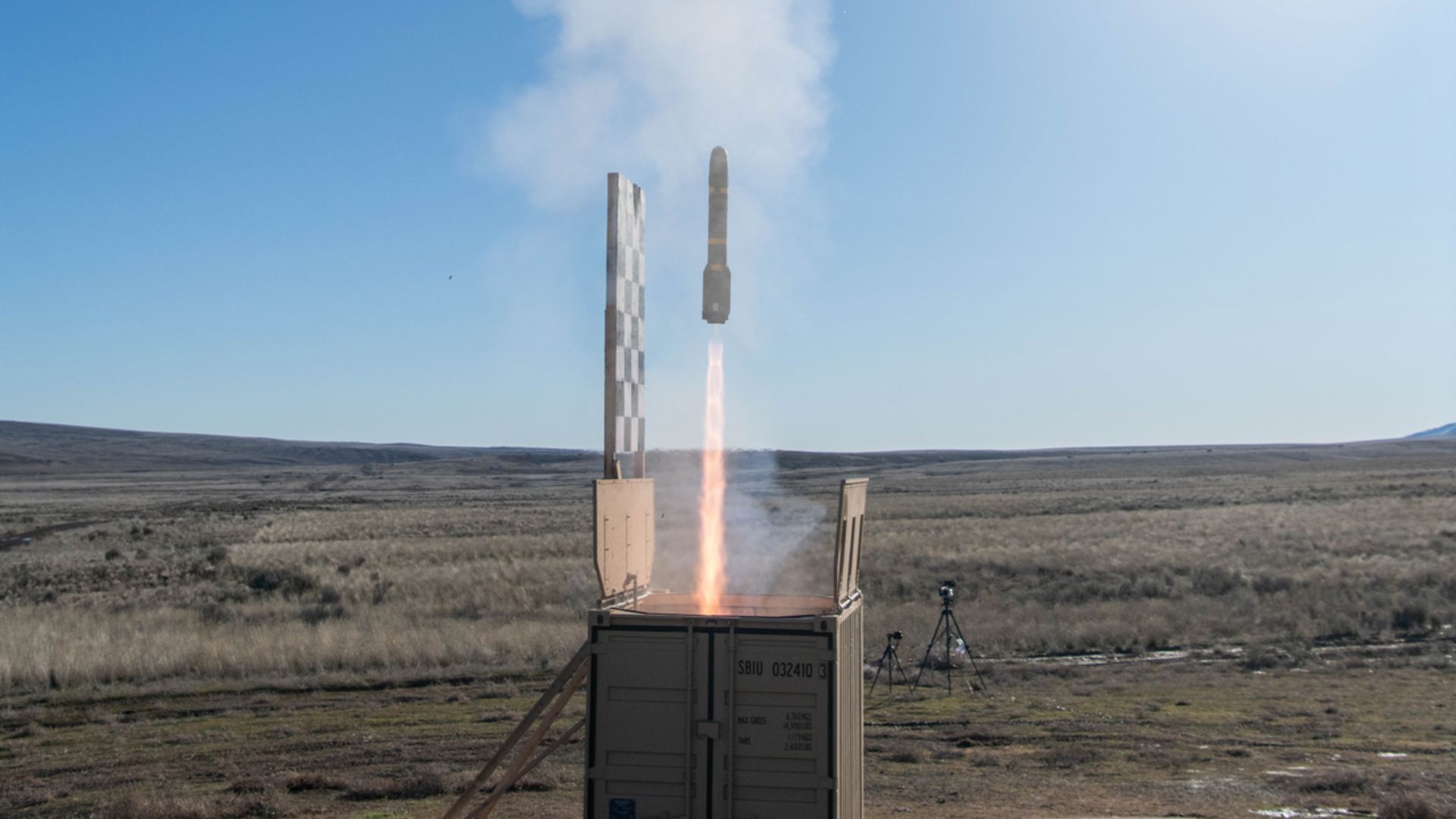
After completing tests with the real firing of the HELLFIRE missile and vertical launch, the GRIZZLY missile launcher draws attention for hiding firepower in a 3-meter container, enhancing mobility, camouflage, and difficulty of detection in monitored combat areas
On March 24, 2026, Lockheed Martin announced that the GRIZZLY missile launcher successfully completed live-fire tests, including the integrated firing of a HELLFIRE missile and a vertical launch test. The result reinforces the advancement of mobile and low-signature systems aimed at increasingly monitored combat scenarios.
The GRIZZLY was designed to address a growing problem on today’s battlefield: the increased vulnerability of traditional launchers in the face of drones, satellites, and persistent surveillance tools. In this context, the demand for platforms capable of moving quickly and remaining hidden for longer is increasing.
Missile launcher bets on discretion and mobility
The system’s proposal is to hide the attack capability inside a 3-meter container. Externally, it resembles a common logistics cargo, not military equipment, making it difficult to identify and potentially neutralize by opposing forces.
-
Helicopter Drops 180 Tons of Sand and Gravel on Swedish River to Revive Ecosystem Damaged by Decades of Exploitation

-
Brazilian Company Launches Retro Smartphone with 48 MP Camera, T9 Keyboard, and Privacy Features for Social Media-Free Use

-
Self-Taught Chinese Farmer Builds 5-Ton Submarine from Scrap, Launches It in Anhui River
-
Invisible Induction Technology Enables Wireless Power for Blenders, Coffee Makers, and Air Fryers, Reducing Countertop Cables





The logic of the project is straightforward: by camouflaging in transport environments, the launcher can delay detection and extend the time available for action and repositioning. In conflict areas with rapidly changing scenarios, even brief exposure can open the door for a counterattack.
System uses already known technologies
Instead of developing an entirely new weapon, Lockheed Martin assembled the GRIZZLY based on existing solutions. The system integrates the AGM-114 Hellfire missile and utilizes the architecture of the M299 launcher, focusing innovation on the method of employment rather than the missile itself.
According to the company, development was completed in just six months with internal investment. This timeline indicates an attempt by the defense industry to react more quickly to the evolution of threats, without relying solely on slower acquisition cycles.
The launcher also uses commercially available materials and was designed to be flexible. It does not depend on a specific command or sensor system, allowing integration with different operational networks.
Applications and advantages in contested areas
Among the main attributes of the GRIZZLY are mobility, concealment, and rapid response capability. These characteristics gain importance in environments where fixed positions can be located and destroyed in a short time.
Being containerized, the system can be employed in remote land areas, coastal zones, and temporary forward bases. It can also operate in island missions or in contested maritime regions, where flexibility becomes a central factor.
By blending in with common logistics infrastructure, the system makes it more difficult to distinguish a missile launcher from regular cargo. This uncertainty amplifies the so-called target dilemma, complicating target selection for the adversary.
Trend of more distributed warfare
With precision weapons like the HELLFIRE, the GRIZZLY can support anti-armor attack missions, short-range coastal defense, and force protection. The system can also be adapted based on the sensors and command means to which it is connected.
The project fits into a broader shift in contemporary warfare, marked by the search for distributed and quickly deployable firepower. Instead of relying solely on large, easily identifiable launchers, the trend now includes smaller, dispersed units capable of spreading risks over a larger area.
Despite successful tests, the future adoption of the GRIZZLY will still depend on practical factors such as ammunition capacity, reload speed, network integration, and performance after firing.
Recent trials indicate that the concept works, but the next steps will show whether it will be widely incorporated or remain a niche solution.





Be the first to react!