





 Portuguese
  English
  Spanish
  4 min of reading
  0 comments


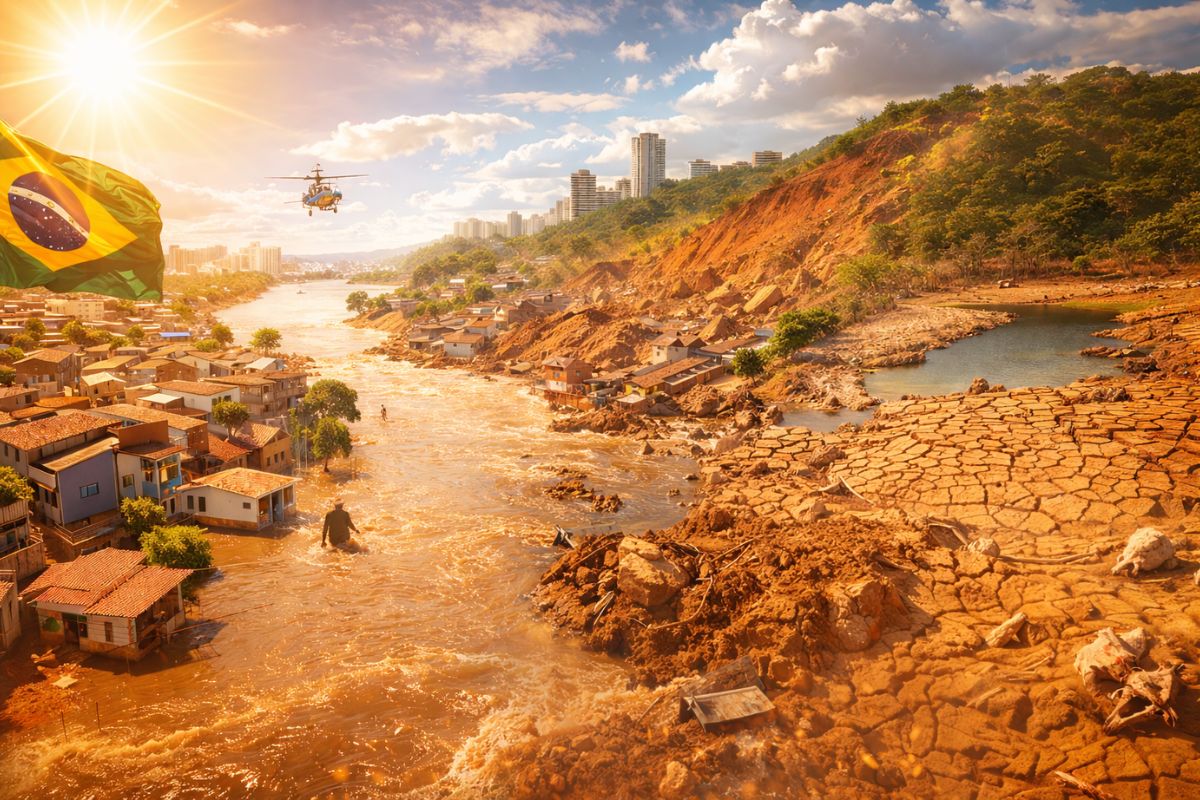
Report links global warming to climate disasters in the country, with 336,656 people affected, and warns of more extremes and risks in thousands of cities
The year 2025 was the third hottest ever recorded on the planet, and this warming scenario was reflected in Brazil through disasters associated with extreme climate events that affected 336,656 people and caused estimated economic losses of R$ 3.9 billion.
The data is in the report State of the Climate, Climate Extremes, and Disasters in Brazil, from the National Center for Monitoring and Early Warning of Natural Disasters (Cemaden), compiled with information from agencies and monitoring programs from various regions of the world, including the Copernicus Climate Change Service.
2025 on the planet and the effect in Brazil
According to the report, the global average temperature reached 1.47 degrees Celsius above pre-industrial levels (1850 to 1900). The document also indicates that the global average temperature reached 14.97 °C in 2025, very close to recent values in the historical series.
-
From Napoleon to the lion of the Revenue: how the Income Tax was born in 1922, became the largest source of revenue in 1979, reached the floppy disk, and today generates R$ 2.88 trillion in Brazil.

-
With the new law, Brazilians can obtain a driver’s license at 16 years old; new rules for psychological exams, toxicological tests, speed enforcement, and the electronic free flow toll system will be discussed in the Chamber of Deputies.

-
At 106 years old, Mrs. Maria decided to go back to work to continue buying her wines, but ended up being hired as an influencer by a brand and now calls herself the ‘most empowered grandma in the world.’

-
A 3-year-old child was playing with their father’s metal detector and found a gold pendant over 500 years old, valued at $4 million, a piece with a secret compartment linked to the era of Henry VIII, found by James Hyatt.

The authors argue that high global temperatures and record levels of water vapor in the atmosphere in 2025 helped trigger unprecedented heatwaves, droughts, wildfires, and intense rainfall, with widespread impacts on the population.
Hydrological disasters: 1,493 occurrences and a list of impacts
The report indicates that Brazil recorded 1,493 hydrological events in 2025, including intense droughts, flooding, overflow of watercourses, floods, flash floods, and landslides.
The majority of these disasters were classified as small-scale, but the total volume shows the frequency and persistence of episodes throughout the year.
The breakdown presented was 1,336 small-scale events, 146 medium-scale events, and 11 large-scale events, with a predominance of floods, flash floods, and landslides.
Hottest summer and droughts in 100% of the territory in eight states
The document highlights that, in Brazil, the summer of 2024/2025 was the sixth hottest since 1961. It draws attention to a snapshot from November when eight federal units recorded droughts in 100% of their territories: Ceará, Federal District, Goiás, Minas Gerais, Piauí, Rio de Janeiro, São Paulo, and Tocantins.
Additionally, the report indicates that the country was marked by seven heatwaves and the same number of cold waves, within a wide variety of hydrometeorological disasters strengthened by extreme climate patterns associated with global warming.
Where disasters concentrated and why it matters
The Southeast region concentrated 43% of the total occurrences. According to the authors, the events highlighted both more vulnerable territorial contexts, where intensity and local conditions increase damage, and municipal differences in institutional response capacity.
In practice, this means that similar disasters can cause very different damage depending on the vulnerability of the territory and the preparedness of local management.
Exposed cities and the specific alert for Minas Gerais
The report points out that 2,095 of the 5,570 Brazilian cities are exposed to geo-hydrological risks and should be a priority focus for risk management and disaster prevention actions.
Minas Gerais is cited as the federation unit with the highest number of cities at risk during rainy periods: of the 853 municipalities in Minas, 306 are susceptible to landslides, flash floods, and flooding, which poses a danger to about 1.5 million people.
Outlook: trend of more disasters and new extremes
Cemaden highlights that the number of climate disasters in Brazil increased by 222% between the early 1990s and the first three years of 2020.
The report warns of a trend of more extreme events in the coming years, including more frequent and intense heatwaves and fewer cold waves, although some may be very intense.
The central message is that disasters are not isolated episodes but part of a pattern that pressures infrastructure, health, economy, and cities’ response capacity.
What the report reinforces as a response
For the Ministry of Science, Technology, and Innovation, to which Cemaden is linked, the consolidation of data reinforces the importance of investments in science and technology, continuous monitoring, and integration between research and public management to anticipate risks and reduce vulnerabilities.
In a more challenging and complex climate scenario, scientific capacity and monitoring become key to reducing impacts and saving lives in new disasters.
In your city, which disasters had the most impact in 2025: drought, flooding, flash flood, or landslide?
With information from Agência Brasil







Seja o primeiro a reagir!