Portuguese
  Spanish


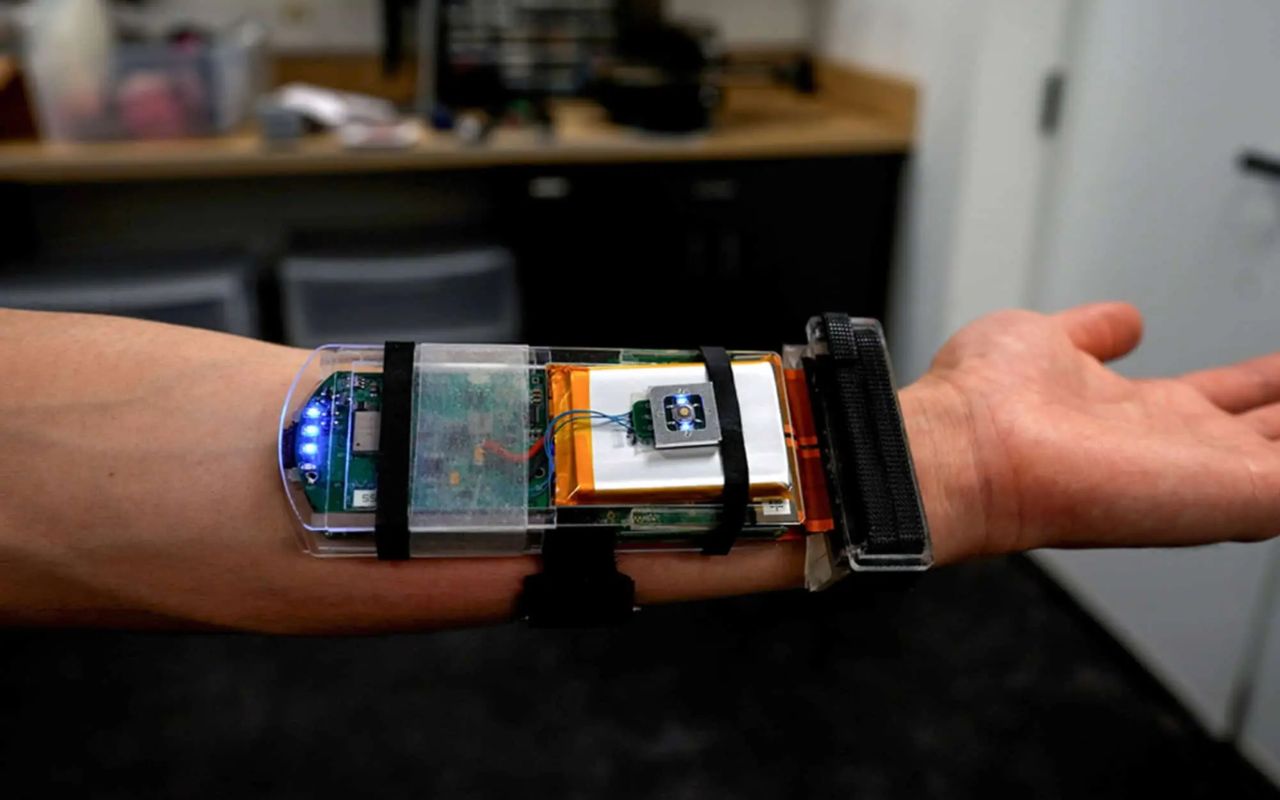


New MIT technology: researchers created a bracelet with ultrasound capable of controlling robots and virtual systems with precise hand movements in real time.
A new technology developed by researchers at the Massachusetts Institute of Technology (MIT) promises to transform the way humans interact with machines. The study, published on March 25, 2026, in the journal Nature Electronics, presents a bracelet equipped with ultrasound sensors capable of tracking, in real time, hand movements and translating them into digital commands.
The innovation was created in the United States, aiming to make the control of robots and virtual systems more precise, natural, and intuitive.
According to the scientists, the technology combines internal images of the wrist with artificial intelligence, allowing for a high level of detail in identifying the position of the fingers and palm. Thus, it seeks to overcome the limitations of traditional methods and bring the performance of machines closer to the complexity of the human hand.
-
What is a red flashlight used for, after all? See why it is so commonly used at night.

-
He has never read a line of code, but he already knows how to work: the French company UMA presented in Paris the Northstar, its first AI-powered humanoid robot designed for factories and warehouses, capable of copying tasks just by observing an employee in action.

-
A young Kenyan engineer collects plastic waste from the streets and transforms it into robots that translate physics lessons into sign language in real-time, a machine made with old bottles that teaches what was missing to deaf children left out of science.
-
What is the dark substance found in the sand of Ipanema Beach? Civil Police conduct an examination, collect samples of the material, and initiate an investigation to identify the composition, clarify the origin, and verify if there was an environmental crime.



How does the ultrasound-based bracelet work?
The bracelet uses small ultrasound sensors, similar in size to a watch, positioned directly on the user’s wrist. These sensors capture continuous images of the muscles and tendons as the hand moves.
Then, the data is processed by an artificial intelligence system trained to interpret these signals. According to the researchers, the tendons function like “strings,” controlling the fingers similarly to a puppet.
To better understand, here’s what the system analyzes:
- Movement of the tendons in real time
- Position of the wrist muscles
- Subtle variations between different gestures
- Combinations of finger movements
With this, the new technology can accurately identify even intermediate movements, something difficult for conventional systems.
Impressive precision in tests with robots and complex gestures
During the tests, eight volunteers participated in experiments that included everything from simple gestures to more complex tasks. Among them were the 26 letters of American Sign Language and the manipulation of objects such as scissors, pencils, and tennis balls.

The results were striking: the bracelet was able to accurately predict hand positions in virtually all cases.
Additionally, the captured movements were transmitted to robots in real time. In this way, the machines were able to reproduce human actions with a high degree of fidelity, such as playing simple songs on a piano and simulating throws in games.
New technology expands possibilities in virtual environments
Another highlight is the integration with digital systems. The new technology has also been applied in virtual environments, allowing users to interact with objects on the screen without needing to touch devices.
For example, it was possible to enlarge images, move elements, and execute commands just with hand gestures. This paves the way for advancements in virtual and augmented reality.
Meanwhile, experts point out that current methods have significant limitations. Systems with cameras can fail when there are visual obstacles, while gloves with sensors restrict natural movements.
Now, researchers at the Massachusetts Institute of Technology are working to make the device even more compact and accessible. The intention is to expand the database with different hand shapes, increasing the system’s accuracy.
According to the team, this new technology could revolutionize robot training, especially in tasks that require high precision, such as surgeries or delicate industrial operations.
Source: Olhar Digital