Portuguese
  Spanish


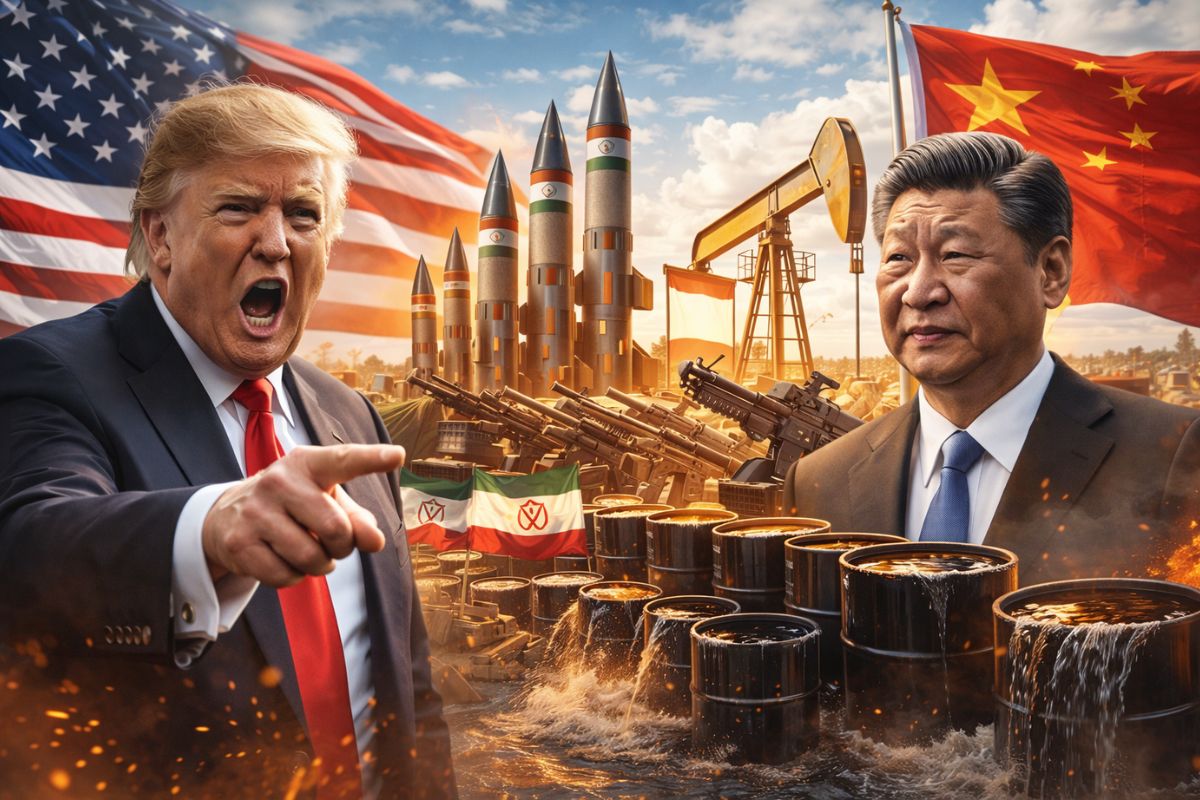

Trump increases pressure with threat of 50% tariff and US oil offer as blockade scenario heightens tension, but measure stalls without decree and faces legal limit.
Trump threatens China with a 50% tariff if Beijing supplies weapons to Iran, in a move that increases diplomatic pressure amid the blockade mentioned in the scenario and reinforces a confrontational tone.
At the same time, Trump tries to open a negotiation door by putting US oil on the table as an offer, but the threat itself encounters a significant brake: there is a legal block and no decree formalizing the measure.
What Trump is threatening to do
The central signal is straightforward: Trump puts a 50% tariff against China on the table as a response if there is a supply of weapons to Iran. In practice, the threat serves as a deterrent tool, aiming to raise the political and economic cost of any military rapprochement between Beijing and Tehran.
-
Ayatollah Ali Khamenei’s Funeral Draws 15 to 20 Million in Tehran, Calls for Revenge Against Trump After Joint Israel-U.S. Attack

-
U.S. Establishes Permanent Embassy in Jerusalem, Reigniting International Debate Over Israel’s Capital
-
The world has nearly 12,000 nuclear warheads, with the majority held by the United States and Russia; see the figures for China, France, and the United Kingdom.

-
Venezuela Faces UN Alert for Hunger, Disease, and Service Collapse After Earthquakes Cause Nearly 2,000 Deaths and $6.7 Billion in Damages


Trump also uses the escalation as a message to other actors, indicating that he intends to respond with tough trade measures if he sees material support for Iran.
The offer that accompanies the threat
In addition to punishment, there is an incentive. Trump offers US oil as part of the pressure package, suggesting that access to energy could serve as a counterbalance to reduce friction and distance China from any supply of weapons.
This type of combination, threat and offer, tends to aim at two objectives simultaneously: creating fear of loss and presenting an immediate gain, pushing the negotiation into the economic realm.
Why the tariff hits a legal block and remains without decree
The sensitive point of the scenario is that the measure hits a legal block and there is no decree. This weakens the practical effect in the short term, because the threat becomes dependent on formalization to move from rhetoric to action.
Without a decree, Trump maintains pressure at the political and communication level, but finds it difficult to transform the tariff promise into concrete application within the required process.
How the blockade enters the pressure escalation
With the blockade mentioned in the context, the environment becomes more tense and sensitive to signals of strength. Trump takes advantage of this increase in tension to raise the tone, trying to use the tariff threat as leverage.
At the same time, the blockade amplifies the risk of a chain reaction, where economic and strategic movements feed back into each other, even when the execution of the measure is not yet formalized.
What to observe from here on
The immediate effect is the rhetorical escalation: Trump increases pressure on China and places the Iran issue at the center of the calculation, but the effectiveness depends on how this threat evolves into a formal act.
If there is a decree, the conversation shifts from “threat” to “measure”. If not, Trump may be using the tariff as a warning and bargaining chip, while trying to extract concessions with the offer of US oil.
And you: does this threat from Trump seem more like a real pressure to turn into a tariff or just another negotiation ploy to force Beijing to back down?