





 Portuguese
  English
  Spanish
  3 min of reading
  0 comments


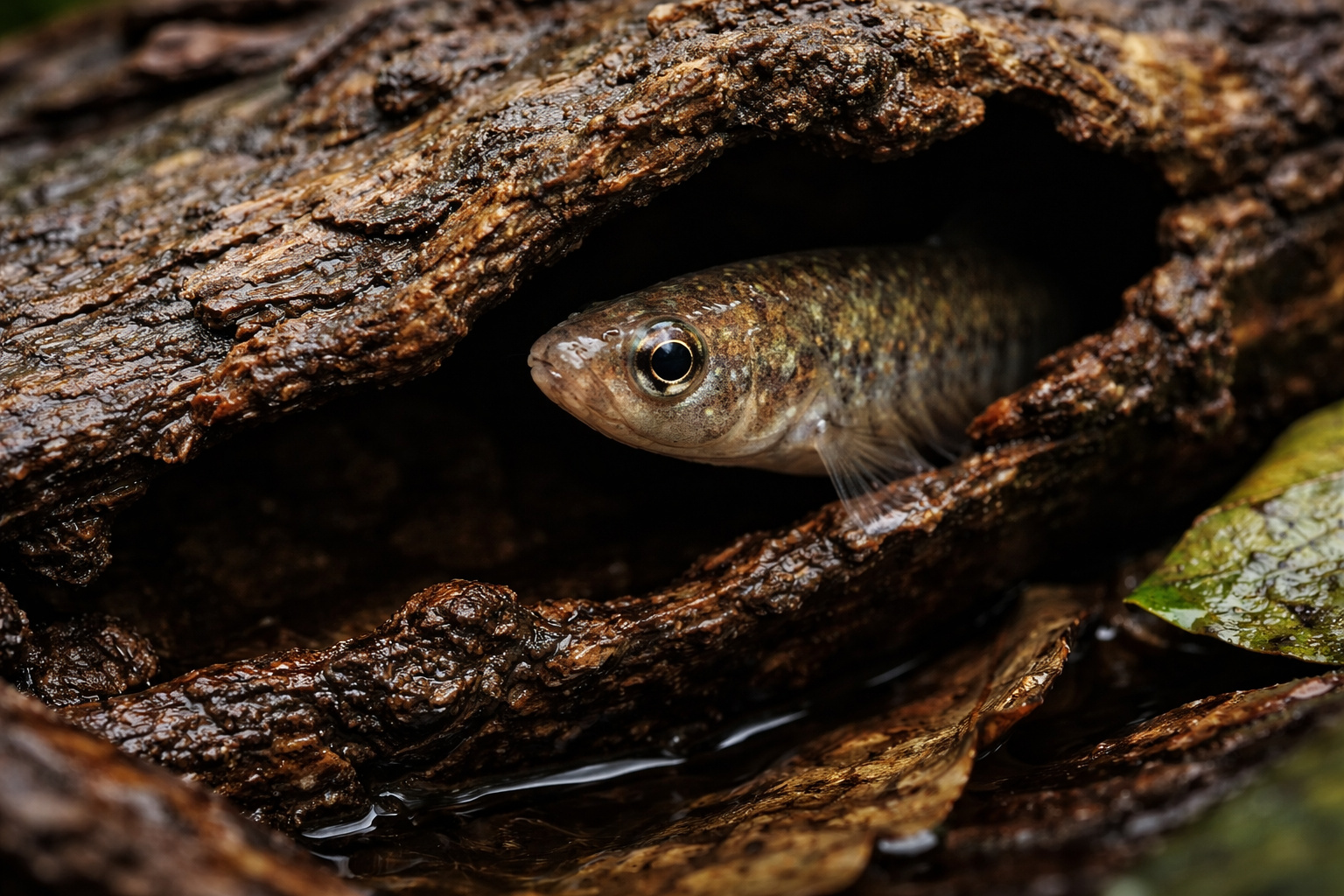
The mangrove rivulus surprises science by surviving out of water and using logs as shelter in unstable coastal environments
One of the most unusual behaviors of Brazilian fauna has been documented by researchers over the past decades, especially since the 1990s.
The mangrove fish of the genus Kryptolebias, also called the mangrove rivulus, can live out of water for long periods and hide in dry logs. This scientific record, described in consolidated studies throughout the 2000s, reveals a rare adaptation among vertebrates.
The fish inhabits mangroves along the Brazilian coast, environments known for their instability.
It faces constant variations in salinity, temperature, and water availability. Its survival occurs even when water temporarily disappears.
Biological adaptation allows survival out of water
The Kryptolebias does not depend on water all the time, which contradicts the pattern of most fish.
When the environment dries up, it reduces its activity and seeks humid places. The organism continues to function even out of the water layer.
-
The Brazilian Navy puts on a show in a complex operation in the Atlantic and rescues an African ship adrift for almost 60 days, with 11 crew members, a rudder failure, no communication, environmental risk, and a mission 1,200 km from the coast.

-
A 68-meter tower, which housed a historic brewery in the heart of Germany’s port, balances on a small base and uses activated core concrete for cooling that reduces the need for air conditioning.

-
For decades, a 50-kilometer ring structure in the middle of the Sahara has puzzled scientists: visible from space, it reveals layers of millions of years and turns the desert in Africa into a geological mystery.

-
With an unusual prize, Japan transforms office chairs into a resistance race on the streets, the ISU-1 Grand Prix grows, fills events, and pays 90 kilograms of rice.


The fish performs important exchanges through its skin, which helps maintain vital functions.
This mechanism allows it to resist until moisture returns to the environment.
It does not go in search of larger new puddles.
The most common behavior is to look for dark and stuffy environments. This reduces water loss, decreases stress, and increases survival chances.
Use of dry logs as a survival strategy
Researchers documented, throughout the 2010s, individuals living inside emerged mangrove logs.
These records show that the behavior is not occasional.
The logs have galleries excavated by insects.
They serve as temporary shelters and maintain shade and humidity, creating a favorable microenvironment.
This environment protects the fish from heat, salinity, and predators.
The log ceases to be just a hiding place and becomes a survival strategy.
Rare characteristics make the Kryptolebias unique
The group exhibits unusual adaptations beyond semi-terrestrial life.
Some species can survive weeks out of water, as discussed in research since the mid-2000s.
The reproductive system is also considered unusual among vertebrates.
This factor has made the fish an important model for scientific studies.
Researchers use the Kryptolebias to understand how organisms cope with extreme environments.
It helps explain the transition between aquatic and terrestrial life.
Discretion explains why the fish is still little known
The fish remains little known because it is small and discreet.
It lives in mangroves, environments that do not facilitate observation.
Much of the time is spent hidden in mud, leaves, or wood.
Its presence goes unnoticed by those who circulate in these areas.
Even so, it is among the most impressive examples of Brazilian coastal fauna.
The ability to live out of water and use logs as shelter reveals a level of adaptation that transforms the perception of mangroves.
How many other extraordinary behaviors remain hidden in these ecosystems?








Seja o primeiro a reagir!