





 Portuguese
  English
  Spanish
  3 min of reading
  0 comments


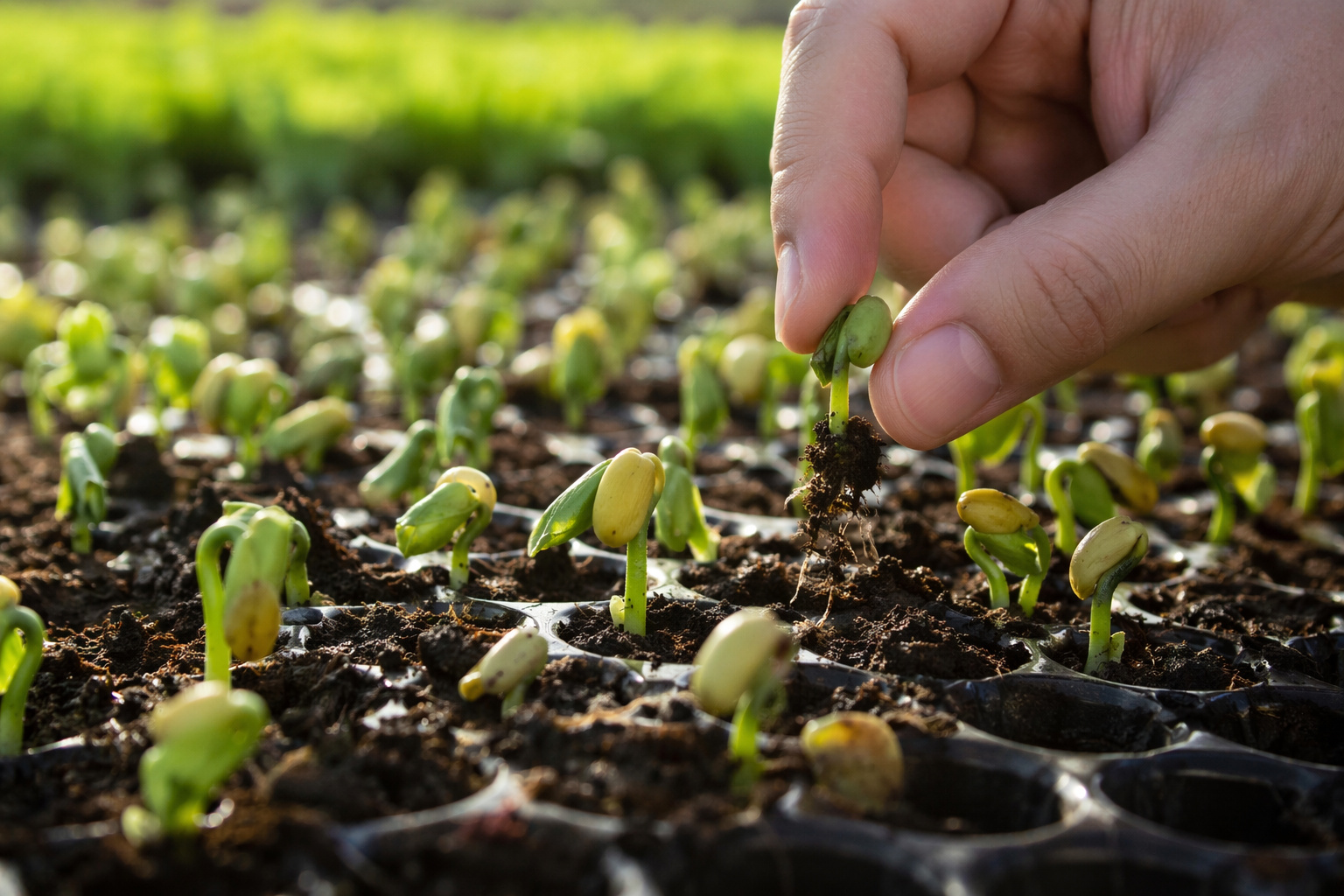
Technology developed by researchers at USP uses nanofibers with bioactive compounds to improve soybean germination and optimize initial plant performance
A scientific innovation developed by researchers at the University of São Paulo has drawn attention by presenting a new approach to soybean seed germination.
The study was conducted by the Faculty of Pharmaceutical Sciences of Ribeirão Preto and revealed that nanotechnology can enhance the initial development of plants.
The research was published in a recent scientific publication and also resulted in a patent application, indicating potential application in the agricultural sector.
The advancement demonstrates a strategy focused on productive efficiency, based on the use of nanometric scale structures for the transport and release of active compounds.
Nanofiber technology redefines soybean germination
The proposal uses short cellulose acetate nanofibers produced by electrospinning, a technique that employs high voltage to form nanometric structures.
These fibers have a length greater than their diameter, which favors their application as a support for bioactive compounds.
During the process, zinc oxide nanoparticles and gibberellic acid are incorporated, substances associated with plant growth.
The combination of these elements allows the compounds to be released in a controlled manner during seed germination.
The developed system represents a technical alternative to improve the initial performance of crops.
Practical application increases efficiency in plant development
The method includes the mechanical fragmentation of the nanofibers, making them dispersible in water and suitable for application by spraying.
This procedure differentiates the technique from conventional seed coating methods.
After preparing the solution, the material is applied directly to the grains, keeping the compounds close during germination.
The experiment was conducted with seeds placed on petri dishes containing cellulose substrate suitable for germination.
For seven days, the solution was applied daily, allowing the monitoring of seedling and secondary root development.
The results indicated improvement in the germination process and initial plant growth, highlighting the efficiency of the approach.
-
Brazil reaches historic record of judicial recoveries in 2025, with 2,466 companies in crisis and agribusiness leading the financial collapse.

-
From 13 borrowed cows to millions of liters per year: Argentine producer transforms small beginnings into an empire with technology, management, and high productivity of cows.

-
In just two months, Brazil exported 372 thousand tons of beef to China, and now the sector is racing against time before the quota of 1.1 million tons runs out and a 55% tariff comes into effect, changing everything.

-
Maggi Group moved from soy to agricultural infrastructure: 212 vessels in the Amazon, 1,100 trucks, ports and hydroelectric plants, its own biodiesel, and the Northern Arc, all to transport 20 million tons in record time.

Toxicity control guarantees process stability
The research also considered the evaluation of toxicity of the compounds used in the formulation.
This care is necessary because inadequate concentrations can affect seed development.
Excess nanoparticles can cause agglomeration and reduce the expected efficiency of the system.
The researchers analyzed germination and root development to identify possible negative effects.
Seeds that do not germinate or show visible deformities indicate potential toxicity.
In the study, no significant signs of toxicity were observed, suggesting compatibility of the compounds with the seeds.
Research advances with patent and market potential
The development of the technology resulted in the creation of solutions with potential for commercial application.
One of the innovations has already been licensed by the startup InNanoTecnologia, founded by the responsible researcher.
Additionally, a patent application related to the dispersion system of the nanofibers and their application in seeds has been prepared.
The study was published in the journal Reactive and Functional Polymers, with participation from researchers in the field.
The research received support from the São Paulo Research Foundation through the PIPE program.
A second phase of the project is planned, focusing on technical adjustments and validation for market use.
Technology expansion may broaden applications in agriculture
The results indicate that the technology can be adapted for other agricultural crops.
The possibility of expanding its use reinforces the potential of the innovation in the productive sector.
The development of solutions based on nanotechnology can contribute to efficiency gains in the field.
The continuation of the project should deepen the analysis of application parameters and commercial viability.








Seja o primeiro a reagir!