Portuguese
 Spanish




Research led by the Brazilian Center for Physics Research (CBPF) found evidence of the optical Aharonov-Bohm effect in a molybdenum disulfide bilayer. The scientists also observed valley and spin polarization close to 100% in biexcitons.
A semiconductor made of just two ultrathin layers has revealed quantum behavior not previously identified in structures of this kind. A team led by the Brazilian Center for Physics Research (CBPF) found evidence of the optical Aharonov-Bohm effect by measuring the light emitted by a molybdenum disulfide (MoS₂) bilayer.
The scientists observed periodic oscillations in the intensity of the emitted light as they varied the magnetic field applied to the material. Under certain experimental conditions, they also recorded valley and spin polarization in biexcitons close to 100%, a finding that opens up avenues for research in photonics and quantum information.
The work, announced by the CBPF on November 9, 2026, was published on October 22 in the journal Nature Communications. The study brings together 17 authors affiliated with institutions in Brazil, Japan, and Belgium.
-
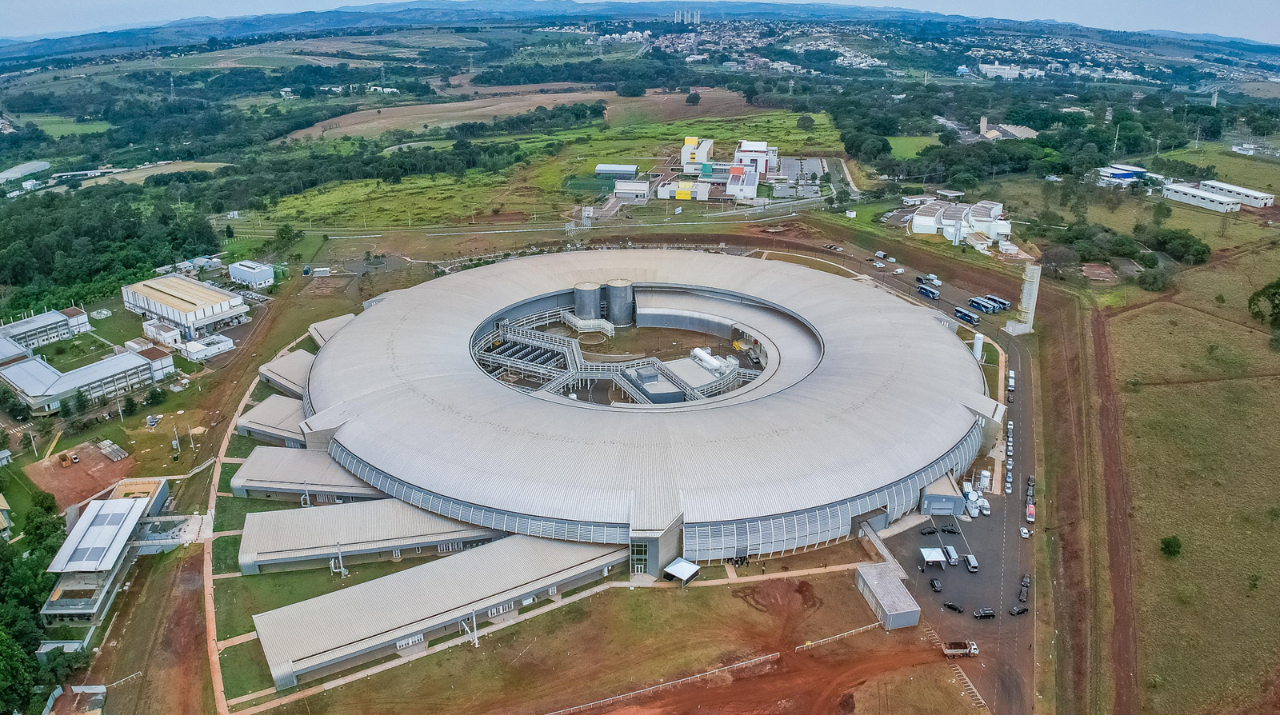
Sirius, a particle accelerator with a 518-meter ring in São Paulo state, adapts three beamlines and a laboratory to study blood, tissues and other samples under more natural conditions

-
BYD in exclusive talks to buy Hambach plant in France, previously built by Mercedes for Smart production

-
Brazilian scientists use radar to probe 1.5 meters underground, finding 54% greater root volume in trees growing in green spaces and revealing a hidden risk to city sidewalks
-
Yamaha unveils fishing boat that automatically holds its position at a chosen spot using GPS, an outboard motor and a bow thruster controlled by wireless remote, alongside an electric boat that moves sideways



Two semiconductor layers form a structure that can confine particles
Molybdenum disulfide belongs to a family of materials that can be studied at extremely small thicknesses. Each monolayer consists of a plane of molybdenum atoms between two planes of sulfur atoms, as described in earlier research on the crystal structure of MoS₂.
When two monolayers are stacked with different orientations, the arrangement of the atoms forms a periodic pattern on a larger scale than the original crystal lattice. This pattern is called a moiré pattern, similar to the visual effect that appears when two gridded screens are placed one over the other with a slight misalignment.
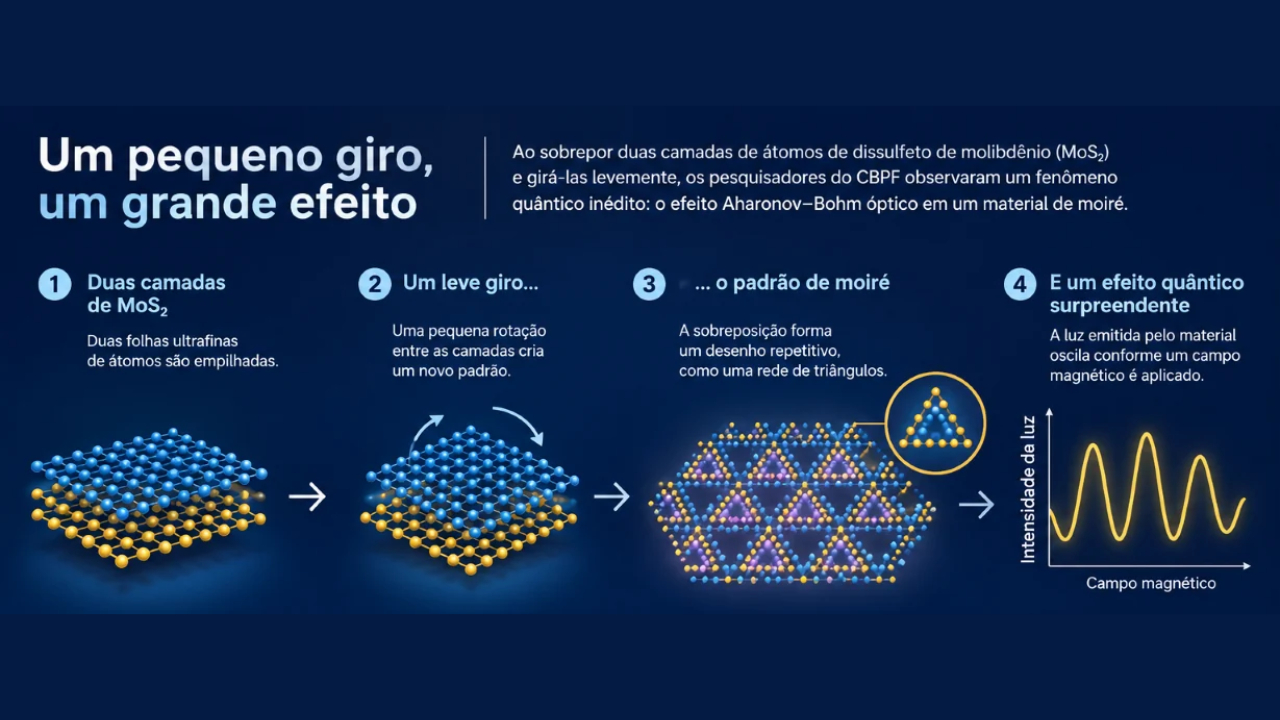
In the Brazilian experiment, the relative orientation of the layers was close to 60 degrees. The bilayer’s geometry created nanoscale regions with different electronic properties, capable of restricting the movement of excitations produced within the semiconductor.
The researchers interpreted the results in terms of triangular confinement regions. This arrangement makes it possible to investigate how the material’s geometry and the magnetic field affect the quantum motion of electrons and the positive charges associated with them.
Changes in emitted light reveal a phenomenon predicted in 1959
In 1959, physicists Yakir Aharonov and David Bohm published a paper in Physical Review describing how electromagnetic potentials could produce measurable effects on charged particles even in regions with no local field.
In quantum mechanics, a particle can behave like a wave. When alternative paths are available, the amplitudes associated with those paths can interfere with one another. The resulting phase difference changes what is observed, much like the superposition of waves.
In the optical version studied by the CBPF team, the scientists investigated this type of interference using composite particles known as excitons. They form when energy absorbed by the semiconductor excites an electron to a higher-energy state, leaving behind a vacancy that behaves like a positive charge.
The electron and this vacancy, called a hole, can remain bound by electrical attraction. When they recombine, some of their energy can be released as light, allowing researchers to study the pair’s behavior through optical emission.
The team used magnetophotoluminescence to track the emission while varying the magnetic field. The signal intensities attributed to excitons and biexcitons oscillated, which the authors linked to quantum interference.
The frequency of these oscillations made it possible to estimate effective interference areas related to the geometry of the moiré pattern. Numerical simulations based on the Wannier equation supported the interpretation of the experimental data, connecting the measured emission to the quantum motion of the confined particles.
Polarization near 100% expands possibilities for quantum control
In addition to excitons, the experiment examined biexcitons, complexes that form when two excitons temporarily bind together. The team found valley and spin polarization close to 100% for these complexes under moderate magnetic fields.
Spin is an intrinsic quantum property of particles. The valley index, meanwhile, distinguishes states associated with different regions of the electronic structure in certain semiconductors. Both can offer additional ways to represent and manipulate information in two-dimensional materials.
Research fields known as spintronics and valleytronics explore these properties. The experimental result indicates that moiré structures could serve as platforms for studying how to control them alongside light emission.
Brazilian and Japanese institutions prepare next stages of research
Physicist Andreij C. Gadelha, affiliated with the Federal University of São Carlos (UFSCar) and the Brazilian Center for Research in Physics (CBPF), is the paper’s lead author. Structural characterization of the samples included atomic force microscopy, with researcher Danian A. Dugato also taking part.
Scientists from the Federal University of Ceará (UFC), the Federal University of Minas Gerais (UFMG), Japan’s National Institute for Materials Science (NIMS), and the University of Antwerp in Belgium also participated. The work received support from agencies including FAPESP, FAPERJ, CNPq, and CAPES.
The group plans to expand the tests to stronger magnetic fields, assess other two-dimensional materials, and investigate ways to control quantum paths electrically. These steps could help assess the potential of optical interference in future quantum emitters and devices that use valley and spin properties.