





 Portuguese
  English
  Spanish
  5 min of reading
  0 comments


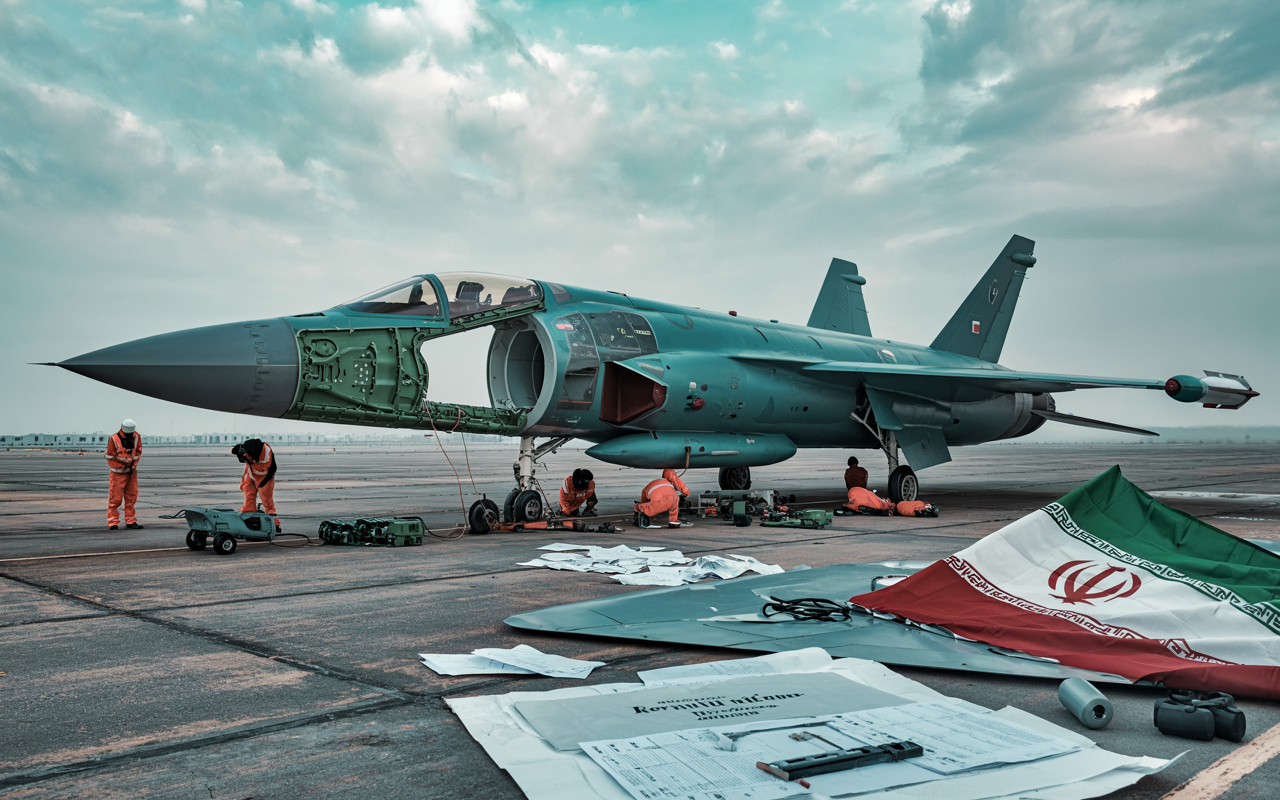
The Iranian Qaher-313 Fighter Jet Was Announced Over A Decade Ago, But Has Never Managed To Take Flight. Understand The Case Of The Iranian Military Aircraft Accused Of Being A Fake Technology
In 2013, Iran caught the world’s attention by revealing the Qaher-313, a stealth fighter presented as a game changer in the Iranian defense industry. According to the country’s authorities, it was a fifth-generation combat aircraft, equipped with advanced technology, stealth design, and the ability to operate in hostile environments with complete autonomy.
However, shortly after the announcement, technical analyses and released images questioned the veracity of the claims. Experts pointed out structural inconsistencies, a lack of real flight tests, and a series of indications suggesting that the showcased model was, at best, a mock-up. The project ultimately became a symbol of fake technology and military propaganda, with no operational proof to this day.
What Was The Qaher-313?

The Qaher-313, also known as F-313, was presented by then-President Mahmoud Ahmadinejad as a revolutionary fighter jet that would place Iran in the exclusive group of countries with fifth-generation stealth aircraft, such as the United States (with the F-22 Raptor) and Russia (with the Su-57). The project was attributed to the Iranian Aircraft Industries Organization (IAIO), a branch of the country’s Ministry of Defense.
-
American Airlines starts selling trips as if they were flights, with check-in and baggage check at the airport, but on short routes, passengers board luxury buses connecting cities to major hubs in the U.S.

-
São Paulo surprises the world with a colossal railway network project that promises over 1,000 km of tracks, R$ 194 billion in investments, and 40 projects connecting the capital to the interior with fast and sustainable trains.

-
The world’s largest escalator, measuring 905 meters in China, reduces urban travel time from 1 hour to about 20 minutes and transforms mobility in mountainous regions with an engineering solution adapted to the terrain.

-
A R$ 300 million logistics giant is taking shape in Serra with over 100,000 m² and raises a question: how can this transform e-commerce and distribution in the state?

According to official statements, the fighter would have the capability to evade radars, operate at low altitudes, strike targets with high precision, and be entirely produced in Iranian territory. However, experts soon noticed technical and structural issues with what was publicly displayed.
Questionable Design And Lack Of Tests Of The Iranian Military Aircraft
The design of the Qaher-313 raised immediate suspicions. The fuselage featured angular lines, common characteristics in stealth aircraft, but the construction was visibly rudimentary. The air intakes for the engine were too small to provide adequate thrust. The landing gear appeared fragile, more suitable for light civilian aircraft than military supersonic jets.
The cockpit, showcased in official images, contained panels and instruments similar to those found in experimental or ultralight aircraft, such as those from Garmin and Dynon Avionics. This suggested that the prototype lacked sophisticated flight systems or military avionics. Furthermore, there were no signs of internal compartments for armaments, which are crucial in stealth fighters to maintain stealth.
Another critical point was the total lack of records of actual flight. No image or video showed the Qaher-313 taking off, flying, or landing. The only visual records involved the aircraft parked in hangars or maneuvered on the ground.
The test videos released in 2013 showed only a small-scale, unmanned model flying remotely — very different from what one would expect from a functional prototype.
Experts Point Out Flaws And Propaganda Of The Iranian Fighter Jet
Various international military aviation experts reacted with skepticism. The website The Aviationist described the Qaher-313 as “implausible,” stating that the design seemed more suited for science fiction movies than for real-world use. According to expert David Cenciotti, “there was absolutely nothing about that model suggesting it could fly.”
Other analysts even claimed that the Iranian fighter resembled a fiberglass mock-up more than a functional aircraft. The magazine Flight Global also harshly criticized the project, emphasizing that the aircraft’s proportions indicated serious stability, lift, and thrust issues.
This discrepancy between the official narrative and observable facts led many to classify the Qaher-313 as a classic example of fake technology, used for internal propaganda and external intimidation, especially during a time of political tension and international sanctions.
The Return As A Drone: Attempted Repurposing
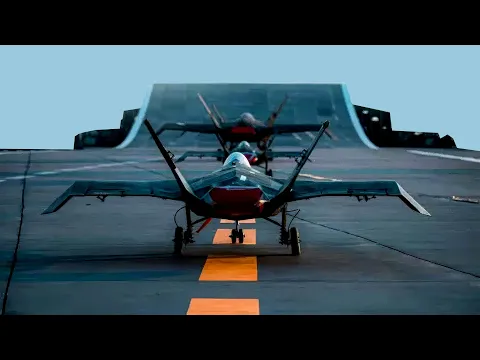
After years of silence, Iran returned to showcase the project, this time in a new form. In 2023, it was announced that the Qaher-313 would be repurposed as a combat drone. The new version, dubbed JAS 313, was presented as a Naval Unmanned Aerial Vehicle (UAV), with reconnaissance and attack capabilities.
The new model was displayed aboard the Shahid Bagheri ship, a cargo vessel converted into a drone carrier. However, the images and videos released again raised doubts about the system’s functionality. The drone appeared to be a reduced replica of the original model, and once again, there were no flight demonstrations.
Western experts criticized the project once more, stating that the presentation served more to impress public opinion than to introduce a new functional weapon to the country’s arsenal. The lack of technical information, performance, range, armament, and autonomy indicated that the Iranian military aircraft remained without any practical application.
Impacts On Iran’s Military Image
The Qaher-313 episode had a negative impact on the credibility of the Iranian arms industry. Despite specific advancements in attack drones and ballistic missiles, the failure to develop a functional fighter aircraft highlighted the technological limits faced by the country, especially under sanctions that restrict access to high-tech components.
While Iran has sought to position itself as a self-sufficient military power, cases like the Qaher-313 reveal the gap between ambition and reality. Furthermore, the attempt to repurpose the platform as a drone reinforces the narrative of improvisation and a lack of technical consistency.
From a strategic perspective, the episode also undermines Iran’s deterrence power. In a scenario where countries like Israel, Turkey, and Saudi Arabia heavily invest in modern defense and attack systems, the presence of non-functional projects can be seen as a sign of weakness, not strength.
The case of the Qaher-313 is an emblematic example of how political propaganda can overshadow technical reality. The Iranian fighter, announced with fanfare as a revolutionary advancement, proved unable to achieve even a basic flight, becoming a symbol of fake technology in the military field.
Even with the attempt to repurpose it as a drone, the project remains shrouded in doubts and discredit. For international observers, the episode reinforces the importance of evaluations based on concrete evidence and practical demonstrations, especially in such a critical sector as defense.
The lesson left by the Qaher-313 is clear: a country’s credibility in the military arena depends not only on the narrative but also on the actual capacity to deliver what it promises. And, to date, the Iranian military aircraft remains merely an unfulfilled promise.










-

Uma pessoa reagiu a isso.