





 Portuguese
  English
  Spanish
  6 min of reading
  0 comments


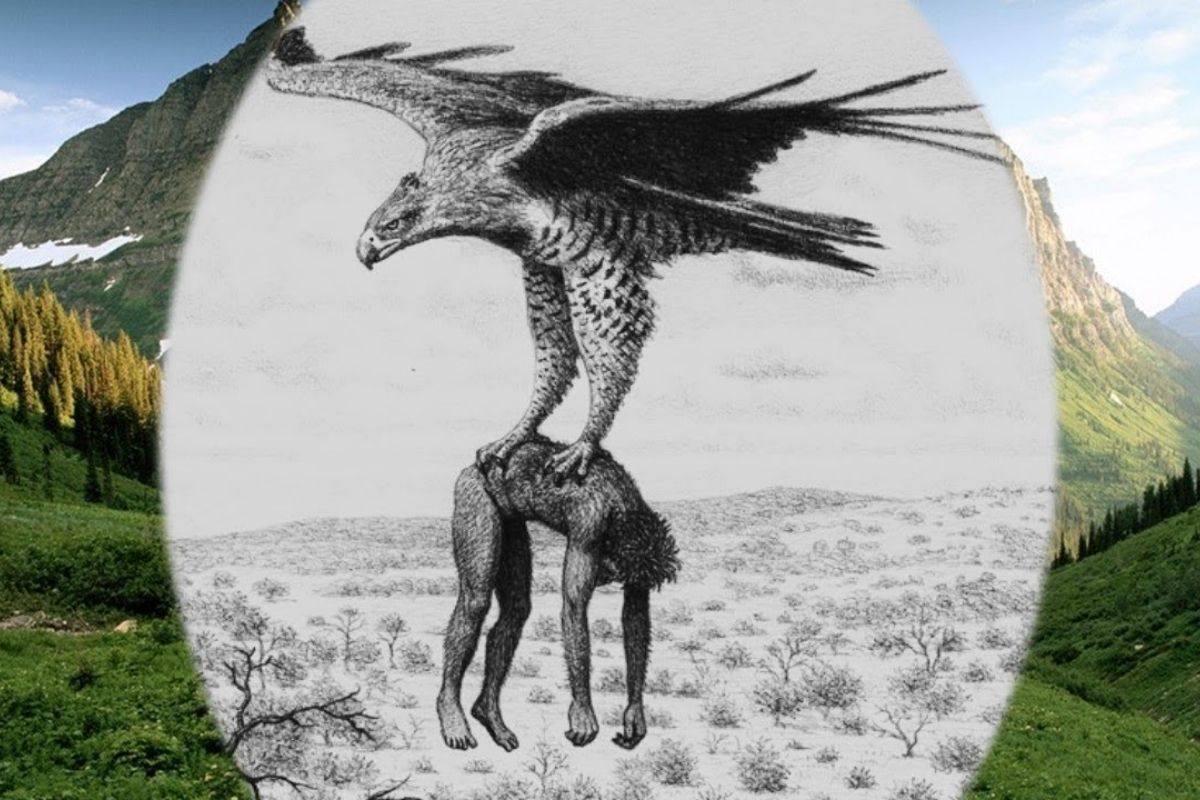
The Haast’s Eagle, with males weighing 12 kilos and females 16 to 18, had a wingspan of 2.60 to 3 meters, claws with a hallux of 11 centimeters and attacked moas up to 15 times heavier, before disappearing around 1400 on the south island of New Zealand after human hunting
On a mountainous island covered with dense forests in southern New Zealand, the Haast’s Eagle occupied the top of the food chain for thousands of years. The predator did not rely on discreet ambushes: it dominated by weight, speed, and precision, turning enormous moas into its main target.
The turning point came when humans arrived around 1280 and began to hunt the large flightless birds intensively. When the moas disappeared around 1400, the Haast’s Eagle lost its energy base and fell along with them. Extinction was not an isolated event, it was a chain of cascading losses in New Zealand.
Giants of Today and a Giant That Went Beyond the Limit

The largest living raptors still impress, but are on a different scale.
-
The oceans are darkening all over the planet – what is happening?
-
An engineer designs a solar plane to fly on Mars at an altitude of 1,000 meters and a speed of 300 km/h, covering 16,000 kilometers in a Martian year, 900 times the distance traveled by the Ingenuity helicopter in three years on the planet before experiencing a rotor failure, and NASA is already funding the feasibility study.

-
A new phenomenon of contactless magnetic friction intrigues scientists and questions a theory that has been valid since the 17th century.

-
An impressive phenomenon in Northern Brazil causes rivers of different colors to flow side by side, revealing secrets about sediments, currents, and biodiversity.

The Philippine Eagle can measure 1 meter in length and have a wingspan of 2 meters and 40.
The Steller’s Sea Eagle can measure 87 centimeters, have a wingspan of 2 meters and 40, and weigh more than 9 kilos, primarily feeding on fish such as salmon and trout.
The Harpy Eagle reaches 1 meter and 15 in length and has a wingspan nearing 2 meters.
Even with these numbers, the mentioned limit for large modern eagles tends to be clear: most do not exceed 9 kilos.
The Haast’s Eagle comfortably exceeds this ceiling.
Males were described as weighing around 12 kilos, and females between 16 and 18 kilos, figures that change the type of prey possible and the type of attack viable in a forest.
Wingspan, Shorter Wings and the Logic of the Closed Forest

The wingspan of the Haast’s Eagle was estimated between 2.60 and 3 meters in adult females, a range close to that of large modern eagles.
The striking detail is the contrast between body size and wing geometry.
The wingspan was considered relatively short for such a heavy animal, and this does not mean weakness: in dense forests, shorter wings can be an advantage.
The cited hypothesis is functional: shorter wings would facilitate rapid movements between trees and tight turns, reducing the chance of collisions in the closed forests of New Zealand.
To compensate for some of the lost aerodynamic control, there are estimates of a tail with long feathers, reaching up to 50 centimeters, and in females, this tail would also be wider.
Claws, Legs and the Point of Impact

The bones associated with the Haast’s Eagle allowed measurements that help to imagine contact with prey. The lower jaw measured about 11.4 centimeters.
The tarsals, which are leg bones, were described as being between 22 and 25 centimeters in length, suggesting strong levers for landing, holding, and stabilizing a moving body.
The claws appear as the centerpiece of the attack.
The front claws were described as being between 5 and 6 centimeters, while the hallux claw, the back toe, could reach 11 centimeters.
In practical terms, this means a large rear hook to latch onto the prey and prevent the body from escaping on first contact, especially if the target was larger and heavier.
Diving Speed and Force Compared to Concrete
The Haast’s Eagle was associated with diving attacks, reaching speeds of up to 80 kilometers per hour.
In such an impact, mass, speed, and point of contact define the outcome.
The comparison used to illustrate the strike is direct: the combination of size and weight would indicate a force equivalent to a block of concrete falling from the top of an eight-story building.
This type of description helps to understand why, in an environment without other large predators and scavengers, a large carcass could be a resource for days.
After the attack, the beak was cited as a tool for tearing internal organs, while the claws and legs held the body in place.
Moas, Giant Prey and the Ecological Role in New Zealand
The heart of the story lies with the moas. Moas were enormous flightless birds, an extinct group with about nine different species, and lived only in New Zealand.
The two largest species reached about 3 meters and 60 in height with neck extended and could weigh up to 230 kilos.
Within this scenario, the Haast’s Eagle fed on large flightless birds and was described as hunting moas that could be up to 15 times larger and heavier than itself.
The ecological math is simple: such a large prey sustains energy for a long time, which aligns with a predator that, after dominating the area, can remain on a large carcass for several days.
The ecological fit is also mentioned by analogy: moas occupied a role similar to that which deer occupy in other parts of the world, and the Haast’s Eagle assumed a role equivalent to that of large apex predators, such as tigers and lions, only without being a mammal.
Scientific Discovery and the Clue Left in Bones
The Haast’s Eagle was first described in 1878 by a German geologist, based on remains found on an old farm.
From these bones, biologists were able to make comparisons with modern eagles and propose that, during evolution, there was a relative reduction in wing size.
This pattern of reduction also appears in large modern eagles cited as references, such as the Philippine Eagle and the Harpy Eagle, which would have reduced the relative size of their wings as an adaptation for moving more skillfully and quickly among trees.
Human Arrival, Hunting, and Chain Collapse
The first human colonizers, called Māori, arrived in New Zealand around the year 1280.
The occupation brought a change in pressure on the fauna: hunting began to intensively target large flightless birds.
The most documented effect in this sequence was the end of the moas around the year 1400. Without moas and without the same volume of large prey, the Haast’s Eagle also disappeared shortly afterward.
An entire chain was damaged, prey and predator, and the top of the food chain lost its support.
Legend, Hypothesis of Attacks, and What Remains Uncertain
There is a hypothesis cited in recent studies: besides hunting flightless birds, the Haast’s Eagle possibly hunted humans, primarily children and young people.
This idea often appears alongside a local legend describing a huge bird called the “ārāua” as a hunter of mountains and a predator of people.
There are also unproven reports of modern eagles attacking and hunting children, and the strength of the wings and musculature are pointed out as factors that could make an attack possible in certain contexts.
At the same time, there is a cited example of a widely shared recording on the internet showing an eagle attempting to capture a child in a park, which was later deemed false.
Outside New Zealand, the fear of attacks also appears as a cultural perception.
In riverine regions of the Amazon, for example, some fear that harpy eagles attack children, although this usually appears more as fear and rumor than as a documented pattern.
What the Extinction of the Haast’s Eagle Leaves as a Warning
The trajectory of the Haast’s Eagle summarizes a classic ecological mechanism: when a dominant prey disappears, the specialized predator loses its food base.
In New Zealand’s case, the loss was not slow. In just over a century, from 1280 to 1400, moas disappeared, and the predator that depended on them collapsed.
Looking at figures like 230 kilos of a large moa, 80 kilometers per hour in a dive, and claws measuring 11 centimeters at the hallux, it is clear that the adaptation was extreme.
The entire system was calibrated for a world with moas, and without moas, the wingspan, claws, and strength became attributes without a target.
The story of the Haast’s Eagle in New Zealand shows how a predator can be gigantic and still fragile in the face of a rapid change in prey availability.
When moas were exterminated, the reign ended, and the food chain lost an element that had no substitute.
If you follow conservation, biodiversity, or wildlife management, it’s worth keeping this case as an example of a domino effect. In your opinion, would the Haast’s Eagle have survived if the moas had not been hunted, or was extinction inevitable?









-

-

4 pessoas reagiram a isso.