





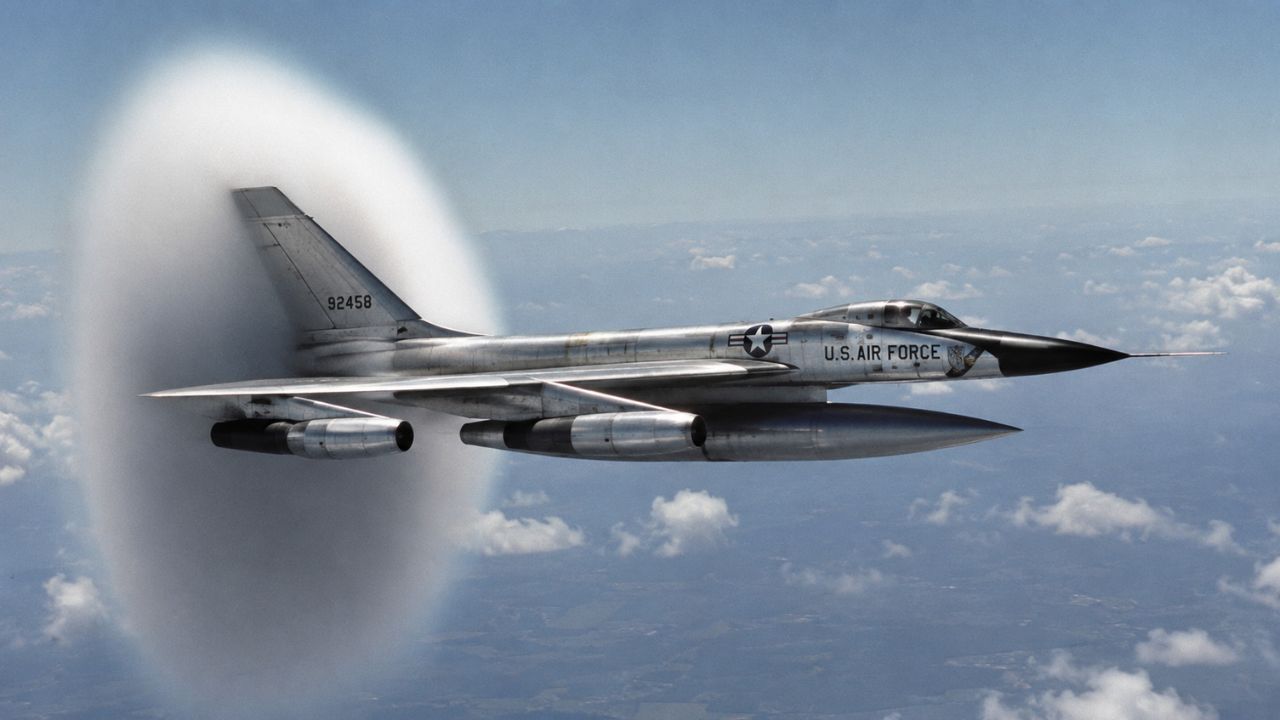

Convair B-58 Hustler reached 2,132 km/h, carried nuclear armament, and set 19 records, but remained in operation for only a decade.
A bomber of almost 74 tons, equipped with four engines and capable of exceeding 2,100 km/h, should have represented a huge military advantage for the United States. The Convair B-58 Hustler, however, remained in service only between 1960 and 1970, despite incorporating some of the most advanced aeronautical solutions of its time.
The problem was not in its inability to fulfill what it was designed for. The plane indeed reached Mach 2, operated close to 20,000 meters altitude, and could carry nuclear weapons, but the strategy that justified its existence lost importance before the model could build a lasting career.
Convair B-58 Hustler was born to penetrate defenses at high speed
In the early 1950s, the United States was looking for an aircraft capable of replacing the Boeing B-47 Stratojet in certain strategic missions. The idea was to cover long distances and accelerate during the approach to enemy territory, reducing the reaction time of radars and fighters.
-
Ridiculed for riding a bicycle with his pockets full of seeds, a man sold his own three acres of land to buy seedlings and spent six decades sowing roads and arid hills, credited with covering the region with millions of trees.

-
A residential artesian well can start at R$ 18,000 and exceed R$ 127,500 when factors such as depth, type of rock, casing, pump, electrical installation, piping, water analysis, and regularization are considered, turning an apparently simple drilling into a technical project subject to additional costs after finding water.

-
Near-Earth object was treated as an asteroid for almost 30 years, but telescopes detected a faint tail and revealed that 1998 SH2 is actually an active comet whose gas release alters its orbit and may help scientists calculate future impact risks more accurately.
-
Near-Earth object was treated as an asteroid for almost 30 years, but telescopes detected a faint tail and revealed that 1998 SH2 is actually an active comet whose gas release alters its orbit and can help scientists calculate future impact risks more accurately.


Convair was given the responsibility of turning this concept into an operational aircraft. The design adopted a narrow fuselage, triangular wings, and four engines installed separately under the main structure.
The shape was not chosen just for appearance. Each part needed to reduce air resistance and allow the bomber to maintain supersonic speeds over extended stretches.
First flight took place in November 1956
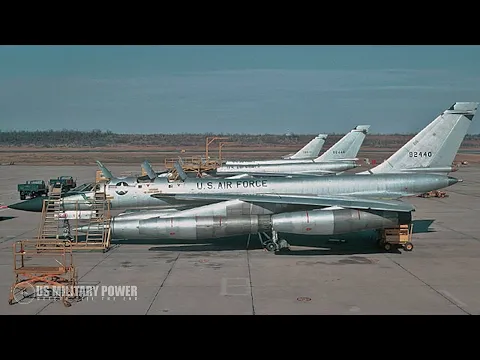
The prototype took off for the first time on November 11, 1956. A few years later, the Hustler became part of the Strategic Air Command of the United States Air Force. In total, 116 units were built.
Of this total, 30 aircraft were allocated for development and initial evaluations, while another 86 went on to operational use. The fleet was distributed between only two bomber wings. This limited quantity already indicated that the B-58 would not be used on the same scale as more versatile platforms, such as the B-52.

Four engines took the bomber to 2,132 km/h
The propulsion came from four General Electric J79 turbojets with afterburners. Each unit provided approximately 15,000 to 15,600 pounds of thrust, the force needed to move the enormous aircraft at supersonic speed.
The Convair B-58 Hustler could reach about 2,132 km/h, depending on altitude, load, and configuration used. Its operational ceiling was close to 19,750 meters, while the range without refueling reached approximately 7,081 kilometers.
These numbers placed the bomber in an unusual category. Until then, speeds of this order were more associated with fighters and experimental aircraft than with a strategic platform with four engines.
Structure needed to withstand Mach 2 heat
Flying twice as fast as sound required more than just powerful engines. The intense contact with the air heated the surface, affecting electronic components, internal compartments, and structural parts. To tackle this problem, Convair used metal panels joined to honeycomb-shaped structures. The solution aimed to combine rigidity, thermal resistance, and lower weight.
The air intakes also required special attention. Movable cones controlled the flow and shock waves before the air reached the engine compressors. The pursuit of a narrow body created an important limitation: there was no space for a conventional internal armament compartment.
The solution was to concentrate fuel, equipment, and nuclear load in a structure attached under the plane. This external pod could be configured for different purposes. In later versions, its lower part, intended for fuel, could be released separately from the section carrying the weapon.

Other points under the wings allowed for increased offensive capacity. The model also had a 20-millimeter cannon installed in the tail and remotely controlled.
Three crew members worked in isolation
Instead of a cockpit with two pilots side by side, the B-58 accommodated its three occupants in aligned positions. In the front was the commander, followed by the navigator-bombardier and the person responsible for defense systems.
This arrangement helped maintain a thin fuselage but made communication difficult and increased the sense of isolation. The pilot also did not have a co-pilot to directly share control of the four-engine aircraft.
The crew needed to manage navigation, attack, electronic warfare, and defense during high-speed missions. The Convair B-58 Hustler could respond well to commands but offered little room for operational errors.
Capsules enclosed the occupants before ejection
Traditional ejection seats proved inadequate for an aircraft operating at such high speeds and altitudes. Abandoning the plane directly at Mach 2 could expose the body to extreme conditions.
The solution was to adopt individual pressurized capsules. When the system was activated, a cover enveloped the crew member and created a small protected space with its own oxygen supply.
The capsules allowed ejections at speeds of up to Mach 2 and altitudes close to 70,000 feet. After separation, the set used parachutes, shock absorbers, and inflatable elements that could also function in a water landing.
Pilot could still control the protected aircraft
In the front position, some controls remained accessible even after the capsule closed. In this way, the pilot could try to stabilize the aircraft or guide it to a less dangerous condition before abandoning the cockpit.

The mechanism was heavy, expensive, and technically complex. Even so, it corresponded to the risks of a bomber operating far beyond the limits faced by conventional aircraft. The adaptation of the capsules began at the end of 1962. The equipment became one of the most curious features associated with the Convair B-58 Hustler.
Plane accumulated 19 world records
The short career did not prevent the Hustler from achieving impressive results. The B-58 family achieved 19 international speed and altitude records, as well as five significant aviation trophies.
In January 1961, a crew completed a 2,000-kilometer circuit carrying 2,000 kilograms, maintaining an average speed close to 1,709 km/h. The same flight also broke records in other cargo categories.
The following year, a unit made a trip between Los Angeles and New York, then returned to the west coast. The operation produced three new records and earned the Bendix and Mackay trophies.
Main numbers of the B-58 Hustler
The dimensions and capabilities help to show why the plane attracted so much attention in the late 1950s:
- Length: 29.51 meters;
- Wingspan: 17.32 meters;
- Height: 9.58 meters;
- Maximum weight: approximately 73,936 kilograms;
- Maximum speed: about 2,132 km/h;
- Estimated range: approximately 7,081 kilometers;
- Operational ceiling: about 19,750 meters;
- Crew: three people;
- Engine: four General Electric J79 turbojets;
- Total production: 116 units.
The values could vary according to the mission, altitude, fuel, and external load. Even so, they show that the project was among the most ambitious of its time.

Missiles changed the logic of aerial warfare
The Hustler was created based on the idea that flying very high and very fast would be enough to penetrate enemy defenses. The advancement of surface-to-air missiles put this premise in doubt.
The shooting down of a U-2 reconnaissance plane by a Soviet S-75 system in 1960 demonstrated that high altitudes no longer offered the expected security. Military planners began to require bombers to approach targets by flying close to the ground.
This change directly affected the Convair B-58 Hustler. Its structure had been optimized for rapid displacements in high-altitude regions of the atmosphere, not for long incursions at low altitude.
Low flight reduced the advantages of the design
Near the ground, denser air increased drag, stress on the structure, and fuel consumption. Supersonic speed ceased to produce the same strategic benefit.
The range also decreased, increasing the dependence on aerial refueling. Long-distance missions needed to rely on KC-135 tanker aircraft and an increasingly complex operational structure.
The Hustler could perform low flights, but it had not been designed to remain in that environment. The characteristic that justified its development no longer solved the main challenge faced by bombers.

Maintenance required specialized professionals, specific equipment, and constant attention to the engines, movable air intakes, and electronic systems. The frequent use of afterburners also significantly increased fuel consumption.
Meanwhile, the B-52 carried more armaments, reached greater distances, and accepted adaptations for different types of missions. The B-58 offered extraordinary performance but little flexibility. Intercontinental ballistic missiles added another difficulty. They could hit targets without exposing crews and did not depend on in-flight refueling.
Accidents affected the reputation of the Hustler
The development of such an advanced aircraft involved problems in systems that were still maturing. Tires, landing gear, controls, engines, and emergency procedures underwent adjustments during the program.
Accidental losses reinforced the image of a demanding aircraft. The combination of high speed, a large number of systems, and the absence of a copilot made each failure potentially more serious.
Training and modifications improved safety over time. Even so, costs, accidents, and the transformation of military strategies limited the model’s longevity. The Strategic Air Command ended the operation of the B-58 on January 16, 1970. The remaining units were sent to storage at Davis-Monthan in Arizona.
The role of the Hustler was passed to the FB-111A, an aircraft derived from the F-111. The successor had variable geometry wings and had been prepared for low-altitude attacks. The replacement reflected a new priority. Instead of relying solely on speed and flight ceiling, the military sought flexibility, autonomy, and greater adaptability.
Convair B-58 Hustler was not a technical failure
The premature end does not mean that the plane failed as a machine. It reached Mach 2, carried nuclear weapons, set records, and remained integrated into the United States alert force.

Its fragility lay in specialization. The design was very well-suited to a specific mission but struggled to take on other roles when threats changed.
The Convair B-58 Hustler thus became an example of how a technically brilliant solution can lose utility in the face of a strategic transformation.
The experience gained with honeycomb materials, inertial navigation, air intake control, and integrated electronic systems contributed to later projects. The pressurized capsules also demonstrated an alternative for survival in extreme conditions.
The J79 engines achieved a much longer trajectory than the bomber itself. They were also used in aircraft like the F-104 Starfighter, the F-4 Phantom II, and the A-5 Vigilante.
More than five decades after its retirement, the Convair B-58 Hustler continues to attract attention for its shape, performance, and short operational life. It overcame engineering challenges but could not escape a change that no aircraft could overcome by simply accelerating: the transformation of war itself.
With information from Poder Aéreo


