





 Portuguese
  English
  Spanish
  3 min of reading
  0 comments


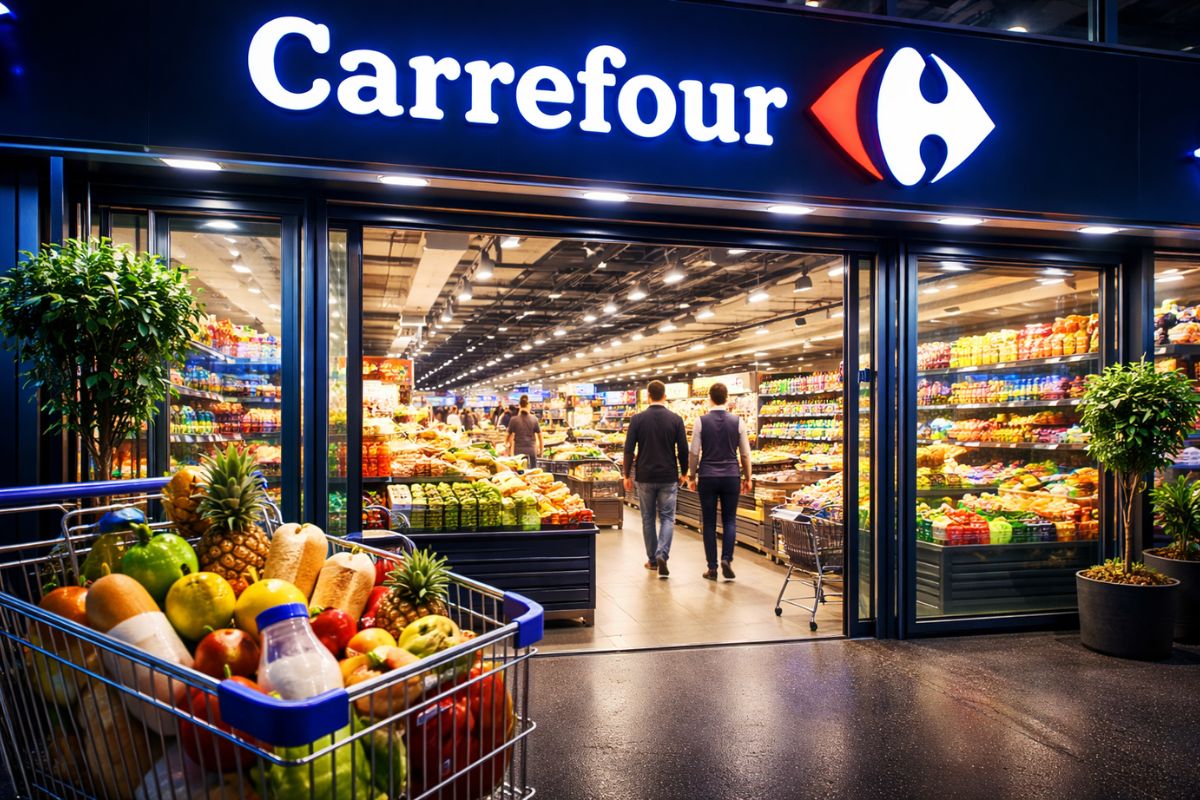
The Decision of Carrefour to Maintain 64 Units Open 24 Hours Exposes a Geographic Pattern of Nighttime Consumption, Concentrated in São Paulo and a New Store in São José dos Campos Announced on January 28, While the Chain Promises to Expand the Format in Brazil in 2026.
Carrefour has turned nighttime operations into store policy by confirming that there are 64 active 24-hour units. This data changes the interpretation of convenience and supply when the city empties, placing consumption routines under a different logic of availability.
The most direct novelty is the entry of São José dos Campos, in the Paraíba Valley, into the 24-hour operations scope. The measure was announced on January 28 for a unit in the eastern zone of the municipality, and it reinforces how São Paulo appears as the axis for the format, even when the promise speaks of national expansion.
What Does It Mean to Operate 24 Hours
Operating 24 hours is not just about keeping doors open.
-
“No one will make us change the Pix,” says Lula after the US report.

-
Lula responds directly to Trump and says that Pix is from Brazil and will not change under pressure from anyone, after a report from the United States pointed out the Brazilian payment system as an American trade barrier.

-
Amazon has just announced a new fee on all deliveries, and your online purchases will become more expensive starting April 17, including for those buying from the United States here in Brazil.

-
He sold his share for R$ 4 thousand, saw the company become a giant worth R$ 19 trillion, and missed the opportunity of a lifetime.


For Carrefour, the model pressures replenishment processes, security, cleaning, loss control, and work schedules, because the supermarket no longer has a long low-traffic interval to reorganize operations.
In practice, the existence of 64 24-hour units creates a demand laboratory.
Those who shop at night tend to seek immediate replenishment, ready-made food, basic items, and convenience, and the tolerance for stockouts usually decreases, as alternatives nearby may be limited.
Where the Map of 24-Hour Units Appears with Greater Strength
The list of addresses released with the announcement highlights one point:
São Paulo emerges with a density much higher than the rest, gathering several units in the capital and also in municipalities like Barueri, São Bernardo do Campo, São José dos Campos, and Praia Grande.
This helps explain why Carrefour views the format as scalable, yet still anchored in high-traffic markets.
Outside of São Paulo, the presented list mentions Brasília, Salvador, Goiânia, Recife, and Curitiba.
Even without detailing all 64 24-hour units, the group suggests a pattern of capitals and areas with continuous flows, where 24-hour operations can be absorbed by constant demand and urban logistics.
São José dos Campos as a Sign of Internalization
In the case of São José dos Campos, the highlight is the combination of industrial city, regional mobility, and consumption outside commercial hours.
The inclusion of the municipality in Carrefour’s model indicates that nighttime demand does not rely solely on tourism or financial centers, but also on work and travel routines in the Paraíba Valley.
There is a practical reading component: when São José dos Campos enters the list, the debate shifts from being just capital versus interior.
The 24-hour format begins to test how neighborhoods and road axes sustain demand and how this interacts with the concentration of the state of São Paulo itself.
The Promise of Expansion and What Consumers Need to Observe
The chain claims that it intends to increase the number of 24-hour units.
Operationally, this tends to require selection of locations with relative security, compatible work contracts, and night supply capacity, as well as service standardization.
Without these pillars, 24 hours becomes a showcase, but does not deliver predictability.
For the consumer, the address list is just the beginning. It is worth observing if Carrefour maintains service standards in 24 hours, whether there are changes in assortment at night, and whether the experience is consistent between São Paulo and other mentioned capitals.
What appears as convenience may also bring indirect costs, such as longer travel and dependence on a few 24-hour units in each region of Brazil.
If you already use a 24-hour supermarket, what matters most in your choice: safety on the way, variety of products, speed at the checkout, or the certainty that the unit really operates all night long? And in your city, where would Carrefour make the most sense to open as one of the 64 24-hour units: near hospitals, bus stations, residential neighborhoods, or work hubs?









-

-

4 pessoas reagiram a isso.