





 Portuguese
  English
  Spanish
  6 min of reading
  0 comments


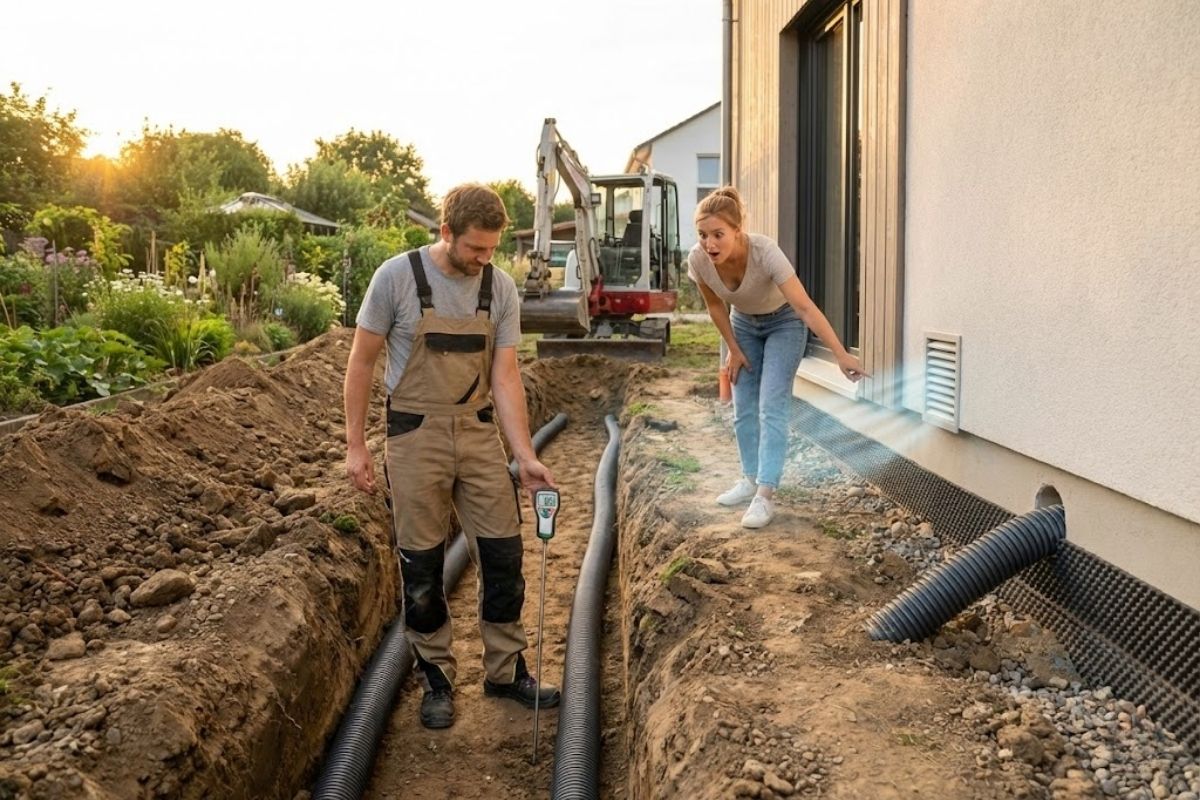
Free-Cooled House Born from a Canadian or Provençal Well That Pulls Cold Air from the Ground Through a Trench of 60 cm by 40 cm; Sensor Recorded 15.6°C in the Trench and 18.7°C in the Office at 8:06 AM, with Continuous Convection, Fan Can Be Turned On When the Heat Hits Without Using Energy
A free-cooled house described in the guide is the result of a system that harnesses the cold from the earth and a convection air circuit, with air “forced” to enter the environment. The measurement presented shows 15.6°C in the trench and 18.7°C in the office at 8:06 AM, with the fan still off.
The step-by-step details excavation, duct, and sealing, as well as practical measures to prevent soil entry and reduce insect passage. The author himself indicates performance limits in very hot climates and lists precautions about moisture, filters and physical barriers, maintaining the proposal to climatize without air conditioning in summer.
What Is the Canadian or Provençal Well and Why Does the Free-Cooled House Depend on the Earth

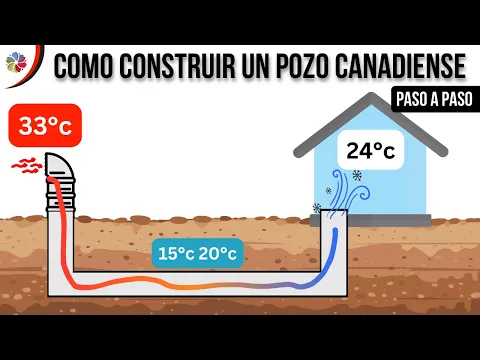
The system presented is called a Canadian well or Provençal well and works as an “air conditioner” primarily designed for summer, using the cold from the earth to reduce the temperature of the air entering the environment.
-
Home environment can influence the brain, mood, and well-being: studies indicate an increase of up to 15% in productivity, a reduction of 12% in stress with plants, and a direct impact of the circadian rhythm on the 24 hours of the day.

-
A Brazilian millionaire couple restores a farm over 150 years old in the interior of São Paulo and transforms the historic property with Portuguese tiles, antique furniture, and new spaces into a refuge that blends tradition, comfort, and sophistication.
-
Submerged city in a lake in Minas reveals intact streets, preserved vehicles, and houses after more than 60 years, impressing divers.

-
Yellowstone has started to rise again in an area of the caldera, and the movement rekindles fears surrounding the U.S. supervolcano, as scientists monitor the deformation and try to understand what is happening underground.

The logic is simple: the air passes through an underground section, loses heat to the ground, and rises into the space to be climatized.
In the configuration shown, the free-cooled house relies on two modes of operation.
One mode is constant convection, which occurs without energy consumption, and the other is a reinforcement mode with a fan, activated when further lowering the temperature in the space is desired.
Trench 60 cm by 40 cm: Excavation, Post-Rain Time and Alignment

The guide begins with the trench that will connect the ventilation system to the environment.
The specified dimension for the trench is objective: 60 cm deep by 40 cm wide.
To facilitate excavation, the author states that they waited two days after heavy rain, a recommendation used to soften the soil.
To keep the path straight, he describes using a rope as a reference, avoiding deviations during the soil cutting.
The trench is treated as the structural piece of the system because it defines the path of the cold air that will be captured underground and directed inside.
Underground Duct: Cement Bricks, Fabric and Sealing to Keep Out Soil

The section through which the air passes is constructed with cement bricks.
The author explains that it could have received a direct pipe and even concrete to simplify, but chose to assemble the duct with bricks, forming a kind of channel.
To prevent soil from entering through the joints, he describes a layered sealing solution: the bricks are coated on the outside with frost protection fabric and receive cement on top, creating a tighter structure.
He also acknowledges that the quality of the bricks may not be the best, but claims that the final sealing ensures the integrity of the entire structure.
Air Entry Tower, Silicone-Sealed Lid, and Barriers Against Insects
The system includes an “air entry tower”, described as the point where the air enters and follows into the circuit.
The assembly involves removing a part of the brick to form the entry mouth and install a lid.
The final sealing is done with silicone, intending to seal and control the flow.
In the finishing stage, the author mentions the need for a grille and the inclusion of a mosquito net, recommending a plastic screen to reduce insect entry.
The same logic of physical barriers is repeated later to deal with insects and even rodents: grilles, mosquito nets, and physical protections.
Convection and Fan: Two Modes That Sustain the Free-Cooled House
The operation is described as a circuit in which cold air enters through the duct and circulation occurs through convection.
Convection is presented as “constant”, and the author states that it does not consume energy in this mode, associating the effect with the presence of a greenhouse connected to the system, which creates a thermal difference that pulls the air.
The fan is mentioned as an optional reinforcement. He describes a large fan, with ample flow, that can be connected to speed up air exchange and further reduce internal temperature.
In the account, this fan is already used in another space and can be turned on when the convection is not “strong enough”, but is still present.
Measurements on Site: 15.6°C in the Trench and 18.7°C in the Office at 8:06 AM
The most objective part of the guide is the measurement.
The author reports that, at 8:06 AM, the ambient temperature in the office was 18.7°C.
In the trench, measured by a sensor placed inside the duct, the reported reading was 15.6°C, accompanied by a mention of 69% humidity at the measurement point.
He emphasizes that the fan was still off at the moment when he showed the airflow and the sense of cold coming from the trench.
Then, he turns on the fan and describes the increase in flow, maintaining the idea that the system can operate without energy in convection mode and with reinforcement when necessary.
Sizing: 8 m³, Inlet and Outlet 110 and Adjustments for Larger Environments
The author himself delimits the size of the environment served in the example: the system was described as sized to climatize 8 m³.
He also cites air inlet and outlet parameters, with 110 at the inlet and 110 at the outlet, stating that this is “a bit over 4 inches”.
For larger environments, the guide recommends increasing the dimensions: inlet and outlet should have 30 cm or 40 cm, and the trenches need to be longer and deeper.
The guidance is pragmatic and does not promise universal numbers: “you define that”, with the idea of sizing according to volume and need.
Limits and Safety: Very Hot Climates, Radon, Moisture, and Filters
The guide admits that, in very hot climates, it may happen that the desired “ideal” temperature is not reached, citing 22°C as a reference.
Even so, he suggests a significant relative gain: reducing an environment that would start at 30°C or 32°C to something like 26°C or 24°C, which would already decrease dependence on air conditioning and improve comfort.
In the frequently asked questions section, he addresses radon and states that the system would not be affected in the described model because there is constant air renewal in large volume.
He warns, however, about other practical precautions: concern with paints and volatile organic compounds, controlling insects and rodents through physical barriers, and for moisture and fungal spores, the recommendation is to use filters, including carbon filters and specific filters, in addition to possible improvements with more ventilation and extraction.
The guide for the free-cooled house describes a Canadian or Provençal well built with a trench of 60 cm by 40 cm, a duct assembled with cement bricks, protective fabric, and sealing with cement, in addition to an air entry tower sealed with silicone and protection with netting.
The reported measurements indicate 15.6°C in the trench and 18.7°C in the office at 8:06 AM, with constant convection and optional fan to reinforce cooling.
If you plan to test something similar, the most realistic step is to measure temperature and humidity at the capture point and in the environment at different times, adjust sealing and physical barriers, and plan filters if moisture becomes an issue, before scaling up to larger volumes.
Would you build a free-cooled house with a Canadian or Provençal well, even knowing that it may require a deeper trench, filters, and sizing adjustments to work well in your climate?








-

-

-

-

9 pessoas reagiram a isso.