





 Portuguese
  English
  Spanish
  5 min of reading
  0 comments


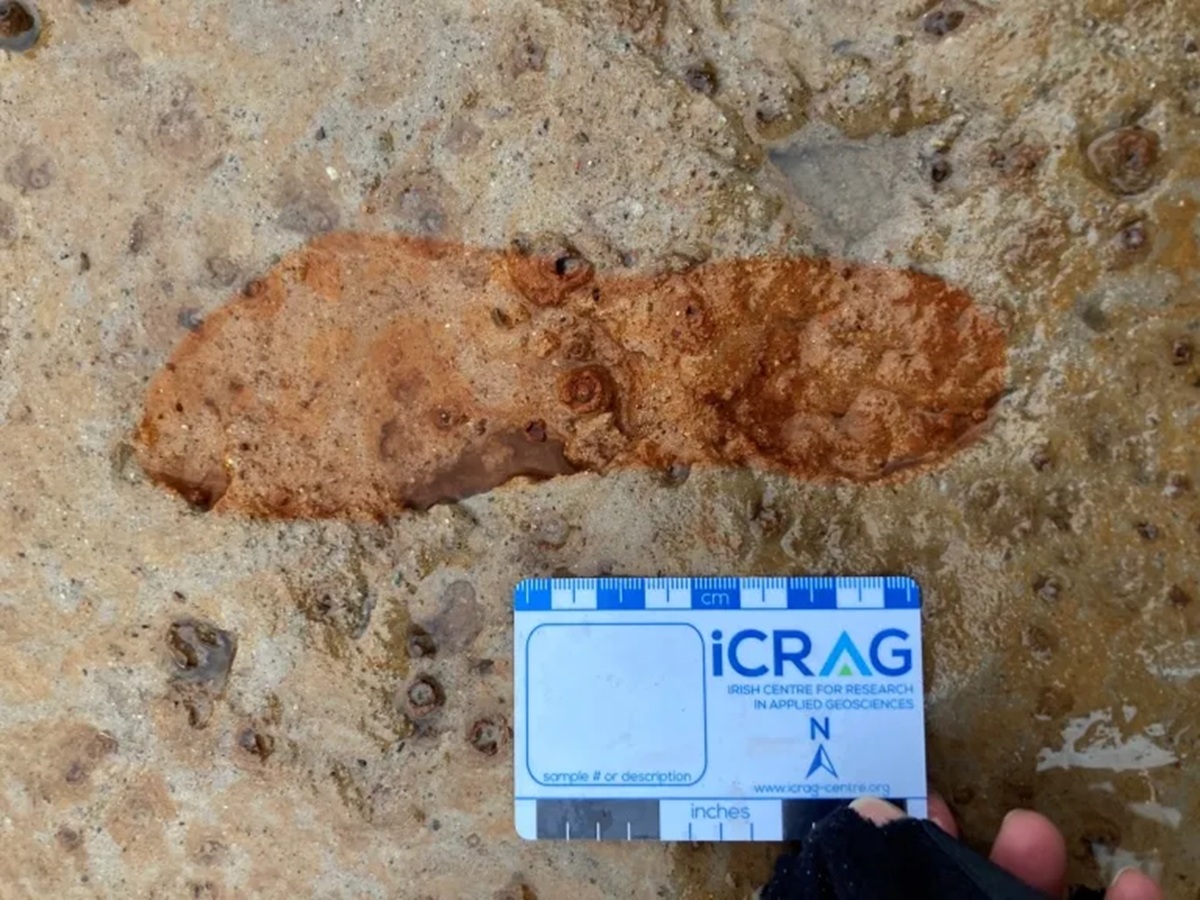
Human Footprints And Deer Tracks About 2,000 Years Old Temporarily Appeared In The Sand Of Lunan Bay, Scotland, After A Storm Removed Layers Of The Beach And Exposed Ancient Clay, Mobilizing Archaeologists In A Race Against Time To Record The Site Before It Disappeared Again
A walk with dogs led a couple to find footprints that are about 2,000 years old in Lunan Bay, in eastern Scotland. The marks were visible for just a few days before disappearing again under the action of the waves.
The discovery occurred at the end of January when Ivor Campbell and Jenny Snedden were walking along the beach accompanied by their dogs, Ziggy and Juno. During the walk, they noticed a series of unusual shapes emerging in the wet sand along a stretch of dunes.
The marks resembled footprints and caught the couple’s attention. They decided to take pictures of the site and forwarded the photographs to Bruce Mann, the regional archaeologist responsible for the councils of Aberdeenshire, Angus, Moray, and the city of Aberdeen.
-
In France, a group of artisans spends 28 years building a medieval castle with 13th-century tools, without machines, without measuring tapes, and with almost zero carbon footprint, and the rediscovered techniques helped in the reconstruction of Notre-Dame.

-
Tourists on Everest were poisoned by guides who mixed substances in food to provoke false symptoms of altitude sickness while helicopter operators and hospitals charged inflated rescue fees to insurance companies.

-
Few people know this, but Neil Armstrong, one of the most famous NASA astronauts in history, survived the Korean War after jumping from the plane during his seventh combat mission aboard the USS Essex aircraft carrier of the United States.

-
Diving with a camera in Lake Furnas reveals a submerged city with an entire street, almost intact houses, a preserved bridge, a wood stove, a Kombi, and even a bus at the bottom of the largest lake in the Southeast.


Upon viewing the images, Mann immediately realized it could be something significant. He quickly organized an investigation to examine the footprints before they disappeared, as they were exposed in a coastal area subject to constant erosion.
Winter Storm Exposed The Preserved Footprints Below The Sand
The footprints were located in a stretch of dunes in Lunan Bay. A strong winter storm had removed some of the beach sand, exposing an ancient layer of clay that preserved the semi-fossilized marks.
This centuries-old layer acted as a natural record, keeping the footprints protected for centuries. Among the identified marks were human footprints made by bare-footed individuals, as well as tracks left by red deer and roe deer.
The sudden exposure of the site created an unusual situation for researchers. While the storms revealed the footprints, they also quickly began to destroy the archaeological site.
As soon as he learned of the discovery, Bruce Mann contacted archaeologists from the University of Aberdeen. The request for help was sent by email late at night, quickly mobilizing researchers and students for an emergency investigation.
Race Against Time To Record The Footprints Before They Disappeared
A team from the university arrived at the beach shortly afterward and began documenting the site. The goal was to record as much information as possible before the footprints were erased by the wind and waves.
Archaeologist Kate Britton from the University of Aberdeen led the emergency excavation. According to her, the team spent several nights organizing logistics to quickly reach the archaeological site and begin the records.
The researchers worked under difficult conditions, with strong winds and unstable weather. Even so, they managed to spend several days mapping the footprints and creating plaster molds to preserve some of the evidence.
In addition to physical molds, drones and cameras were used to capture detailed images of the site. The collected material allowed for the creation of a complete three-dimensional map of the footprints once the data was analyzed in the laboratory.
Britton described the situation as a true archaeological emergency. The site had been revealed by recent storms but was simultaneously being gradually destroyed by the ongoing action of the sea.
Charcoal Remains Helped Determine The Age Of The Footprints
During the investigation, archaeologists identified an important detail beneath some of the footprints. Beneath the layer of preserved marks were remains of charcoal plants.
This organic material provided a key clue for determining the age of the site. The team used radiocarbon dating to analyze the plant remains found at the site.
The results indicated that the charcoal plants were approximately 2,000 years old. The discovery suggests that the footprints were made during the late Iron Age.
This period coincides with the time when Roman armies were attempting to conquer the region that now corresponds to Scotland. The conquest attempts began around AD 70.
According to information from the National Museums of Scotland, the Romans won an important battle at Mons Graupius in the northeast of the territory. However, a few years later, they abandoned the region due to the need to shift troops to other areas.
Footprints Reveal Possible Human Activity In An Ancient Muddy Estuary
The chronology obtained through dating also coincides with other archaeological finds from the same period in the region. At that time, the area of Lunan Bay was not a sandy beach as it is today.
The evidence indicates that the site was likely a muddy estuary. In this type of environment, humans and animals could easily leave footprints preserved in the wet ground.
Researchers consider it possible that people traversed the area while gathering plants for food. Other hypotheses suggest hunting activities for deer or checking fishing traps.
Archaeologist Gordon Noble from the University of Aberdeen stated that the discovery represents a concrete connection to the region’s past. For researchers, the footprints offer a direct record of human presence in that environment.
Footprints Completely Disappeared In Less Than A Week
Despite the quick mobilization of the team of archaeologists, the site had a short life. In about a week, the footprints were completely destroyed by the combined action of the waves and the wind.
Even so, the brief period during which they remained visible allowed for the gathering of an important set of scientific records.
The collected material can continue to be studied by experts.
The discovery also suggests that other ancient footprints may be hidden beneath the sand of the region. Similar sites have been found previously in England.
So far, however, nothing comparable had been recorded in Scotland. This makes the Lunan Bay episode a rare case in regional archaeology.
During moments of calm weather, researchers were able to send drones to capture aerial images of the site. These records include photographs and videos that help document the discovery.
Studies Show That Footprints Can Reveal Ancient Behaviors
Footprints preserved in the soil can provide important information about the people and animals that left them. Analyzing these traces can indicate approximate weight, height, and age of the individuals.
It is also possible to estimate walking speed and identify whether people were wearing shoes or walking barefoot. In some cases, footprints allow for the reconstruction of specific behaviors.
Research conducted in other locations around the world demonstrates this scientific potential. At White Sands National Park in New Mexico, footprints indicated that a person was carrying a small child while walking quickly for about one and a half kilometers over 10,000 years ago.
Other examples include footprints found in Kenya that suggest the presence of two different human species walking near a lake about 1.5 million years ago.
In another area of New Mexico, traces indicated the use of primitive devices to carry heavy loads about 22,000 years ago.
These examples demonstrate how footprints can record details of daily life in very ancient periods. Even when they appear for just a few days, as happened in Lunan Bay, these traces can reveal valuable information about the past.









Seja o primeiro a reagir!