





 Portuguese
  English
  Spanish
  3 min of reading
  0 comments


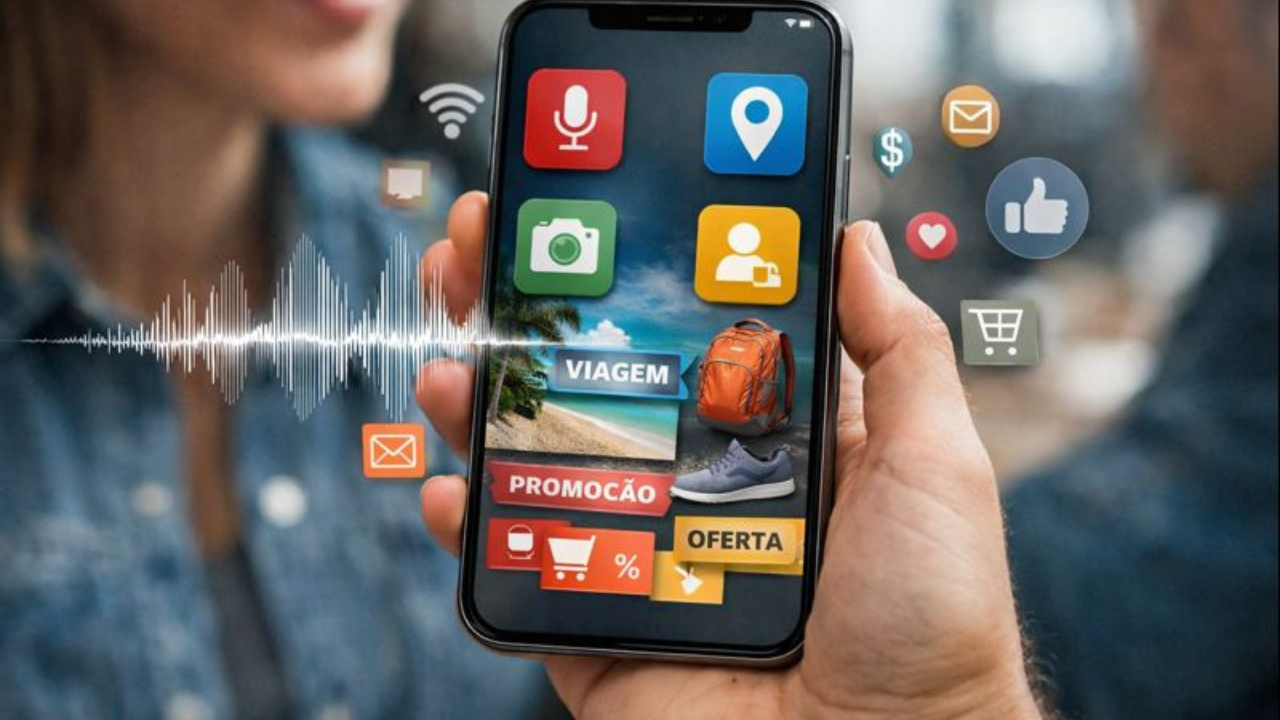
Understand Whether Your Phone Listens to Conversations, How Data Collection Works, and Why Targeted Ads Appear in Your Daily Life.
The suspicion that smartphones listen to in-person conversations to display targeted ads has ceased to be merely a popular theory.
According to digital security experts, smartphones can indeed capture audio from the environment when users authorize certain app permissions, allowing for data collection for advertising purposes.
This practice occurs daily, in Brazil and worldwide, mainly because many users accept terms of service without prior reading, raising relevant alerts about digital privacy.
-
The Himalayas continue to grow to this day, with tectonic plates advancing 5 cm per year, mountains rising up to 10 mm annually, and the 2015 earthquake that killed 9,000 people may have increased the risk of an even larger seismic mega-event.

-
At an altitude of 400 km by astronauts from the International Space Station, Paris transforms at night into a golden mesh so precise that it reveals the outline of the Seine River, avenues, and entire neighborhoods like a luminous map drawn over the Earth.

-
iPhone 17 reaches historic low price with 256 GB, 120 Hz display, and drops to R$ 5,703 on Shopee, featuring A19 chip, dual 48 MP cameras, battery life of up to 30 hours, and advanced AI features.

-
Trip to Mars getting closer: Pulsar Fusion, from the UK, advances with plasma ignition in fusion engine and could drastically reduce space travel time, making crewed missions faster, safer, and economically viable.


In an interview with Podcast Canaltech, cybersecurity expert Madu Melo from NordVPN explained that monitoring happens legally when there is explicit user consent.
In other words, the problem lies not only in the technology but also in how people manage authorizations and usage policies.
Phone Listens to Conversations: Why Is This Feeling So Common?
The impression that your phone listens to conversations often arises when extremely specific ads pop up immediately after a casual dialogue.
While it is not an indiscriminate continuous listening, apps can access the microphone in the background, provided that permission has been granted.
According to data from the National Privacy Test, cited by Melo, 37% of Brazilians never read the service conditions of apps.
“It is in these fine print that apps obtain our consent for personal data and voice collection,” the expert explains.
Thus, by clicking “accept,” the user legally authorizes access to sensitive resources on the device.
The Role of App Permissions in Data Collection
App permissions are the main link between the user and data collection.
Microphone, camera, location, and contacts are frequently requested, often without a clear justification for the app’s main functionality.
Meanwhile, this data feeds advertising algorithms.
This data makes targeted ads increasingly precise by combining online behavior with information gleaned from everyday device use.
Practical Test Shows How Targeted Ads Emerge
To demonstrate how this process can occur, NordVPN suggests a simple test.
The user should choose a random theme, far removed from their routine, such as “orangutan” or a specific travel destination, and talk about it near their phone for a few days.
Melo gives an important alert: do not search for the theme on Google, social media, or AI tools.
Only spoken words should be used. “In one of the tests conducted, ads started appearing after two days,” she reports. According to her, the response from algorithms can vary between 48 hours to up to two weeks.
Digital Privacy and Risks Beyond Advertising
Although targeted ads may seem harmless at first glance, the expert highlights more serious risks to digital privacy.
Excessive data collection can expose users to financial scams, fraud, and highly personalized fake ads.
“The ad that may seem safe can hurt your wallet,” warns Melo. Scammers use behavioral data to create convincing campaigns, increasing the chances of financial loss.
How to Reduce Risks and Protect Your Data
To mitigate the impacts of improper information collection, Madu Melo recommends seven essential cybersecurity practices:
Download apps only from official and verified stores;
Regularly review app permissions, especially microphone and camera;
Remove unknown or unused apps;
Clear the history of voice assistants, such as Siri and Alexa;
Keep the operating system and apps always updated;
Enable two-factor authentication whenever possible;
Use a VPN to encrypt the data flow.
These measures do not completely eliminate data collection but significantly reduce user exposure.
Digital Awareness Is the Main Defense
In an increasingly connected environment, understanding how app permissions work is crucial to preserving digital privacy.
The notion that your phone listens to conversations does not represent mere paranoia, but invites the user to digital education and more conscious use of technology.
The complete interview, with detailed explanations about passive listening, algorithm functioning, and data protection, is available in the episode of Podcast Canaltech, offering essential insights into the topic.










Seja o primeiro a reagir!