





 Portuguese
  English
  Spanish
  4 min of reading
  1 comment


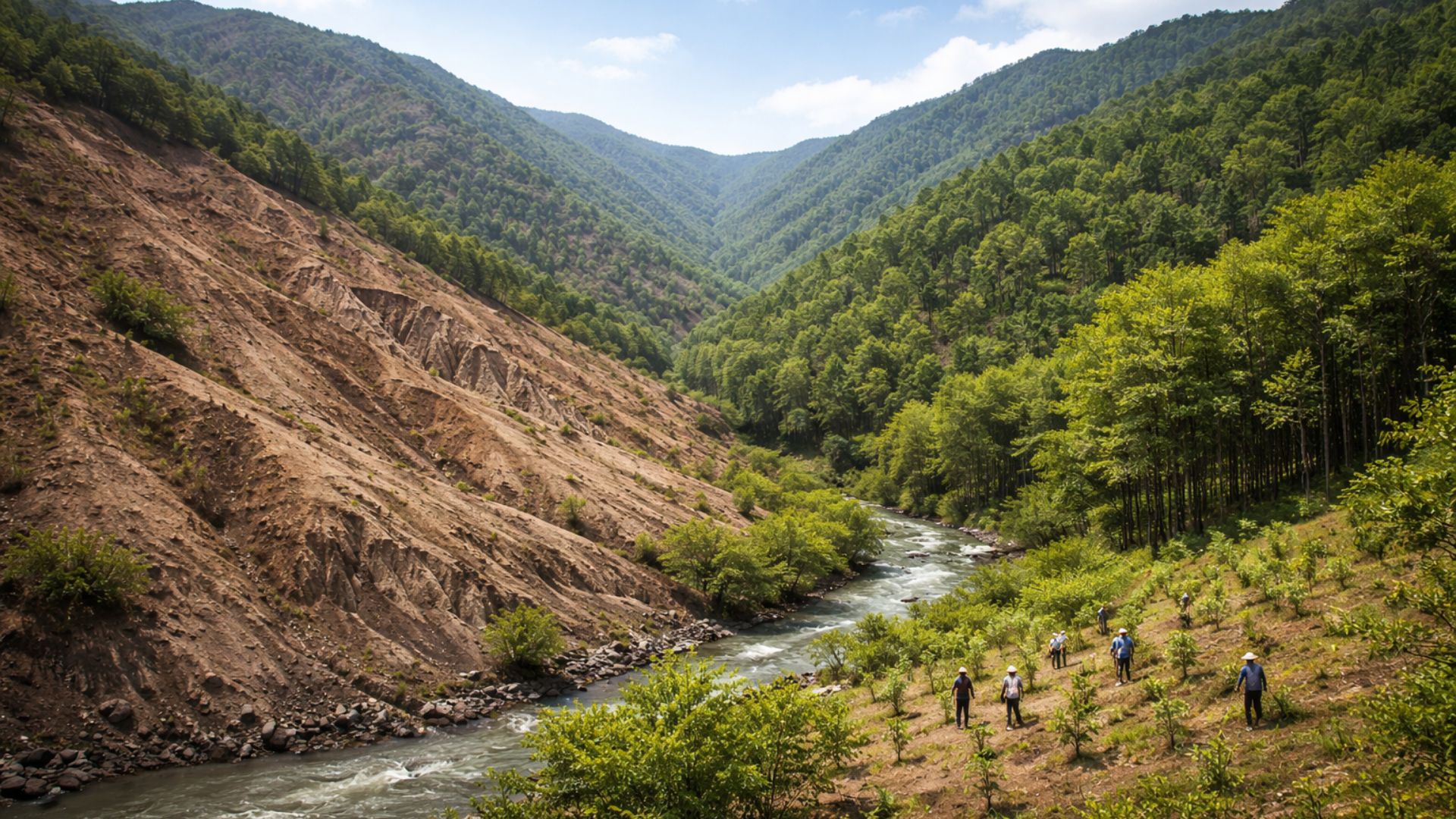


War-Devastated Country Turned Eroded Slopes into Consolidated Forests Through Continuous National Reforestation Plans, Combining Official Goals, Supervision, and Social Mobilization, Until Surpassing 60% Forest Cover and Becoming an International Reference in Environmental Recovery.
South Korea emerged from the Korean War with exposed slopes, sediment-laden rivers, and a forest crisis threatening economic reconstruction, but reversed the situation with national reforestation plans that raised forest cover to over 60% of the territory.
The turnaround combined large-scale planting, supervision, and community mobilization, and began to be cited in international documents and analyses, including from the FAO, as a rare case of sustained environmental recovery with practical effects on soil, water, and natural risks.
Degraded Landscape After the Korean War
For decades, the removal of wood and intensive fuelwood use weakened soil protection, and the war accelerated wear by hitting rural areas and local structures, leaving bare hills and increasing vulnerability to flash floods.
-
From Florianópolis to Antarctica non-stop at 60 years old: 1st Brazilian woman to sail solo makes history by facing one of the most dangerous routes on the planet.

-
A Brazilian recounted how a sudden malaise triggered the entire hospital machinery in the United States, with emergency protocols, tests to rule out a heart attack, and a bill that could reach $40,000.

-
Discovered just 4 meters deep, a 5,000-year-old submerged city with streets, tombs, and trade signs with Crete reveals how one of the oldest civilizations in the world lived before disappearing beneath the sea.
-
The new “monster” submarine of the United States Navy weighs nearly 8,000 tons, is 115 meters long, does not require fuel, and can operate for long periods submerged; meet the USS Massachusetts (SSN-798), which arrives to strengthen the military power of the U.S. amid global tensions.


With less vegetation to cushion the rain, water began to flow more forcefully over the surface, opening furrows, carrying soil into watercourses, and increasing sedimentation in reservoirs, which raised costs and reduced water security.
Reforestation as a Territorial Protection Policy


Instead of viewing planting as a symbolic campaign, the government began to treat forest recovery as a territorial protection policy, because landslides and erosion affected roads, agricultural areas, and communities in mountainous regions.
In this model, trees and grasses would function as “living engineering,” since their roots stabilize slopes and the canopy reduces the direct impact of raindrops on the soil, promoting infiltration and reducing the amount of sediment washed away after heavy rains.
National Reforestation Plans and Decadal Goals
The strategy gained strength with programs structured in phases, especially from the 1970s onward, when the country adopted decadal forest rehabilitation plans, with area recovery targets, schedules, and responsibilities distributed among levels of government.
The first major cycle, initiated in 1973, established a nationwide reforestation and management effort and was accelerated by monitoring mechanisms and complementary actions, such as protection of planted areas and discipline over the use of forest resources.
Nurseries, Seedling Production, and Large-Scale Logistics
To plant at a pace compatible with national goals, it was necessary to expand nurseries, ensure seed supply, and organize the delivery of seedlings to steep areas, a classic bottleneck in restoration projects due to the technical, labor, and transportation challenges involved.

By connecting central planning with local execution, the policy created an operational chain capable of sustaining a continuous volume of planting, and historical records from the South Korean forestry sector indicate billions of trees established over decades of successive programs.
Supervision and Social Mobilization to Prevent Setbacks
Another crucial point was to reduce pressure on recovering areas, as the demand for fuelwood and timber tends to grow during reconstruction periods, and any illegal cutting could quickly nullify planting efforts in fragile slopes.
In this context, supervision and usage rules went hand in hand with mobilization campaigns, involving communities and institutions, so that reforestation did not rely solely on technical teams, but also on local adherence and everyday protection of newly planted areas.
Erosion Reduction and Impacts on Watersheds
The effects on rivers and reservoirs tend to appear early in mountainous regions, and vegetation recomposition in strategic watershed areas helps to reduce the load of suspended sediments, especially after intense and repeated rains.
With more coverage at the tops of slopes and protection of banks, the tendency is to decrease the speed of the flood, reduce soil wash, and increase the stability of the terrain, which also contributes to less damage to infrastructure and lower agricultural losses.
Environmental Indicators and International Recognition

Technical materials indicate that restoration has drastically reduced “bare” forest areas over time, with a significant drop in the proportion of treeless land compared to the 1960 scenario, reinforcing the idea of continuity as a key factor.
Moreover, studies and reports indicate the expansion of forest stock and the consolidation of extensive areas of planting and management, helping to explain why the experience has begun to appear in international debates on restoration, disaster risk, and water management.
Institutional Learning and Sustainable Forest Management
An operation of this scale required standardization, training of officials, review of methods, and correction of failures along the way, as seedling survival rates, species selection, and initial care determine planting success.
With the accumulation of experience, the country strengthened monitoring routines and created a technical base for other fronts, such as fire prevention, sustainable management, and protection of sensitive areas, maintaining reforestation as a monitored policy rather than a one-time event.
The combination of state goals, execution instruments, and social participation is cited as an explanation for the relatively rapid transformation compared to the time it took for degradation to consolidate in previous decades.
By showing that eroded slopes can return to fulfilling a protective function with persistent planning, the South Korean trajectory has become a reference in discussions about landscape restoration, especially where erosion and sedimentation threaten water supply and agricultural production.
If soil degradation continues to advance in different regions of the world, with extreme events pressing rivers and cities, what kind of political and social commitment would be necessary to maintain for decades a reforestation effort capable of changing the landscape so profoundly?







Quando povo e governo trabalhar juntos, todos ganhamos…