





 Portuguese
  English
  Spanish
  5 min of reading
  0 comments


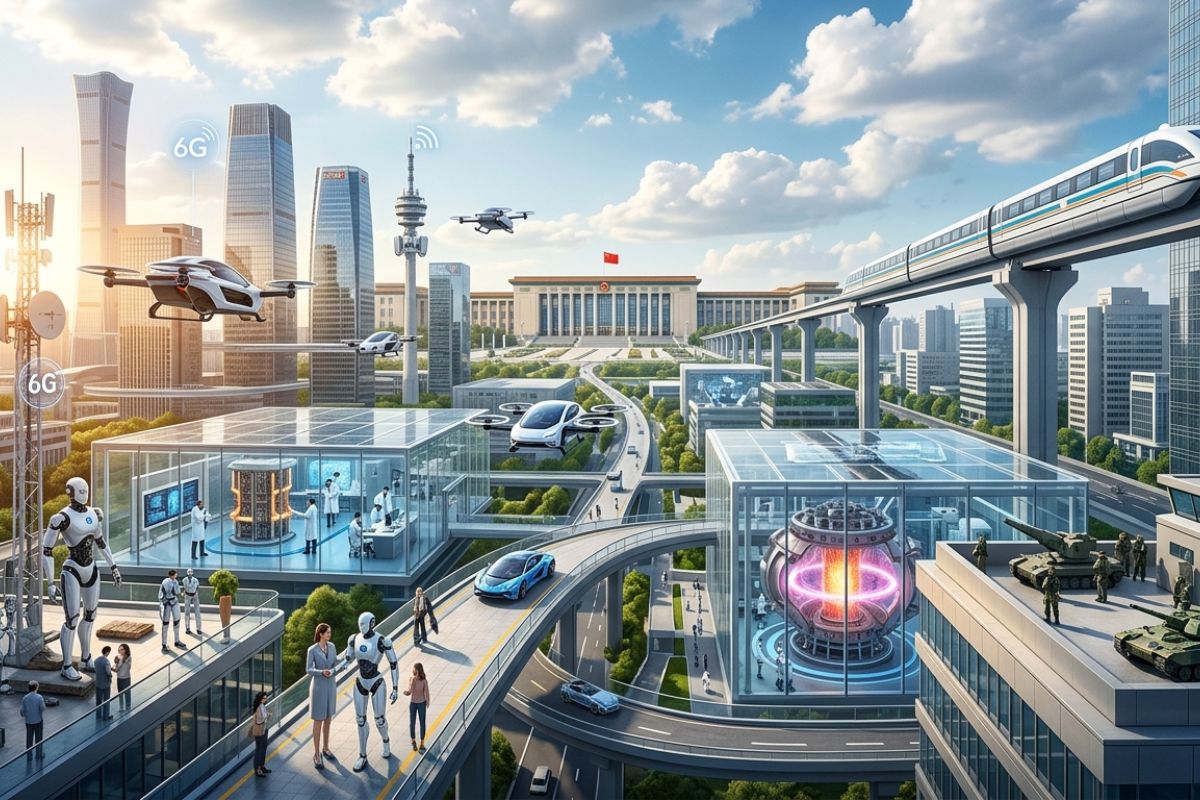
China places future technologies at the center of the 2026-2030 plan, strengthens defense and economic resilience, and tries to accelerate the race to become a world power
China has approved the 15th Five-Year Plan for 2026-2030 and treated the document as a roadmap to bring the country closer to the goal of leading the world. The plan prioritizes a package of technologies that, if successful, will change entire sectors: brain implants, 6G with artificial intelligence in infrastructure, humanoid robots, flying cars, quantum technology, and nuclear fusion.
But China is not only looking at innovation. The plan combines economic growth and defense, focusing on comprehensive security against “extreme scenarios,” seeking economic, energy, and military resilience to maintain the ability to compete in advanced technology even in a tougher geopolitical environment.
What is the 15th Five-Year Plan and why has it become a showcase of power
Five-Year Plans are a method that China uses to define national priorities and organize industrial and strategic policies in five-year cycles. The 15th plan, covering 2026-2030, is described as the most ambitious so far because it tries to tie together three fronts at once:
-
HONOR X80i arrives with a massive 7,000 mAh battery, a 120 Hz AMOLED display with a brightness of 6,500 nits, and the new Dimensity 6500 Elite chip, promising up to 22 hours of video playback and impressive performance in casual gaming.

-
Xiaomi TV Stick HD 2 is announced with Google TV and dual-band Wi-Fi, offering 38% superior performance, HDR10+, Dolby Atmos, a quad-core chip, Mali-G31 GPU, 1 GB RAM, and support for 1080p at 60 Hz.

-
Brazil joins the select group of countries by producing a supersonic fighter that reaches 2,400 km/h with advanced electronic warfare technology, US$ 4 billion in investments, 36 units planned, 350 trained engineers, and unprecedented national production by 2032.

-
At the bottom of the sea, scientists have found a true underwater cathedral measuring 62 meters at the base, 31 meters at the top, and 1,347 square meters of giant coral in the Maug Islands, estimated to be 2,050 years old.


technological dominance to lead emerging areas
economic and energy resilience to reduce vulnerabilities
defense preparedness to operate under pressure, including in conflict scenarios
In practice, the plan is a “technological and industrial war map”: the country chooses where it wants to dominate, where it wants to produce, and where it does not want to depend on anyone.
Brain implants become a national priority
Among the most sensitive priorities of the plan, China places brain-computer interfaces as a strategic national theme. The idea is to accelerate development and bring the technology closer to real applications, with the ambition of positioning the country as a reference in this type of solution.
Brain implants are not treated as a scientific curiosity, but as a technological platform that can open pathways in health, accessibility, and integration between humans and digital systems.
6G with embedded AI: the network is more than just “faster internet”
6G appears as a priority, but with a clear directive: China wants to integrate AI into the network infrastructure. This changes the nature of the project, because it transforms connectivity into a strategic advantage.
Instead of just increasing speed, the proposal is to create networks with intelligent capacity from the core, which can impact industrial automation, connected cities, defense, and infrastructure control.
For China, 6G with AI is geopolitics in the form of telecom.
Humanoid robots: from laboratory to industrial scale
The plan also focuses on humanoid robots, with the intention of accelerating development and pushing for large-scale commercialization. Here the goal is clear: to transform prototype into product, and product into industry.
If this bet advances, the effect is not just “robot walking.” It is productivity, reduction of operational costs, and repositioning of the industry. Humanoid robots at scale change the logic of work in entire sectors, from the factory floor to logistics and services.
Flying cars and the “low-altitude economy”
The plan prioritizes the so-called “low-altitude economy,” which includes urban applications derived from drones and electric flying vehicles, such as air taxis. The important point is that China is trying to build an “industrial order” for this sector: encouraging investment while maintaining strong regulatory and safety controls.
In other words, it is not a “loose futuristic announcement.” The intention is to provide structure for a market to be born and grow under state supervision, avoiding regulatory chaos.
Quantum technology with a goal by 2030
Quantum technology enters as one of the most demanding bets. China sets a goal of achieving a “real quantum computer” by 2030, capable of solving real-world problems.
This priority is significant because quantum is not just about processing speed. It involves new computing architecture and can impact material simulation, optimization, and advanced capabilities that change research and industry.
The plan tries to place China at the finish line of a technology still full of technical and commercial uncertainties.
Nuclear fusion and the “artificial sun”: the target is strategic energy
Nuclear fusion appears as one of the boldest goals. China accelerates its program known as the “artificial sun,” expecting to have an operational reactor by 2030 and to start commercializing fusion energy by 2035.
If this is confirmed, the impact is historic: abundant and more stable energy as a basis for competitiveness. But the very level of ambition reveals the central point of the plan: China wants to reduce energy dependence and transform energy into a strategic advantage, not just in supply.
Scientific exploration: ocean, poles, and space enter the package
In addition to “product” technologies, China includes in the plan the intensification of efforts in areas of exploration and scientific innovation, such as the depths of the ocean, polar research, and space.
This expands the strategy: it is not just about developing applied technology, but dominating scientific frontiers where data, materials, methods, and long-term industrial advantages are born.
Economy: income goal and the challenge of growing consistently
The plan also has an economic pillar: to raise per capita GDP, currently around $14,000, to at least $20,000 or $30,000 by 2035. To achieve this, it would be necessary to maintain high annual growth in the next decade.
Here the central tension appears: China wants to accelerate technology and income, but faces deceleration and structural challenges. The plan is an attempt to use technology as a productivity engine, but the required pace is high and depends on execution, market, investment, and stability.
Defense and preparation for war scenarios
One of the most strategic points of the plan is the emphasis on defense. China wants to prepare for war scenarios involving unmanned and intelligent weapons, strengthen border security, and ensure strength on multiple fronts.
In addition, there is a focus on creating strategic industrial zones inland and reinforcing self-sufficiency in food and energy. The logic is simple: if the world becomes more unstable, China wants to continue functioning, producing and sustaining its vital supply chains.
The “yes, but…”: huge ambition, uncertain execution
The plan is gigantic, but execution is the real test. Recent history shows that China has managed to lead in more established technologies, such as renewables and batteries for electric vehicles, but has faced more difficulty in highly complex areas, such as advanced chips.
This raises the central question of the 15th Five-Year Plan: how far can China turn state priority into real leadership in frontier technologies, especially in those that still have many technical and commercial unknowns?
In your opinion, is China charting a realistic path to lead future technologies or is it trying to embrace goals that are too big to achieve by 2030?








Seja o primeiro a reagir!