





 Portuguese
  English
  Spanish
  4 min of reading
  0 comments


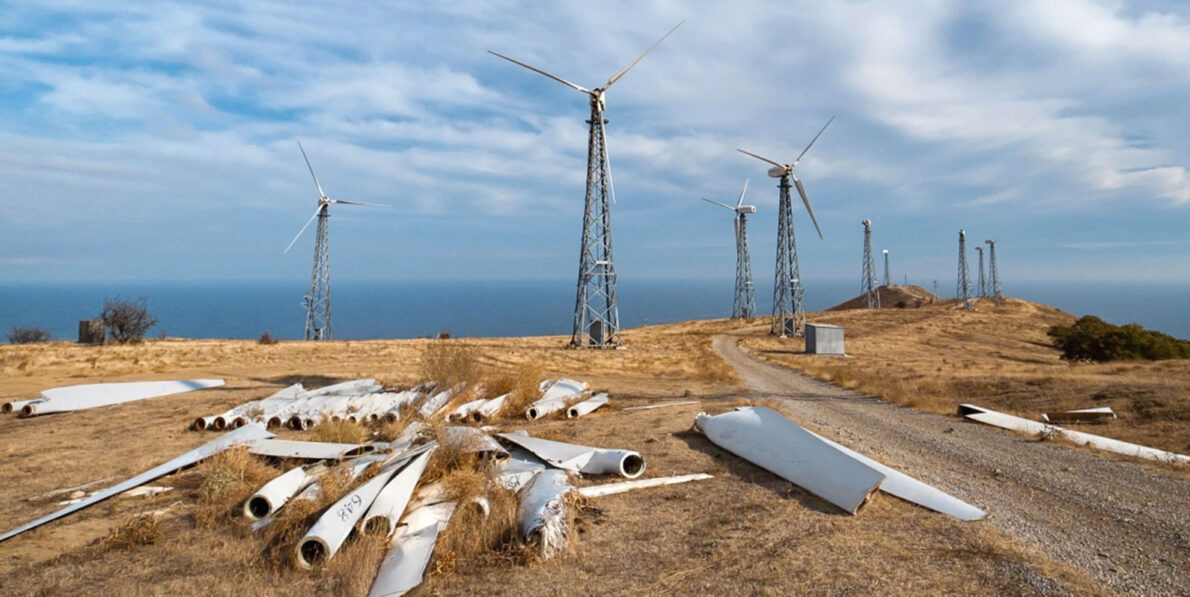
China Faces An Energy Challenge: Recycling Millions Of Turbines And Solar Panels. Discover How The Asian Giant Plans To Solve This Problem And Lead In Renewables
China faces a huge challenge with renewable energy. The challenge is not only about achieving greater deployment of renewable sources or transitioning to a decarbonized economy, which is also important, but also about preparing for the large avalanche of technological waste that this same effort will generate in the coming years. After all, solar panels and wind turbines can be environmental allies when in operation, but once they reach the end of their useful life, they become exactly the opposite: huge and difficult-to-recycle waste. And there are many of both in China.
What Happened Exactly? China’s National Development and Reform Commission (NDRC), along with five other state agencies, has published a series of guidelines with a clear purpose: to accelerate the recycling of wind and photovoltaic equipment that has already reached the end of its useful life. The guidelines were launched during the summer of 2023 without many details being disclosed about what strategy the country will follow, but earlier this year, Beijing was already outlining some standards for recycling retired wind turbines.
The Chinese authorities want to anticipate the “mass dismantling of equipment” that is approaching. And for this purpose, they aim to have a “basically mature” recycling system for both photovoltaic panels and wind turbine installations by the end of the decade.
-
Historic bankruptcy of Centauro shocks the market, and the century-old company puts more than 500,000 products, machines, and complete infrastructure up for online auction.

-
Renewable energy advances over protected areas in Brazil, and a survey by the Energy Transition Observatory reveals silent impacts that challenge environmental conservation and pressure sensitive traditional territories.

-
Rio Grande do Sul accelerates energy transition: State invests in renewable technologies and consolidates decarbonization strategies and pathways to attract billions in new industrial investments.

-
With 160,000 m² of collectors, an area larger than 20 football fields, Silkeborg, in Denmark, hosts a solar thermal plant that heats 19,500 homes and could become the largest solar heating plant in the world.


And How Will This Be Achieved? What the NDRC specialists want is to develop industry standards and rules that detail how to close, dismantle, and recycle renewable installations. In doing so, according to the South China Morning Post (SCMP), a series of parameters and technical guidelines will be provided for the photovoltaic and wind industries to recycle their discarded equipment.
Among their guidelines, it states that manufacturers must design equipment that is easy to dismantle and recycle, and that energy operators will also be responsible for dismantling the equipment once it has completed its function. Waste cannot be buried in landfills. In this effort, the NDRC proposes that manufacturers offer recycling services or partner with companies that do.
But… What Is The Size Of The Challenge? We have some numbers that help us understand. The experts cited by the Chinese authorities in their study predict — according to Reuters — that by 2030 China will need to recycle about 1.5 million metric tons, and the waste load will surge over time to about 20 million tons in a few decades, by 2050.
These are not the only references we have. Estimates from Greenpeace indicate that by 2040 the country will retire installations corresponding to about 250 GW of solar capacity and around 280 GW of wind generation.
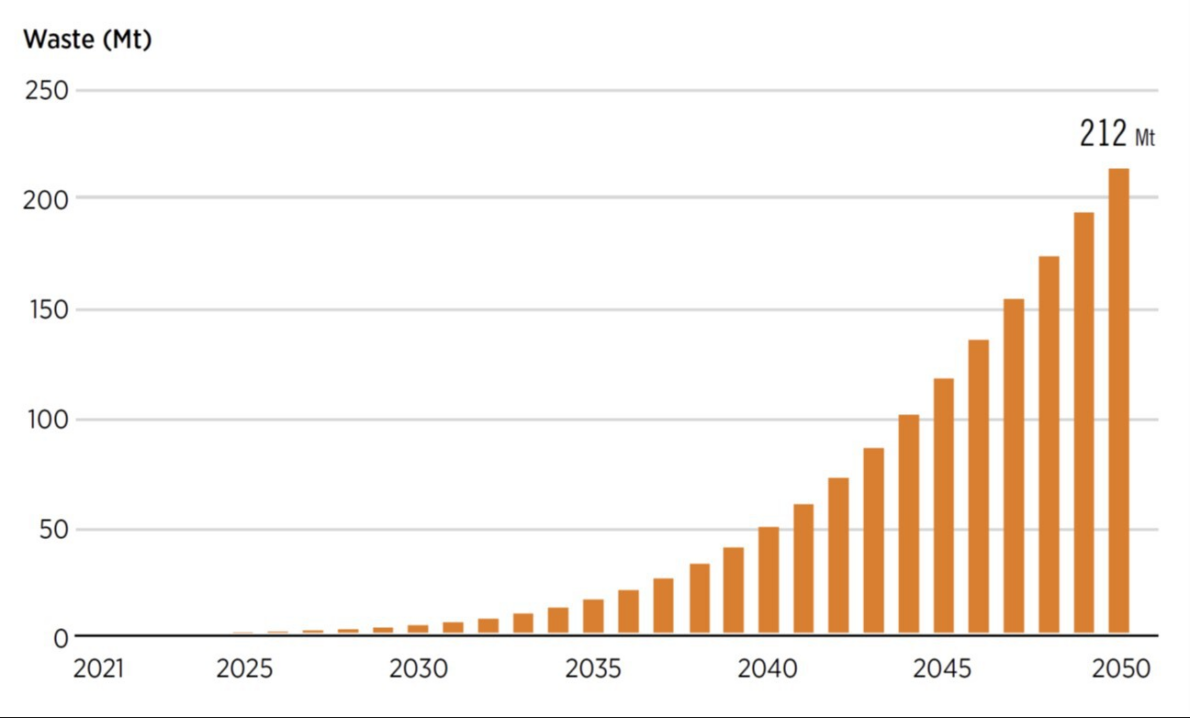
Does This Only Happen In China? No. At the International Renewable Energy Agency (IRENA), they have done the math, and their estimates are striking: “As the photovoltaic market increases, so will the volume of panels retired, and large amounts of annual waste are expected by the beginning of the 2030s.” To be more precise, their specialists expect that the waste from photovoltaic installations accumulated globally will rise from 0.2 Mt in 2021 to 4 Mt in 2030, nearly 50 Mt in 2040, and over 200 Mt in 2050. “G20 member countries will provide the majority of the projected waste,” they conclude.
Do We Have More Data? Yes. WindEurope also warns that there are already wind turbines reaching the end of their useful life and that, although the number of blades retired so far has been low, it is expected to increase in the coming years. “About 25,000 tons of blades are expected to reach the end of their useful life annually by 2025,” they estimate.
Their estimates anticipate a particularly intense load in Germany, Spain, and Denmark. By the end of the decade, it is anticipated that dismantling wind turbines will also begin in other European countries, such as Italy, France, and Portugal, and the annual volume of discarded blades will double to 52,000 tons by 2030.
Why Act In China? Because of the country’s ambition regarding renewables. The Asian giant has set a target to achieve carbon neutrality by 2060 and to reduce its dependency on coal, an ambitious goal for which it is pushing renewable installations.
Just this year, it proposed to install 160 GW of wind and solar energy and wants to have 1,200 GW of large-scale capacity by 2030, an ambition that, according to SCMP, could be achieved five years ahead of schedule. “Wind and solar energy have grown in scale for the first time in China in the early 2000s, and the average lifespan of panels and turbines is around 20 to 25 years,” remembers Li Jiatong, a Greenpeace activist in East Asia, to the Hong Kong newspaper.
Is It A Simple Challenge? China is far from being the first to pay attention to the recycling of wind turbines and blades. The industry itself has been seeking efficient strategies for some time to recycle its blades, turbines, and solar panels, a complex effort for which it has proposed all sorts of strategies: processing generators to extract rare metals, repurposing blades to create bridges and urban furniture, decompounding them, and even recovering some of their compounds for the production of chewing gum. All to prevent retired turbines from becoming a problem instead of remaining environmental allies.










Seja o primeiro a reagir!