





 Portuguese
  English
  Spanish
  5 min of reading
  0 comments


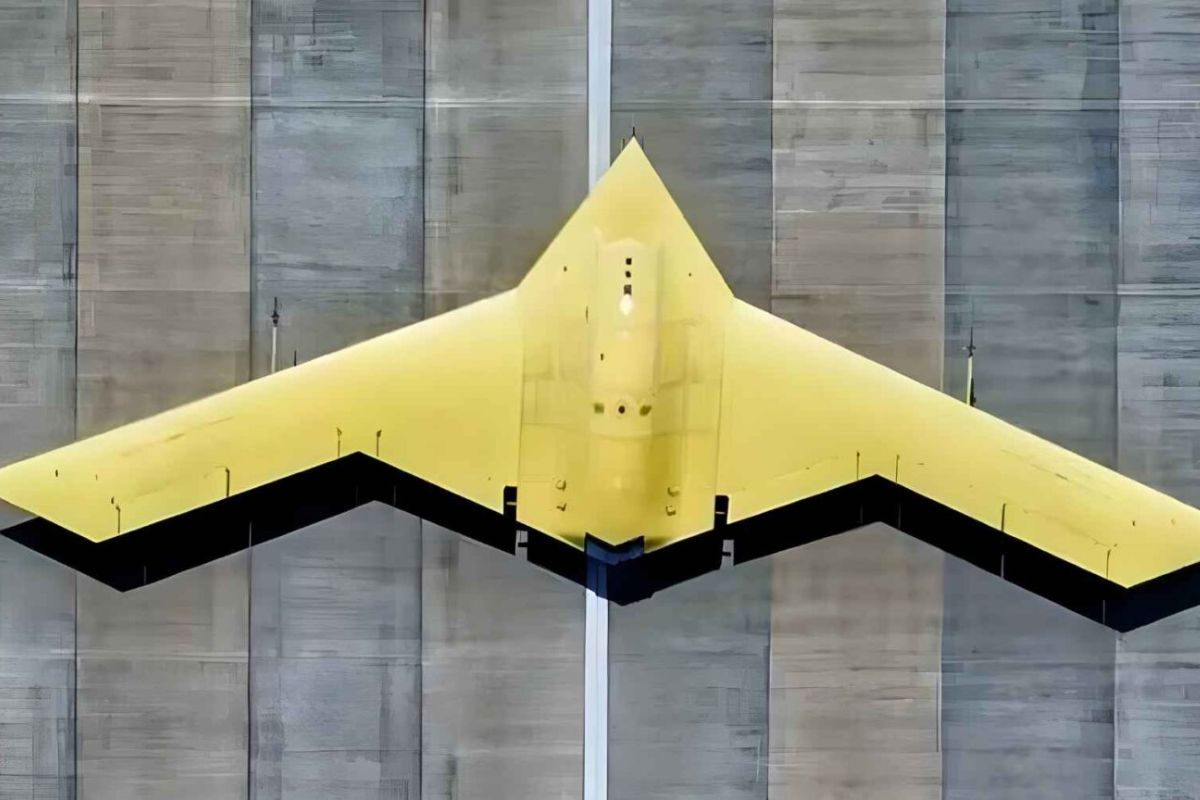
China has completed the first flight of the CH-7, a stealth flying-wing drone capable of reaching 925 km/h, with radar-absorbing coatings and high-tech cameras for long-range reconnaissance over battlefields and strategic maritime areas.
The China has just demonstrated to the world that its capability in advanced military drones has reached a new level. The CH-7, a stealth unmanned aerial vehicle in a flying-wing design, completed its maiden flight at an airfield in the northwest of the country, confirming that the aircraft is capable of taking off, flying, and landing completely autonomously at a maximum speed of about 925 kilometers per hour. The test was conducted by the Chinese Academy of Aerospace Aerodynamics and described by China Daily as a verification of the aircraft’s control, communication, and tracking systems.
What makes the CH-7 particularly relevant in the global military landscape is the combination of speed, stealth, and range. Unlike conventional drones, this stealth drone is designed to operate in areas defended by advanced radar systems, approaching undetected to gather information on land battlefields and maritime zones. China does not hide its ambition: the CH-7 represents a technological leap that places the country on par with ultra-secret Western programs, such as the RQ-180, widely associated with American Northrop Grumman.
What the first flight of China’s stealth drone really proved

The maiden flight of the CH-7 was not a demonstration of acrobatic maneuvers or extreme speed. It was something deliberately basic, according to Chinese authorities. The project leader, Li Jianhua, stated that the test achieved the “desired results”, which, in terms of aerospace engineering, means that the aircraft behaved as the computational models predicted during takeoff, controlled flight, and autonomous landing.
-
Found in Giza 100 years ago, an Egyptian dress made of 7,000 beads belonged to a woman from the time of Khufu and impresses with the details preserved after millennia.

-
With 7.4 trillion tons of artificial snow pumped in 10 years, an extreme operation could stabilize the West Antarctic ice sheet and prevent a sea level rise of more than 3 meters, but it would require snow cannons, ocean water, and energy on an almost industrial scale at the end of the world.

-
The US no longer wants to deal with data centers: the state may prohibit projects of 20 MW that consume as much as 15,000 homes, while AI already requires energy from millions of households and even half a liter of water for 50 questions.

-
Elon Musk’s Starlink should watch out! Amazon is launching its satellite internet service with over 3,000 authorized satellites, betting on the New Glenn rocket and promising faster connectivity integrated with AWS.

This confirmation is especially important for a flying-wing type aircraft. Unlike conventional airplanes with fuselage and tail, flying-wing drones are inherently unstable and rely entirely on onboard computers to stay in the air. A successful first flight proves that the control algorithms work in practice, not just in simulations. From now on, Chinese engineers will gradually expand the “flight envelope,” testing higher speeds, different altitudes, and more complex maneuvers to map the aircraft’s actual operational limits.
How the CH-7 manages to be almost invisible to radars
The stealth concept that China applied to the CH-7 works directly: the radar emits electromagnetic energy and captures the signal that returns reflected. The flying-wing shape of the CH-7 smooths the aircraft’s outline and eliminates the traditional tail, drastically reducing the amount of energy reflected back to the radar. In simple terms, the drone produces such a small signature that it becomes difficult to distinguish from background noise.
But the shape alone is not enough. China equipped the CH-7 with internal structures that absorb radar waves and stealth coatings applied to areas that normally reflect more intensely, such as leading edges of the wings, access panels, and landing gear doors. These surface choices are part of what experts call “low observability”, a set of techniques aimed at allowing the drone to approach defended zones without being detected by enemy air defense systems. The actual effectiveness of this stealth will only be known as tests progress in conditions closer to operational scenarios.
What will China use a drone that monitors entire oceans for
According to the portal ecoticias, the CH-7 was not designed to engage in air combat alongside fighters. Chinese military analysts explain that the drone is not suitable for the “wingman” role, where an unmanned vehicle flies in close formation with combat aircraft, performing sharp turns. The role of the CH-7 is different: long-range strategic reconnaissance, including battlefield surveillance, monitoring vast maritime areas, and detecting large military vessels.
In practice, this means that the drone can fly over areas of the Western Pacific or the South China Sea for extended periods, collecting images with electro-optical and infrared cameras capable of identifying targets in visible light and by thermal signature.
The collected information is transmitted in real-time to command centers. An official description published by the China Aerospace Science and Technology Corporation indicated that future tests will verify the performance of these payloads in “complex conditions,” a term that may include operation at long distances, adverse weather, and environments with electronic interference.
How the CH-7 compares to what the United States already possesses
The most frequent comparison made by analysts is with the RQ-180, an American stealth aircraft of the flying-wing type that the specialized press associates with Northrop Grumman. An investigation by Aviation Week published in 2013 described the RQ-180 as an ultra-secret project that was already advancing to flight tests in the early 2010s, although the United States has never officially confirmed its existence or released specifications. The comparison between the CH-7 and the RQ-180 is inevitable but asymmetrical: almost nothing is public about the American drone; about the Chinese, China openly releases information as a demonstration of capability.
This selective transparency is not accidental. By publishing specifications, images of the prototype, and descriptions of the first flight, China sends a strategic message that goes beyond mere technical demonstration: it shows that it masters stealth technologies, jet propulsion, and autonomous control that until recently were the exclusive domain of a handful of Western countries. For strategic rivals, the message is that the technological gap in advanced military drones is closing rapidly.
What is needed for the CH-7 to enter real operation
The first flight is just the beginning of a process that may take years. Chinese engineers now need to systematically expand testing, verifying how the drone behaves at speeds close to its limit of 925 km/h, at various operational altitudes, and in adverse weather conditions. The published specifications may change as prototypes evolve, as it is common for military drones to undergo significant changes between the first flight and entering service.
Subsequent tests will also need to validate the stealth systems in scenarios that simulate real air defenses. One thing is to reduce the radar signature in controlled laboratory conditions; another is to operate effectively against modern detection systems that combine radar, infrared monitoring, and electronic intelligence.
China has a track record of rapid development in military technology, but the distance between a successful first flight and a reliable operational platform remains considerable. The CH-7 has proven that it flies; now it needs to prove that it works.
China has launched a stealth drone that flies at 925 km/h and is designed to be invisible to radars. Do you think this type of technology changes the global military balance? What will be the United States’ response? Leave your opinion in the comments.








Seja o primeiro a reagir!