





 Portuguese
  English
  Spanish
  3 min of reading
  0 comments


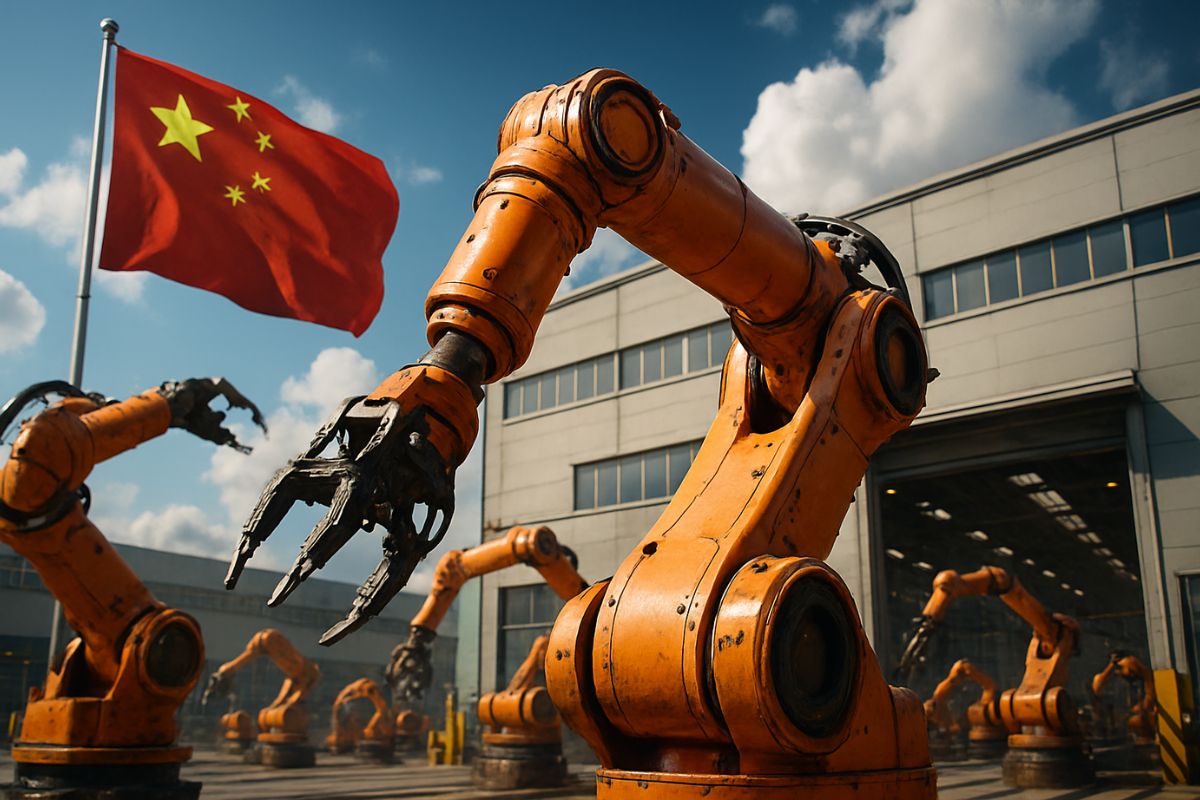
With More Than 2 Million Robots in Factories, China Surpasses United States, Japan, and Europe Together and Consolidates Leadership in Industrial Automation, According to International Report
China has reached a historic milestone by installing nearly 300,000 robots in factories in just one year, bringing the total number of machines in operation in its industrial park to over 2 million. This figure represents more than all other countries combined, reinforcing the country’s central role as a global manufacturing powerhouse.
According to data from the International Federation of Robotics, the accelerated expansion is part of a national strategy that combines subsidies, incentives, and public policies aimed at automation, positioning China prominently against the United States, Japan, and Europe, which have seen declines in new installations.
How China Became a Powerhouse in Industrial Robots
This movement is not recent. Since 2015, with the Made in China 2025 plan, Beijing has prioritized global leadership in strategic sectors, including robotics.
-
Super toxic red mineral found in the double burial of two women aged 1,900 years near the banks of the Dnieper River in Ukraine.

-
No one expected this under a common street: archaeologists find 3 intact oak barrels, buried about 400 years ago, with traces of lime and pieces related to 17th-century construction.

-
After decades of failed attempts, Brazil is once again looking to space with an orbital rocket measuring 12 meters, weighing 12 tons, costing R$ 189 million, and scheduled for launch in 2026, in a new race to finally achieve autonomous access to orbit.

-
The Earth will plunge into a few minutes of darkness in broad daylight in August 2026, when a total solar eclipse transforms the sky into one of the most impressive astronomical phenomena in recent years.


To achieve this, the government has offered low-interest loans, direct support to companies, and encouragement for domestic production.
The results are evident: more than 150,000 robots have been installed annually since 2017, a number that surged to almost 300,000 in 2024.
This growth has not only strengthened local production but also allowed China to manufacture the majority of the robots it installs, reducing dependence on imports.
Today, about three-fifths of the machines are produced domestically, compared to a previous scenario dominated by foreign suppliers.
Impact on Productivity and Employment
The presence of robots in factories has brought significant productivity gains, with greater efficiency in assembly lines for automobiles, electronics, and consumer goods.
The Chinese industrial sector now accounts for nearly one-third of all global manufacturing output, comfortably surpassing the combined totals of the U.S., Japan, Germany, South Korea, and the United Kingdom.
On the other hand, experts warn that automation alters the nature of work.
While it reduces the need for labor in certain functions, it also creates demand for specialists in electronics, programming, and maintenance.
The shortage of these professionals has driven salaries up to US$ 60,000 annually, especially in more industrialized urban areas.
Global Comparison and New Challenges
While China was expanding, countries like Japan, Germany, and the United States reduced their robot installations in 2024.
Japan, for example, installed 44,000 units — less than one-sixth of China’s number.
Currently, the Chinese industrial park has five times more robots than the U.S., revealing an ever-widening disparity.
Still, the Chinese industry faces hurdles.
High-precision sensors and semiconductors continue to be imported, which limits technological autonomy in more sophisticated projects, such as humanoid robots.
Despite this, national companies like Unitree Robotics are beginning to compete globally, offering models at prices much lower than those of Western competitors.
Robots, Artificial Intelligence, and the Future of Manufacturing
In addition to the absolute number of machines, China also excels in the use of artificial intelligence to optimize robot performance.
According to experts, AI systems are already being applied in factories to monitor and adjust processes in real-time, something still underexplored in other countries.
This technological advance indicates that the country not only leads in quantity but also seeks superior quality and efficiency in integrating robotics and AI.
The next challenge will be to consolidate this advantage and transform the industry into a self-sufficient ecosystem, reducing reliance on strategic components from abroad.
The installation of nearly 300,000 robots in factories in a single year shows that China does not intend to forgo global industrial leadership.
With consistent state policies, expansion of local production, and intensive use of artificial intelligence, the country is redefining the future of manufacturing.
In your opinion, should Brazil invest in a national automation program similar to China’s? Do you believe that the massive arrival of robots represents more opportunities or risks for workers? Share your thoughts in the comments.





Seja o primeiro a reagir!