





 Portuguese
  English
  Spanish
  3 min of reading
  0 comments


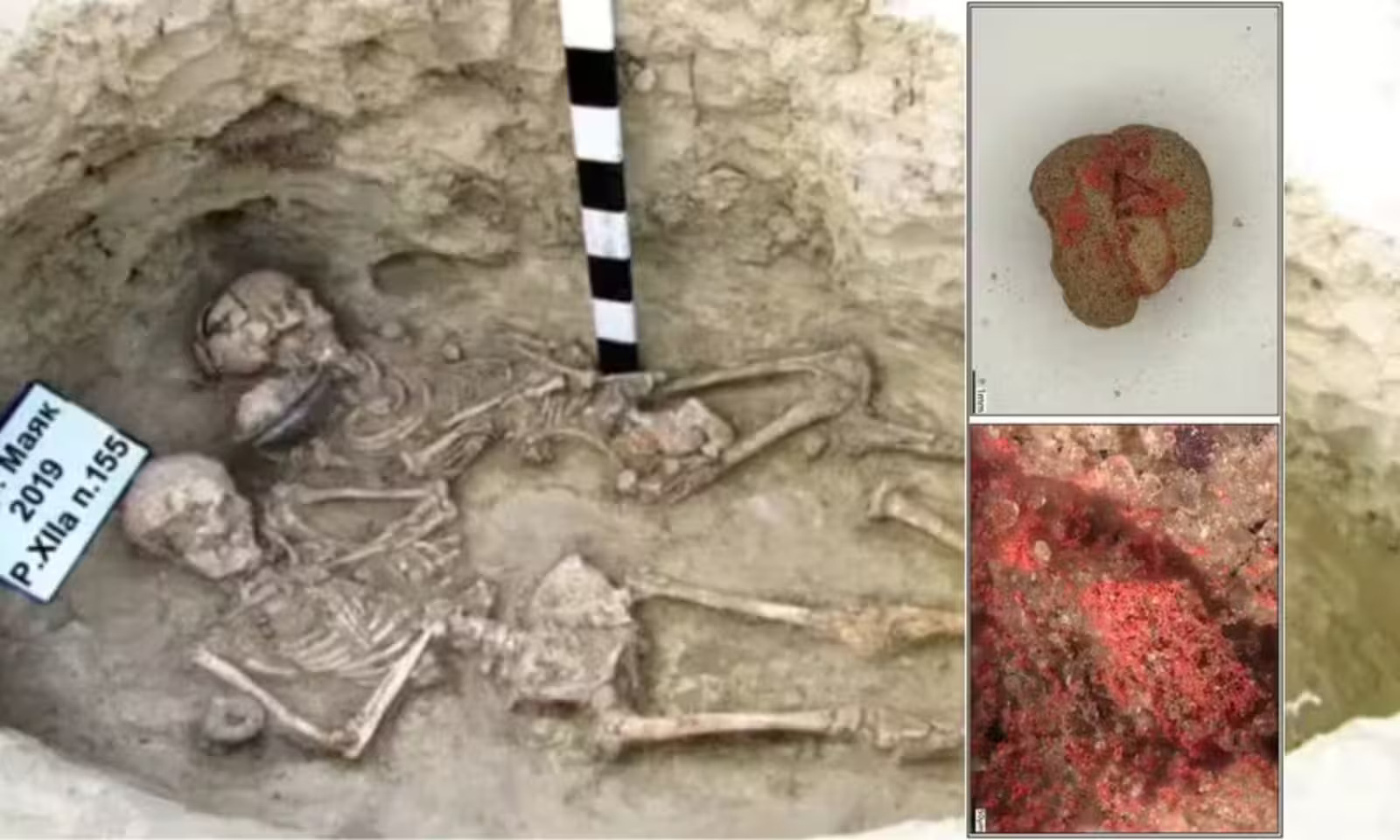
Study published in Antiquity reports the discovery of red cinnabar in a Scythian burial dating back 1,900 years in Ukraine, linked to two female burials
Fragments of cinnabar, a toxic red mineral, were found in a Scythian burial dating back 1,900 years on the banks of the Dnieper River in Chervony Mayak, Ukraine, in a study published on March 12 in the journal Antiquity.
Find in Scythian burial
Researchers from Poland and Ukraine reported the discovery of red pieces of cinnabar in a burial dated to 1,900 years ago.
The material was identified in a burial that housed what appear to be two women of Scythian origin, a nomadic people who inhabited ancient Eurasia.
-
A torpedo-sized submarine robot was launched through a 600-meter hole in the “doomsday glacier” and revealed cracks melting up to 10 times faster; Icefin showed from the inside how warm water threatens Thwaites, an ice mass capable of raising sea levels by almost 70 cm.

-
The iPod is back in full force: young people are reviving Apple’s old device to escape digital distractions and control their own soundtrack.

-
For the first time in history, a submarine cable will descend to four thousand meters deep under the ice of the North Pole to ensure that the internet between Europe and Asia no longer depends on conflict zones in the Middle East.
-
A British company has installed in the middle of the ocean the world’s first floating platform that generates electricity 24 hours a day from the temperature difference between the surface and the depths of the Atlantic, without relying on wind or sun.




Who were the buried women
According to the authors, the two women were buried at different times in the Scythian cemetery located on the banks of the Dnieper River.
One of them was estimated to be between 35 and 45 years old at the time of death. The other was identified as being between 18 and 20 years old when she died.
The researchers state that Chervony Mayak, discovered in 1970, is the first late Scythian archaeological site where cinnabar nodules have been identified.
Possible function of the pigment
In the study, the authors point out that the mineral may have been used to slow the deterioration of the bodies, although the exact function of the pigment is not clarified.
Cosmetic use has also not been ruled out. Dzneladze stated that ochre and other mineral dyes were found in female burials from the late Scythian period, stored in pyxides, coffins, and shells used to dilute cosmetics.
She mentioned that these materials may be attributed to the set of female funerary objects.
Funeral customs and reopening of crypts
The Scythians lived between 800 BC and 300 AD, circulating through the steppe areas of Central Asia that today correspond to territories of Russia, Ukraine, and Kazakhstan.
A common custom among the Scythians and other civilizations was to reopen graves to perform new burials. Olena Dzneladze stated that a crypt could function for up to 50 consecutive years.
She declared that excavations have proven that crypts from the late Scythian period were opened and received secondary and tertiary burials.
Risks of the cinnabar mineral
As the main form of mercury extraction, cinnabar poses a risk of poisoning, especially when heated and with toxic gases inhaled.
Cases of mercury poisoning can cause gastrointestinal, renal symptoms, and even death. Researchers said that prehistoric groups in Ukraine may not have been aware of these dangers.
In Chervony Mayak, three of the 177 graves with identified pigment were of women. The presence of the material remains a mystery.
With information from Galileu Magazine.







Be the first to react!