





 Portuguese
  English
  Spanish
  6 min of reading
  0 comments


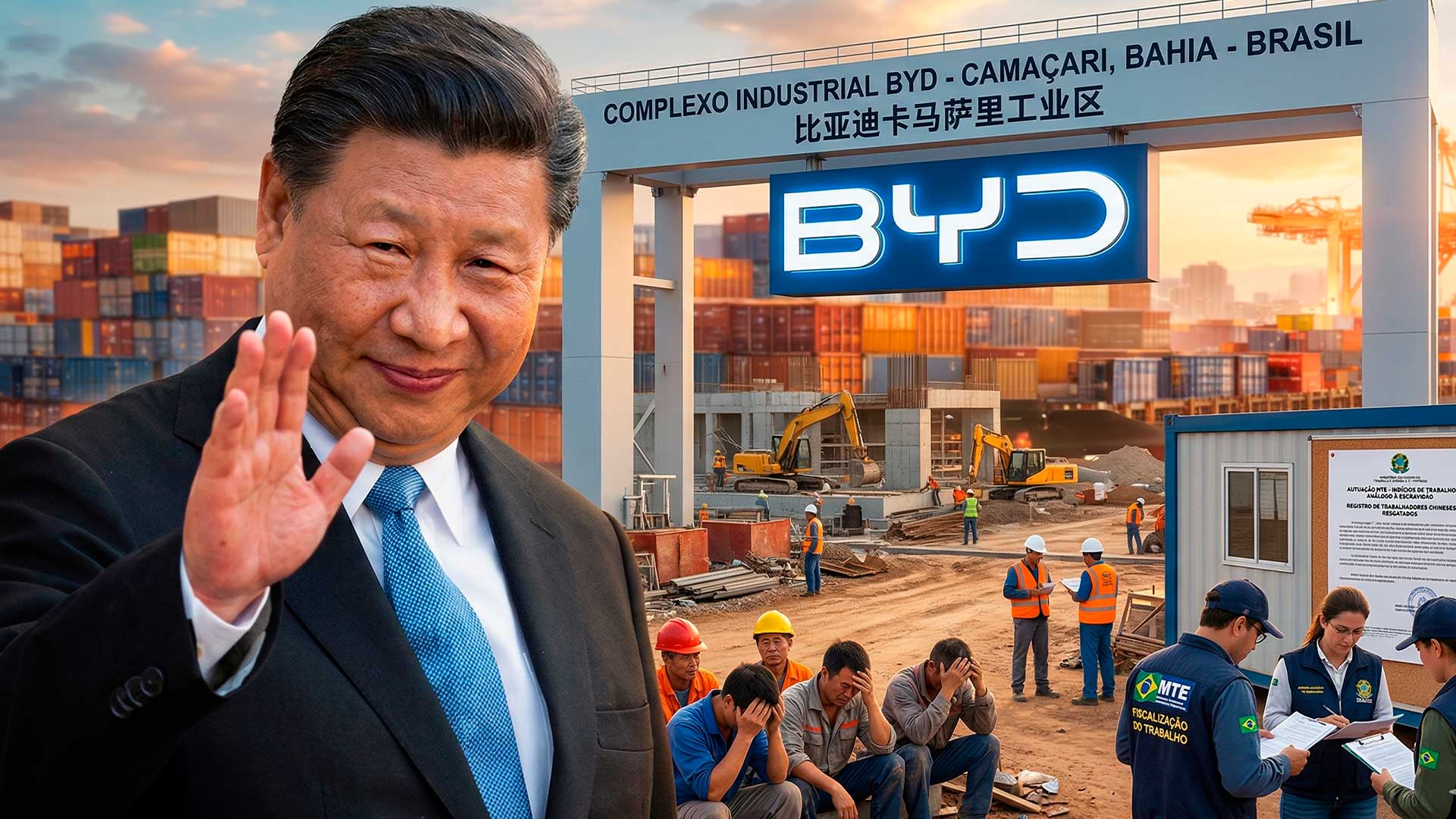
Federal government update included 169 new employers, raised the total to about 613 names and put BYD at the center of a new international wear and tear.
The entry of BYD into the so-called dirty list of slave labor provoked an immediate reaction from the Chinese government and reignited the discussion about the conditions found at the automaker’s factory construction site in Camaçari, in the Metropolitan Region of Salvador. The Chinese manifestation came on April 7, 2026, a day after the update of the public register of employers held accountable for subjecting workers to conditions analogous to slavery.
Through the Ministry of Foreign Affairs, China stated that it sees the protection of workers’ rights and interests as very important and reinforced that Chinese companies must operate in accordance with laws and regulations. The response attempts to contain the political and institutional impact of a case that gained significant repercussions in Brazil.
In the new update, the federal government added 169 new employers, an increase of 6.28% compared to the previous list. Of this total, 102 are individuals and 67 are companies, bringing the register to about 613 names.
-
Brazilian product exports to the U.S. plummet, accumulating 8 consecutive declines after Trump’s tariff hike, resulting in a deficit of $420 million, while China buys more and becomes the great savior of the Brazilian trade balance.

-
Boa Safra (SOJA3) targets Nigeria: $10 million JV brings corn technology to Africa and challenges expensive credit in 2026.
-
Russia and China already conduct 99% of their trade with each other without using the dollar, and BRICS is creating a digital tool on blockchain so that other countries in the bloc can do the same soon.

-
IBGE’s revision redraws the map of Santa Catarina and changes the borders of 18 municipalities, with Penha gaining a piece of Balneário Piçarras the size of an entire neighborhood without anyone noticing.

Among those included, two cases drew more national attention, that of BYD and that of singer Amado Batista. The list is published by the Ministry of Labor twice a year, in April and October, and carries significant weight because it affects reputation, business relationships, and access to credit in various sectors.
How the dirty list of slave labor works and why inclusion only occurs after a final decision without the possibility of appeal
The dirty list is a public document created in 2004 to provide transparency to actions against labor analogous to slavery. An employer’s name only enters the register after the conclusion of the administrative process, with a final decision and without the possibility of appeal.
As a rule, the duration on the register is two years. To be removed from the list, the employer must have no new cases and regularize the labor situation pointed out in the inspection.
The most recent update also removed 225 employers who fulfilled this two-year period. The cases now included occurred between 2020 and 2025, in 21 federative units, showing that the problem continues to spread across the country.
An important change came with an ordinance published in July 2024, which opened the possibility for early removal or even non-inclusion in certain situations. This applies to employers who sign a conduct adjustment agreement, compensate victims with at least 20 minimum wages, and invest in support programs for rescued workers.
In these cases, the name can migrate to the Register of Employers in Conduct Adjustment. Still, a return to the dirty list can occur if there is non-compliance with the obligations assumed or recidivism.
The BYD case, 220 Chinese workers rescued and serious allegations in the construction of the factory in Camaçari
The inclusion of BYD in the register is linked to the rescue of 220 Chinese workers in December 2024, during the construction of the company’s factory in Camaçari, Bahia. Investigations indicated a scenario of severe precariousness and restriction of freedom.
The workers were found in overcrowded accommodations, without adequate comfort and hygiene conditions. There was also surveillance by armed guards, who prevented leaving the site, in addition to passport retention.
The irregularities also included illegal contractual clauses, with exhausting working hours and absence of weekly rest. One of the workers interviewed by the Labor Public Ministry of Bahia, MPT-BA, related an accident with a saw to the fatigue caused by the lack of breaks.
Another serious point raised in the investigation was the migratory situation of the employees. MPT-BA identified that all had entered Brazil with visas for specialized services that did not correspond to the activities actually performed at the site.
At the time, BYD attributed the irregularities to the outsourced construction company Jinjiang Construction Brazil Ltda and reported the termination of the contract with the company. The automaker also stated that it does not tolerate disrespect for Brazilian legislation or human dignity and ordered the transfer of some workers to hotels in the region.
Agreement of R$ 40 million with MPT-BA increased the severity of the case and consolidated the wear and tear of the automaker in Brazil
At the end of 2025, the case advanced to an agreement of significant financial and institutional impact. The MPT-BA entered into a commitment of R$ 40 million with BYD and two contractors, after filing a public civil action for labor analogous to slavery and human trafficking.
After the agreement, the company stated it maintains a non-negotiable commitment to human rights and informed that it would manifest in the case’s records. Regarding the entry into the dirty list, there was no return of the automaker until the last update of the case.
The inclusion in the register shows that the administrative process has reached a definitive stage, which increases the weight of the measure. For a brand that competes for space in the electric cars market and tries to strengthen its industrial operation in Brazil, the damage to its image is evident.
Amado Batista also enters the list after autuations in Goianápolis and contests the rescue of 14 workers
The singer Amado Batista appeared in the update due to two autuations recorded in Goianápolis, in the Metropolitan Region of Goiânia, Goiás. One of them involves Sítio Esperança, with 10 workers, and the other cites Sítio Recanto da Mata, with four workers. The cases occurred in 2024.
The artist’s advisory contested the inclusion and classified the information about the rescue of 14 workers on properties linked to him as false. The defense stated that there was no rescue and that all employees continue to work normally.
The statement also informed that, in 2024, there was an inspection on a farm leased for corn planting. At that time, irregularities were found in the hiring of four workers linked to a third-party company responsible for opening the planting area.
The advisory added that a Conduct Adjustment Agreement, TAC was signed with the Labor Public Ministry, and that labor obligations had been fully complied with and settled. It also stated that, at Sítio Esperança, there was no rescue, only indications of improvements in housing and living areas, which have already been completed.
Map of new cases shows concentration in Minas Gerais and São Paulo and reveals sectors where exploitation is still advancing
The new records included in the register resulted in the rescue of 2,247 workers in situations of exploitation. The economic activities with the highest number of added employers were domestic services, with 23 cases, beef cattle raising, with 18, coffee cultivation, with 12, and building construction, with 10.
Also highlighted is the land preparation, cultivation, and harvesting service, with 6 employers. The picture shows that the problem affects both rural areas and urban activities, including within sophisticated production chains.
Among the states, Minas Gerais leads with 35 employers, followed by São Paulo, with 20. Next are Bahia and Paraíba, both with 17, and Pernambuco, with 13.
The list of states with the most records is completed by Goiás and Mato Grosso do Sul, with 10 each, Rio Grande do Sul, with 9, Mato Grosso, with 7, and Paraná, with 6. There were also cases in Santa Catarina, Maranhão, Federal District, Espírito Santo, Rio de Janeiro, Amazonas, Rondônia, and Sergipe.
The fight against this type of crime has a long history in the country. The Special Mobile Inspection Group, GEFM, completed 30 years in 2025 and, since its creation in 1995, has helped rescue more than 68,000 workers, with over R$ 160 million secured in salary and severance payments.
The entry of BYD and Amado Batista into the dirty list is expected to continue generating debate, including about the accountability of contractors and subcontractors. Do you think the current register is sufficient to punish those who exploit workers or are the rules still too lenient? Leave your comment and join the discussion.








Seja o primeiro a reagir!