





 Portuguese
  English
  Spanish
  5 min of reading
  0 comments


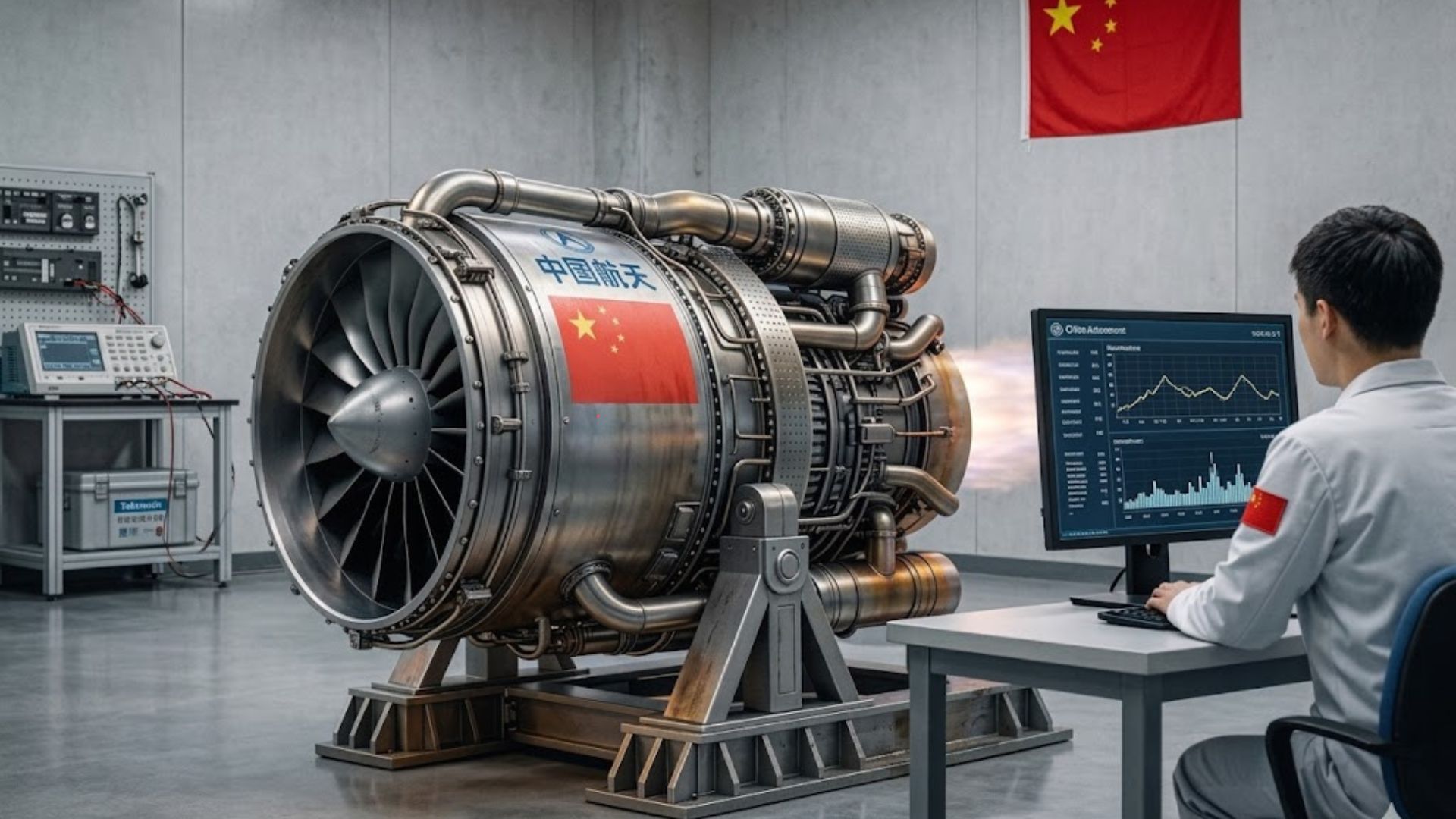
Chinese experimental technology seeks to unify propulsion from ground to hypersonic, eliminating multiple engines and reducing structural weight in high-speed aircraft and missiles, after decades of research focused on stability, energy efficiency, and new methods of air compression in extreme flight.
China has announced the completion of a hypersonic engine prototype designed to operate from takeoff on the ground to speeds exceeding Mach 6, in an attempt to eliminate the need to switch propulsion systems during flight.
According to information released in March 2026 by the South China Morning Post, based on data attributed to the research team, the project is led by scientists affiliated with the Chinese Academy of Sciences and headed by Xu Jianzhong.
The central goal is to tackle one of the most challenging barriers in high-speed aviation: maintaining stable thrust throughout the operational range, from takeoff to hypersonic regime, without relying on the transition between distinct engines during the mission.
-
Avatar was right: scientists from the European Space Agency have proven that a laser beam can move objects in space without using a drop of fuel, and the discovery paves the way for ships that never need to refuel, satellites that never become junk, and interstellar travel that previously existed only in science fiction.

-
A student spent years dragging friends to see a solitary 1.8-meter stone in a forest in England until archaeologists decided to investigate and discovered a 3,700-year-old ritual site hidden beneath the ground, featuring five fallen stones, a ceremonial platform, and a spring that fed Bronze Age rituals.

-
With 80 kilometers in length and 152 meters in height, a gigantic underwater barrier could become the last resort of engineering to contain the Judgment Day Glacier and buy time against the rising oceans on the planet.

-
Why is Mercury so strange? The smallest planet in the Solar System has more iron than the others and days longer than years.

Hypersonic engine without system switching during flight
This challenge has limited the design of experimental aircraft, missiles, and reusable platforms for decades.
At lower speeds, conventional turbines can operate efficiently, but at higher regimes, propulsion often requires a different arrangement, with very different aerodynamic and thermal demands.
What changes in the presented concept
The researchers describe the system as a counter-rotary ramjet engine, a term used to identify an air-breathing engine designed to continuously cover the range currently split between turbines and ramjets in combined architectures.
In the most common configuration, a turbine engine is responsible for takeoff and the initial phases of flight, up to around Mach 3.
Above that, solutions like the ramjet come into play, which depend on prior speed to compress the incoming air.
This combination allows for high performance but comes at a cost in mass, integration, and control.
When one of the systems is inactive, it remains onboard, taking up space and adding weight, while the change in regime can impose instabilities at critical moments.
It is precisely at this point that the Chinese proposal seeks to differentiate itself.
Instead of dividing functions between two independent sets, the project aims to concentrate operation in a single architecture, with a counter-rotating compressor and utilizing shock waves as part of the flow compression.
Counter-rotating compressor and shock waves
According to the description attributed to the team, the heart of the engine is a compressor made up of two sets of blades rotating in opposite directions, one associated with high pressure and the other with low pressure.
This arrangement tends to reduce the absolute rotational speed of specific components, which, according to the researchers, decreases centrifugal forces on disks and blades.
At the same time, the counter rotation preserves sufficient relative speed to maintain efficiency in the air compression process.
Another highlighted point is the deliberate use of shock waves.
In conventional high-speed designs, part of the effort often focuses on controlling or reducing these effects.
In this case, the proposal seeks to transform them into a useful resource for compressing the flow.
If this approach works as described outside the experimental environment, it could allow for a more compact and lightweight set.
For hypersonic applications, any weight reduction is strategic, as it influences available fuel, payload, operational range, and maneuverability.
Three decades of research until the prototype
The path to this announcement has been presented as a long-term effort.
According to the report published by the South China Morning Post, Xu Jianzhong began focusing on hypersonic propulsion in the mid-1990s and had already outlined the concept around 2000.
The project reportedly received institutional support in 2009, a phase in which experimental platforms specifically developed for this type of engine began to be structured.
From there, the group concentrated efforts on engineering bottlenecks, especially in the design of the blade sets.
According to the released material, nearly a decade was consumed in trying to resolve these issues before the stage described as experimental verification of the prototype.
This formulation is relevant because it indicates technical advancement, but it does not equate, by itself, to operational validation in flight.
So far, there is no secure public confirmation of successful flight tests with this architecture.
The reported stage is that of a prototype verified in an experimental environment, which keeps the project in a preliminary phase from the perspective of military or aviation application.
Potential impact on hypersonic missiles and aircraft
If the architecture is converted into a functional system outside the laboratory, the potential impact falls directly on the design of hypersonic missiles and high-speed aircraft.
A lighter and integrated engine could free up internal volume for other platform priorities.
In missiles, this could mean more fuel, greater payload, or better range, depending on the design trade-off chosen.
In reusable aircraft, a single propulsion system would reduce integration complexity and, in theory, simplify the management of flight transitions.
There is also an evident strategic interest.
Hypersonic technologies are treated by major powers as high-value military and industrial assets, both for their offensive potential and for the difficulty of interception and the possibility of reducing travel times in critical missions.
Nevertheless, the announcement needs to be read with caution.
Between a laboratory prototype and an engine capable of operating on real platforms lies a considerable distance, involving materials, thermal control, reliability, maintenance, structural integration, and repeatability under external conditions.
Flight tests are the next challenge
The researchers themselves point out that the next step will be to adapt the engine to real aircraft and missiles and subject it to flight tests.
It is at this stage that promising concepts often face the toughest limits of vibration, temperature, consumption, and stability.
It will also be at this point that the proposal will need to demonstrate whether it can maintain performance throughout the entire promised range, from takeoff to flight above Mach 6, without loss of control or the need for auxiliary arrangements that negate the initial advantage.
For now, what exists publicly is an announcement of experimental verification of a prototype that aims to replace multiple systems with a single solution.
The leap between this stage and a concrete application still depends on additional evidence and validation in real operation.







Seja o primeiro a reagir!