





 Portuguese
  English
  Spanish
  3 min of reading
  0 comments


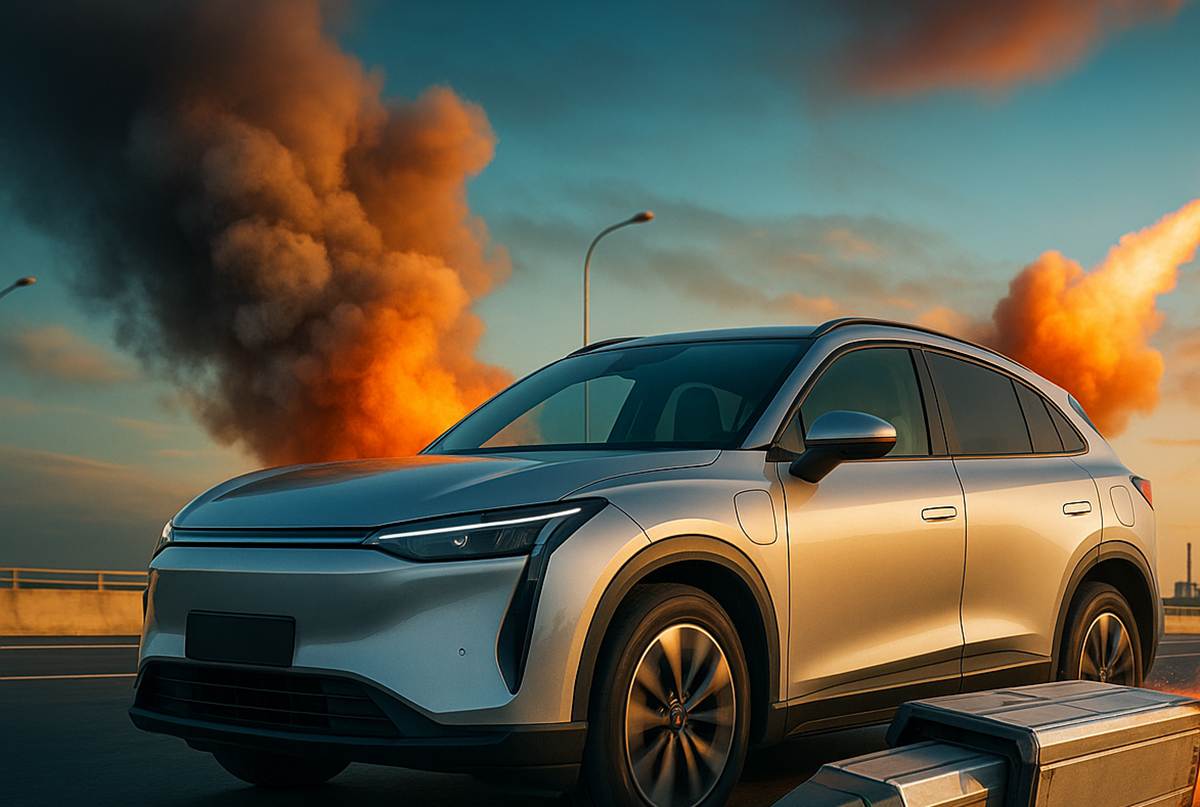
Innovative System Launched In China Promises To Prevent Explosions In Electric Vehicles By Ejecting Batteries In Seconds, But Experts Warn Of Unexpected Risks.
Fires in electric vehicles remain one of the biggest challenges in the automotive industry. When a battery ignites, the fire is extremely difficult to control and can even reignite hours after apparently being extinguished. To tackle this risk, manufacturers and research centers worldwide are seeking safer solutions.
In China, however, an unusual approach has grabbed attention: instead of reinforcing protection, engineers have created a system that simply ejects the battery out of the car in emergency situations.
The Idea Behind The Battery Launch
The prototype works similarly to an airbag. When sensors detect overheating, the mechanism triggers ejection in less than a second. The battery is launched three to six meters away from the vehicle, reducing the risk of explosion inside the cabin.
-
They seemed like common bones, but scientists were surprised to find a relic over 12,000 years old that dates back to before the Bronze Age.

-
With an almost perfect ring of 70 km visible from space, known as the “Eye of Quebec” and over 100 km in length, the Manicouagan Crater in Canada reveals the colossal mark left by a giant asteroid and has become one of the most impressive formations ever identified on the Earth’s surface.

-
Scientists have found in China dinosaur embryos dating back 190 million years in various stages of development, and the discovery still preserves traces of extremely rare proteins in the bones, something that could change what is known about life before hatching.

-
The CEO of Honor in Spain says that smartphones will change with AI, foldables, and even robot phones; the component crisis is making cheap models more expensive in 2026 and shifting the focus to premium.

The demonstration went viral on Chinese social media. In the video, a heavy battery shoots out from the side of an SUV and lands in a test area lined with pillows. Quickly, smoke begins to rise, and safety teams rush in to contain the fire with fire blankets.
Proponents of the project believe that moving the battery away from occupants could be the most effective way to save lives in severe accidents.
Criticism And Risks Highlighted
Despite its boldness, critics see more risks than solutions. The biggest concern is the unpredictable trajectory of the battery in real traffic. A component weighing hundreds of kilograms could cross lanes, hit pedestrians, or collide with other vehicles, turning into an even more dangerous projectile than the initial fire.
Another point raised is the feasibility in severe collisions. In many cases, the car’s body becomes deformed, hindering ejection. Thus, the damaged battery would remain attached to the vehicle, keeping the danger inside the cabin.
There are also those who criticize the cost. Complex ejection systems could make vehicles more expensive without guaranteeing concrete benefits for most scenarios.
Who Is Behind The Technology?
According to released information, the test was organized by the China Automotive Collision Repair Technology Research Center. At the back of the presentation, the event title was visible: “Battery Launch Technology Demonstration and Exchange Meeting”, held on September 19, 2025.
The SUV used resembled the iCar 03T model, but the manufacturer quickly rushed to deny any involvement. In an official statement, the brand owned by Chery stated: “This has nothing to do with the iCAR, please be rational”.
Reports also mentioned the participation of Joyson Group, but the company similarly rejected any connection to the project.
Public Reaction And Conclusion
Reactions on social media were intense. Users described the proposal as “unbelievable” and even as “the most dangerous safety system ever designed.” Others mocked the idea of turning a battery into a missile as a protection strategy.
Experts emphasize that while the risks of battery fires are real, the solution should lie in new materials, more resilient systems, and advanced fire suppression technologies, not in launching heavy components into the street.
In the end, the Chinese experiment became more of a controversy than an innovation. However, the discussion reinforces the urgency for reliable solutions to ensure the safety of electric vehicles, a primary focus of the current automotive industry.





Seja o primeiro a reagir!