





 Portuguese
  English
  Spanish
  8 min of reading
  0 comments


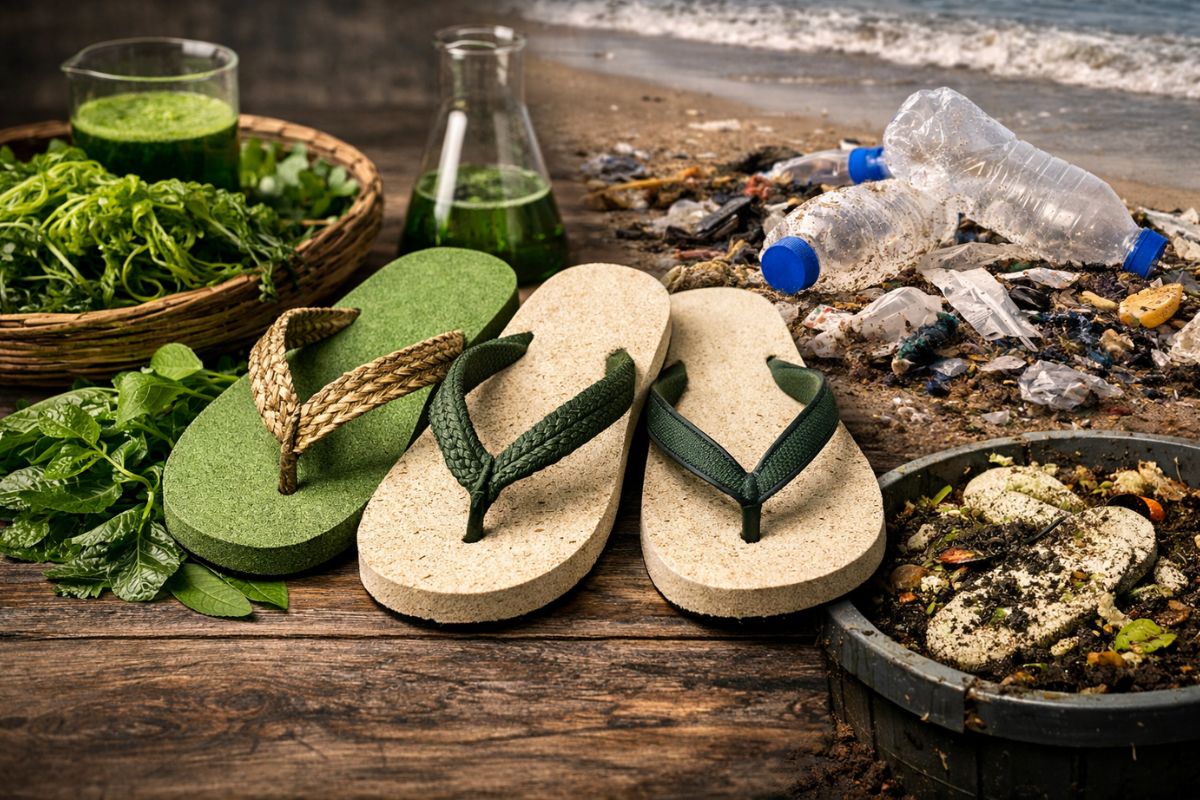
In Steve Mayfield’s Lab, Algae and Vegetable Oils Turn Into Flexible and Rigid Foam in a Machine, Molded and Cured in 10 Minutes. The Promise Is to Reduce Sandal Waste, Breaking Down in 3 to 6 Months in Compost and in About a Year in the Sea, Without Leaving Centuries Behind.
Few people realize that there is a type of waste that is constantly present on beaches and in the ocean, but that rarely becomes the “main villain” in public debate: flip-flops. They are the most popular footwear in the world, found everywhere, and precisely because of that, they appear in mass when one looks closely at what washes up on the sand.
At the same time, a group of researchers led by Steve Mayfield, a scientist who has studied algae for 35 years, bets on an idea that seems simple and, therefore, provocative: to replace traditional plastic foam with a foam made from biopolymers, using algal oil and other vegetable oils. The ambition is to bring to market a sandal that meets basic daily needs and, if it turns into waste, does not last for decades.
The Waste of Flip-Flops That the World Underestimates

Flip-flops and sandals are practical, cheap, easy to find, and part of many people’s daily routine, especially in warm, coastal regions or where there is a strong culture of wearing open shoes. This ubiquity has a direct side effect: when an item is bought by the millions, a minimal fraction wrongly discarded becomes an enormous volume of waste scattered across streets, rivers, beaches, and coastal areas.
-
Brazil has quietly developed an electric tactical drone that takes off and lands vertically without needing a runway, flies at 140 km/h in a fully autonomous manner, and can operate in forests, conflict zones, and remote areas.

-
Novo drone Guardian debuts in the United States with an 8-mile range, robotic battery swapping, and Starlink connectivity for continuous response.

-
100 kW megalasers are already pointing to a new industrial phase, with enough power to cut thick steel, drill through rocks, accelerate mining, and increase productivity in operations previously considered too difficult.
-
Thousands of people in poor countries are paid cents to film household tasks, label images, and operate systems remotely all day long, and this invisible work fuels a $17 billion market that trains the artificial intelligences of Google, Tesla, and Meta.

The critical point is the material. Many of these sandals are made from plastic foam, a type of lightweight, resilient structure that withstands impact, moisture, and repeated use. However, this same durability becomes a problem when the product escapes proper disposal: natural decomposition can take decades or even centuries, and what was “just a lost flip-flop” becomes part of a persistent stock of waste in the environment.
An example of how this materializes occurred in a place surrounded by water: Aldabra Atoll, off the east coast of Africa. In a year of collection, researchers gathered 25 tons of waste in the area and noted that almost a quarter of the total was composed of flip-flops. This type of data changes the mental scale of the problem: it’s not a “curious” waste; it’s a significant piece of the waste found.
How Algae Became Foam for Flip-Flops

The proposal from Mayfield’s lab begins with the choice of the “ingredient” that feeds the chemistry of the material: algae. These organisms are known as the most efficient photosynthetic organisms on the planet, in addition to being easy to cultivate and harvest. An important detail, for the logic of production, is that they can be grown in artificial ponds and would require less land than plants intended for vegetable oils.
The path to the sandal does not require “futuristic machinery.” The researchers use existing industrial machinery typically found in the footwear industry. In it, compounds created from algal oil (and, in current practice, also from vegetable oils) are added. The mixture is poured into molds, heated, and the foam expands and takes the necessary shape. The cure time is about 10 minutes, which reinforces the intention to keep the process “compatible” with the commercial world and not stuck in an academic bench.

The final sandal is assembled with a flexible foam insole, a more rigid foam sole, and a cotton strap. The assembly, as described by the lab, is also straightforward: the strap is passed through, glued, fitted, and the product is ready. The simplicity here is strategic: if the solution requires reconfiguring the entire industry, it tends to become expensive, slow, and difficult to scale, and this, in turn, also influences the amount of waste that continues to be generated.
Biopolymers, Biodegradation, and What Changes in the Ocean

The central argument of the project is not just to be “plant-based.” It is, above all, to be biodegradable from start to finish. The team claims that the sandal is 100% biodegradable, with a decomposition rate much faster than that of a common plastic flip-flop: three to six months in a compost pile and about a year if it ends up in the ocean.

This matters for a practical reason: the marine environment is a frequent destination for waste that exits rivers, canals, and coastal cities. When a material is designed to last, what reaches the sea tends to persist, circulating through currents, washing up on beaches, fragmenting, and spreading. On the other hand, a material with faster biodegradation reduces the “environmental lifespan” of that waste, and therefore the time it can accumulate and cause indirect effects.
There is also reasoning about the origin of raw materials. The lab argues that by replacing traditional plastic sandals with versions made from algae, the demand for fossil fuels is reduced. They make a provocative distinction: oil “in itself” is biodegradable, but it ceases to be when it undergoes refining and chemical transformation to become non-biodegradable plastic. Replacing oil extracted from the ground with “grown oil” in ponds shifts part of the problem to a renewable production cycle, although this does not eliminate all the impacts of the system as a whole.
The Economic Challenge: From Expensive Biofuel to Higher-Value Product

For years, researchers around the world have tried to make algae a cheap source of low-emission biofuel. Over the past 15 years, private investors and the U.S. government have invested billions of dollars in this line of research. Nevertheless, the narrative is that no one has managed to make algae biofuel cheaper than fossil fuels, and the sector lives in a recurring sense of “we will always be five years” from economic viability.
The shift in focus to biopolymers emerges as a market choice, not as a scientific surrender. Instead of competing on price with fuel (a product of high volume and tight margins), biopolymers can be sold at a higher value.
The lab itself presents the difference directly: biopolymers can be about 10 times more expensive than fuels, which paradoxically favors viability, as the market accepts paying more for materials with specific performance and environmental appeal.
The logic, then, is to tackle a huge problem with a more realistic entry point: plastic waste in the ocean. Recent research indicates that plastic pollution is everywhere, even at extreme depths.
And, if current trends continue, the amount of plastic entering the environment each year will almost triple over the next two decades. In this scenario, decreasing any relevant flow of persistent waste such as sandals becomes a strategy for damage reduction, even if it is not a unique solution.
Scale, Supply Chain, and the “Algae Versus Plant” Dilemma
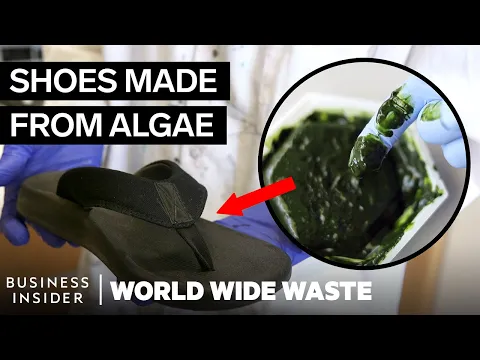

Transforming biodegradable foam into a mass product depends less on the lab and more on “chain”: supply, industrial capacity, distribution, and final price. Mayfield created a startup called Algenesis Materials to tackle this journey. The vision is clear: a great idea that remains in the lab does not change the world; products do.
And the ambition is to produce a shoe that is so sustainable and appealing that it pressures other companies to reinvent themselves.
The plan, according to him, involves working with a major shoe retailer to initiate commercial production in Mexico. There have been delays due to the pandemic, and production continues to advance more slowly than desired.
The mentioned expectation was to have the sandals available “at some point next summer,” a phrase that, in practice, reveals how much the schedule depends on factory, logistics, and negotiation obstacles, as well as material performance.
And there is a bottleneck that seems counterintuitive: the lack of sufficient algae to sustain the supply chain. Therefore, at the moment, the company mainly manufactures flip-flops from plants, not just algae: they extract as much as possible from the algae and complete the rest with vegetable oils.
The hope is that as the market grows, more algae producers will emerge, and supply will meet demand.
This point is where technical disagreement surfaces. Researcher John Benemann points out that algae cultivation would need to increase drastically to support mass production of items like shoes: it would require something like 100 times more.
He raises the idea that, for this reason, it may be more practical and profitable to manufacture biodegradable shoes from widely available crops, such as soybeans.
Mayfield counters with an environmental and resource use criterion: algae would be better because they require less land and water than plants. And to reduce conflicts with food, Algenesis says it opts for non-edible plant oils, avoiding soy and canola as they are food oils.
Ultimately, the “algae versus plant” dilemma becomes a scaling puzzle: the best alternative is not just the “greenest” in theory, but the one that can consistently reduce waste, with sufficient supply and controlled collateral impact.
What Can Accelerate (or Stunt) Arrival in Stores
On the technical side, there is an important message in the lab’s discourse: perfection can be the enemy of good enough.
In enormous problems, waiting for a flawless and universal solution often delays everything. A biodegradable foam that integrates into existing machinery, cures in minutes, and generates a usable product can be more useful than an “ideal” material that never leaves the prototype stage, especially when the goal is to reduce waste at scale.
On the social and market side, the team shifts some of the burden to consumers and demand for supply. The provocation is simple: many people say they would like biodegradable plastics, but they do not see them on the shelves.
And they do not appear, in part, because there is not enough explicit and consistent demand to justify industrial risk. This is not an advertising appeal; it is a description of how production chains respond to purchasing signals, contracts, and predictability.
Nevertheless, it is important to maintain an impartial reading: biodegradable does not mean “can become waste without consequence.”
It means that if disposal goes wrong, the material tends to remain in the environment for less time. The difference is relevant, but it does not replace collection, waste management, and responsible consumption. The foam may shorten the life of the waste; it does not erase the act of generating waste.
In the end, what decides whether this type of sandal becomes a standard is a combination of three factors: performance (comfort, durability in use), economy (cost and scale), and logistics (raw material supply and distribution).
If any of these fails, the product can become a curiosity. If all three work, it can reduce a specific flow of waste that is currently growing silently.
A biodegradable foam made from algae and plants does not alone solve the plastic waste crisis but aims at a concrete target: the enormous volume of flip-flops that ends up in the environment and remains for decades.
If the promise of breaking down in months in compost and in about a year in the ocean holds up in practice, the impact could be real, especially where disposal is most vulnerable, and waste circulates easily to the sea.
Now I want to hear from you sincerely, on a personal experience level: at your home, what makes you most likely to replace your flip-flops, wear, comfort, price, or appearance? And when you think about waste on beaches, did you already notice that sandals appear as much as bottles and packaging, or did that catch you by surprise?






-

-

7 pessoas reagiram a isso.