






 Portuguese


Chinese Scientists Separate 15 Components from Oil Without Boiling the Mixture, Estimating 91% Less Energy Consumption Compared to Traditional Distillation.
According to the National Science Review, a mixture made up of 15 hydrocarbons was passed through a sequence of membranes, resulting in three distinct groups intended for the production of ethylene, chemicals, and gasoline components. The experiment conducted by Chinese researchers tackled one of the most difficult and costly steps in oil processing: separating very similar molecules without relying on successive distillation operations.
The team managed to recover between 85% and 90% of the desired products and estimated approximately 91% less energy consumption compared to conventional distillation.
This technology does not yet replace a refinery and has not been directly used to separate an entire barrel of crude oil. The work was performed using a simulated light naphtha mixture, a fraction that appears in the early stages of refining and contains small hydrocarbon molecules. Nevertheless, the results present a radical possibility: instead of expending large amounts of energy heating and repeatedly condensing liquids, future refineries could utilize materials with extremely small pores to select molecules almost one by one.
-
Oil and Gas Plummet 26.4% in Iran Amid War, Shipments Drop to as Low as 220,000 Barrels Daily, and Crisis Leaves Inflation High, Currency Devalued, and Economy 10.1% Smaller

-
Brazil’s Federal Public Ministry Seeks to Suspend Petrobras’ Drilling License at Amazon River Mouth, Demands Community Consultation

-
Oil Workers Halt Operations in Macaé and the Campos Basin Following Deadlock in 2026/2027 Collective Bargaining Agreement; Indefinite Strike Affects Onshore and Offshore Operations Starting at Airport
-
Energos Infrastructure: Owner of 13 LNG Ships and Two FSRUs in Brazil Could Be Valued Over $3 Billion as XRG, ADNOC’s International Arm, Considers a 50% Stake


Distillation Separates Oil Using Enormous Amounts of Heat
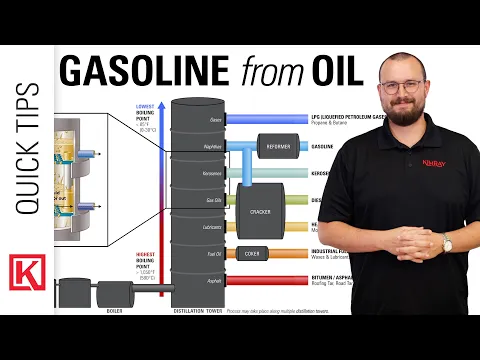
A traditional refinery begins by separating different parts of oil mainly based on differences in their boiling points. The liquid is heated, and its components follow different paths as they evaporate and then return to a liquid state.
It’s a reliable process used on a massive scale, but it requires a lot of heat. A historical analysis by the U.S. Department of Energy calculated that atmospheric and vacuum distillations together accounted for about 30% of the energy used in the process of a typical refinery studied.
Much of that energy comes from burning fuels to heat equipment and produce steam. Pumps, compressors, and other systems also need to operate continuously.
For this reason, finding ways to separate hydrocarbons without evaporating large volumes of liquid has been a longstanding goal in the chemical industry.
Scientists Decided to Work with One of the Most Difficult Mixtures to Separate
The team focused their study on light naphtha, an important raw material for refineries and petrochemical industries.

It mainly contains small hydrocarbons, represented in the study by molecules with five to seven carbon atoms, identified as C5 to C7. The issue is that many have very similar sizes and physical characteristics.
This complicates precise separation.
One molecule might be more useful in producing ethylene. Another is interesting for high-octane gasoline. Aromatics, on the other hand, may be directed towards the production of other chemicals.
Better separation means maximizing the utilization of each component where it holds the highest value.
The first membrane separates molecules with a difference of only 0.08 nanometers
The first filter developed by the team primarily works based on size.
Researchers needed to separate linear alkanes from branched, aromatic, and cyclic molecules. The size difference between some of these groups varies by only 0.08 to 0.12 nanometers.
One nanometer is equal to one billionth of a meter.
To achieve this precision, the team used a membrane made from CuBTC, a material belonging to the family of metal-organic frameworks, known as MOFs.
These materials form networks filled with tiny internal spaces. By altering these pores, scientists can control which molecules pass through the structure more easily.
Tannic acid was used to adjust the pores of the material
The team needed to create similar membranes, but with different behaviors.
The solution was to treat the CuBTC in a controlled manner with tannic acid, a compound naturally found in various plants. The treatment subtly modifies the pore sizes and the chemical properties of the membrane’s surface.
It’s like tuning a sieve on a molecular scale.
One configuration was optimized to distinguish molecules by size. Another received characteristics that allowed for better recognition of certain types of hydrocarbons.
The two membranes were then arranged in sequence, creating a two-step separation line.
The second stage distinguishes molecules separated by only 0.01 nanometers
After the first filtration, an even more difficult problem arose.
Aromatics needed to be separated from highly branched and cyclic hydrocarbons. Within this group, the size differences can drop to as little as 0.01 to 0.03 nanometers.
Attempting to solve this with just a physical sieve would be extremely complicated.
The second membrane also utilizes chemical affinity. In simple terms, its surface interacts differently with certain molecules, allowing some to pass through more easily than others.
Thus, the system first classifies by size and then makes a finer selection based on chemical characteristics.
The 15 components ended up separated into three streams
In the experiments, researchers prepared a simulated light naphtha mixture with 15 different components.
After passing through the membrane system, it was divided into three commercially valuable streams.
The first stream was rich in linear alkanes with a single branch. These hydrocarbons are interesting as raw materials for units producing ethylene.
The second concentrated aromatic hydrocarbons, which can serve as intermediates for chemical industry products.
The third mainly gathered highly branched and cyclic molecules, which are favorable for gasoline components due to their associated octane characteristics.
Recovery of the products was between 85% and 90%
It was not enough to create three different streams. A large portion of the desired components also needed to be recovered.
Published results show recovery rates between 85% and 90% for the three product classes.

This means that the system managed to direct a large portion of the molecules to the planned streams during the experiments.
The concept is called molecular-level refining because it aims to go beyond separating large fractions based primarily on boiling temperatures.
Instead of only asking at what temperature a mixture evaporates, the system tries to recognize the size and chemical characteristics of individual molecules.
Simulation Estimated 91% Lower Energy Consumption
The most striking figure came from the energy analysis.
To calculate the potential savings, researchers used a chemical process simulation with a representative mixture of five components. The result was compared to a conventional distillation system capable of achieving the same planned recovery.
The membrane cascade showed an estimated consumption of about 91% less.
This percentage does not mean that an entire refinery would immediately consume 91% less energy.
The calculation refers to the studied separation operation and was obtained through simulation. A refinery has many other stages, including initial oil distillation, cracking, hydrogen treatment, and blending of final products.
Technology Still Does Not Eliminate the First Distillation of Crude Oil
This point significantly changes the meaning of the discovery.
The study starts with light naphtha, a product obtained after an initial separation of crude oil. Therefore, the Chinese technology did not directly receive crude oil from a well and transform it alone into gasoline, diesel, and chemical products.
The Chinese Academy of Sciences itself explains that the light naphtha studied is obtained after the initial distillation of crude oil.
The advancement occurs in a later stage, when this fraction needs to be further separated into molecules meant for different uses.
Even so, removing some distillation columns or reducing their load could represent significant savings in an industry that continuously works with enormous volumes.
Another Asian Technology Is Already Trying to Filter Crude Oil
The Chinese study also arrives while other groups are progressing in the same direction.
In June 2026, researchers from KAIST in South Korea presented a membrane capable of accepting crude oil at room temperature and separating some of the lighter components before distillation.
In this other project, an analysis estimated a reduction of 31.6% in energy when the membrane is used before a conventional column, along with a calculated drop of 37.6% in CO₂ emissions from the evaluated process.
These are different technologies.
The Korean approach tries to achieve an initial separation of crude oil. The Chinese technology presented now seeks a much more precise separation between molecules of a light fraction already obtained in refining.
Together, they demonstrate how membranes are entering an area dominated for over a century by heat.
Taking a Lab Membrane to a Refinery Will Be the Major Test
The laboratory result is just the beginning.
A refinery needs to process vast quantities continuously. The membranes would need to function for months or years in contact with complex mixtures without quickly losing their separation capabilities.
It would also be necessary to manufacture large areas of membrane with extremely uniform pores, install industrial modules, control pressure and flow, and assess the cost of replacing or cleaning the materials.
Oil and its derivatives still carry impurities that can block pores or alter the functioning of very delicate surfaces.
The study published in August 2026 establishes a scientific foundation. Demonstration in large industrial units will still be necessary before the technology can compete with established distillation systems.
Refineries Could Move Beyond Separation by Boiling Point
The most profound transformation proposed by the work lies in the way oil is perceived.
Today, much of the refining process begins by cutting a huge mixture into groups defined by the temperatures at which their components evaporate.
The new membranes point to a different logic: directly identifying what type of molecule is present and sending it to the highest value destination.
The Dalian Institute of Physical Chemistry describes this change as the shift from “fraction cutting” to “molecular refining”.
In the lab, 15 components have already managed to pass through this kind of microscopic screening and emerge in three streams, with a recovery of up to 90%.


