





 Portuguese
  English
  Spanish
  3 min of reading
  0 comments


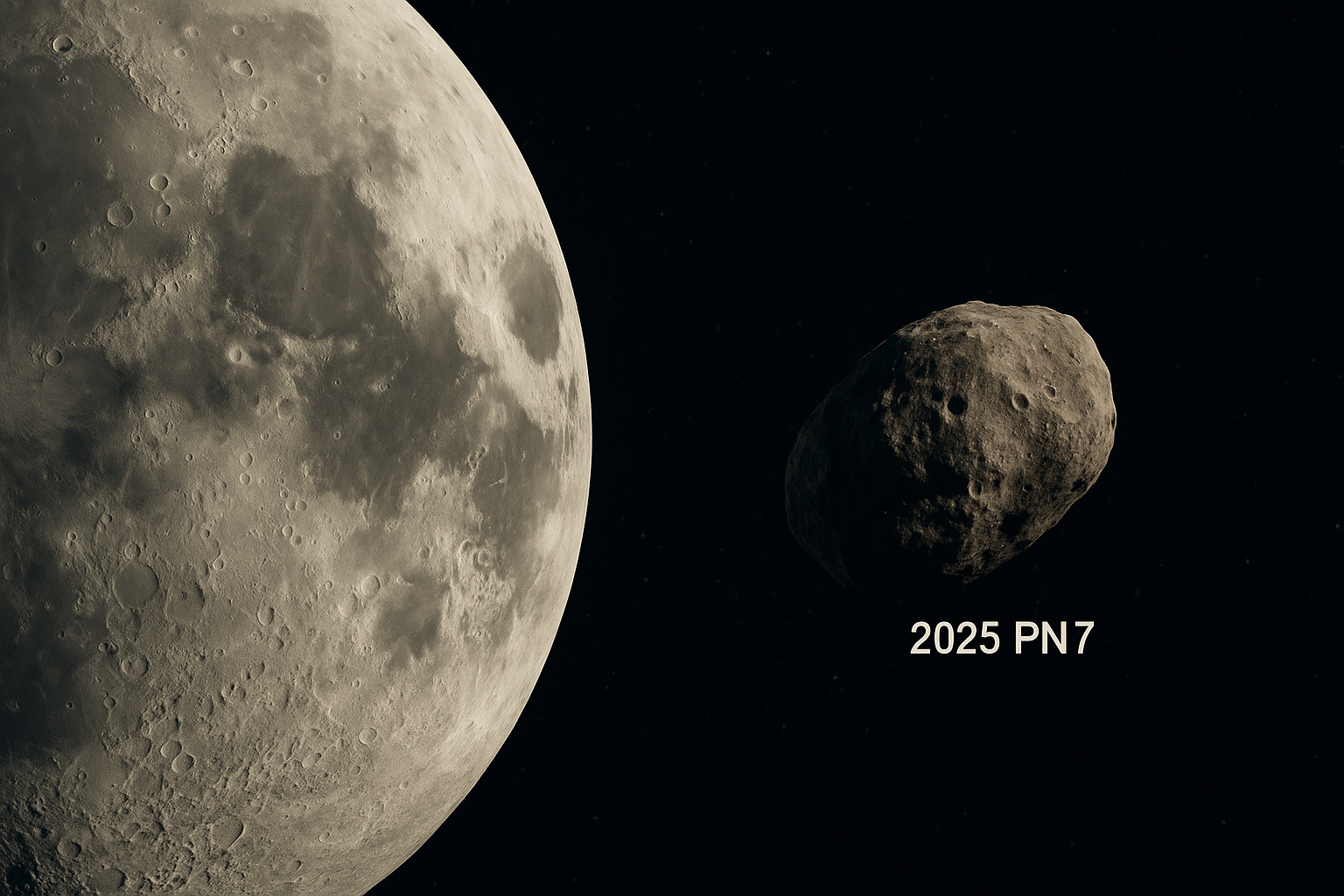
Discovery Surprises Science: The 2025 PN7, a “Near-Moon,” Has Been Accompanying Earth for 60 Years in a Synchronized Orbit Around the Sun.
Astronomy Reveals the Discovery of a New “Near-Moon” Close to Earth
Science has just recorded a curious and rare phenomenon. Astronomers have confirmed the existence of 2025 PN7, a small celestial body that moves almost in the same rhythm as Earth around the Sun for over six decades.
The discovery, made by telescopes in Hawaii, revealed that this object — although it seems to orbit our planet — is not a second moon, but a type of “orbital companion”.
The 2025 PN7 accompanies Earth so closely that it creates the illusion of being “stuck” to it. According to calculations, the asteroid is expected to continue in this trajectory until at least 2083, making it one of the most intriguing discoveries in modern astronomy.
-
The Himalayas continue to grow to this day, with tectonic plates advancing 5 cm per year, mountains rising up to 10 mm annually, and the 2015 earthquake that killed 9,000 people may have increased the risk of an even larger seismic mega-event.

-
At an altitude of 400 km by astronauts from the International Space Station, Paris transforms at night into a golden mesh so precise that it reveals the outline of the Seine River, avenues, and entire neighborhoods like a luminous map drawn over the Earth.

-
iPhone 17 reaches historic low price with 256 GB, 120 Hz display, and drops to R$ 5,703 on Shopee, featuring A19 chip, dual 48 MP cameras, battery life of up to 30 hours, and advanced AI features.

-
Trip to Mars getting closer: Pulsar Fusion, from the UK, advances with plasma ignition in fusion engine and could drastically reduce space travel time, making crewed missions faster, safer, and economically viable.

What Is the 2025 PN7 and Why Is It Called a “Near-Moon”?
Despite the similarity, the 2025 PN7 is not a true moon. It orbits the Sun, not Earth. However, its path is so similar to that of our planet that it appears to follow side by side in a kind of synchronized cosmic dance.
“The 2025 PN7 is a small asteroid, classified among the so-called ‘near-Earth asteroids’, a category that already includes over 30,000 known objects,” explained Fernando Virgilio Roig, researcher and deputy director of the National Observatory (ON).
According to Roig, it is considered a ‘quasi-satellite’ or ‘near-moon’, precisely because it follows Earth’s trajectory without actually being in orbit around it. This type of movement is rare, and so far, only seven objects with similar behavior have been confirmed by scientists.
Discovery in Hawaii and Characteristics of the New Celestial Body
The Pan-STARRS telescope, on the Haleakalā volcano in Hawaii, discovered the 2025 PN7. The observatory leads the search for near-Earth objects.
The asteroid measures 20 to 40 meters in diameter. Scientists track the body precisely, even though it is small by astronomy standards. It is part of the Arjunas group, which includes asteroids with orbits similar to that of Earth.
These bodies orbit the Sun in about a year and maintain nearly circular trajectories. Therefore, Earth’s gravity captures the 2025 PN7 for short periods, creating a temporary and unstable bond with the planet.
A Phenomenon That Intrigues Science and Fuels Theories
Simulations indicate that the 2025 PN7 has been accompanying Earth for around 60 years. At times, it reaches 4 million kilometers from the planet — about ten times the distance to the Moon — and at other times, it moves as far as 18 million kilometers.
This variation occurs due to gravitational force, which causes the body to alternate between closely following Earth or appearing to lag behind. “At some point, it will exit this condition because these quasi-satellite asteroids are not permanent,” Roig explained.
According to him, the body should remain a near-Earth object, but outside this configuration. “Perhaps, after thousands of years, it will become a temporary quasi-satellite again, but that is very difficult to predict,” he added.
Importance of the Discovery for Astronomy and Science
The discovery of 2025 PN7 expands the understanding of astronomy. The body has predictable movement, something rare among asteroids. Unlike the others, it returns to the same point every year.
Astronomer Carlos de la Fuente Marcos from Complutense University of Madrid emphasizes: “These quasi-satellites are easy to reach. Sending a probe to them is much simpler.”
Observing the 2025 PN7 helps science understand the gravity between Earth and NEOs. NASA closely monitors these bodies to study their trajectory and predict future risks.
2025 PN7 Reinforces the Role of Science in Space Monitoring
While NASA has some of its operations suspended due to the government shutdown in the United States, the finding reinforces the ongoing work of astronomers worldwide. The mission to understand and monitor objects like the 2025 PN7 is vital for predicting dangerous approaches and developing planetary defense strategies.
Thus, the discovery of the “near-moon” 2025 PN7 not only fascinates the public but also deepens human knowledge about space and the dynamics of celestial bodies sharing our cosmic neighborhood.










-

-

-

-

6 pessoas reagiram a isso.