





 Portuguese
  English
  Spanish
  3 min of reading


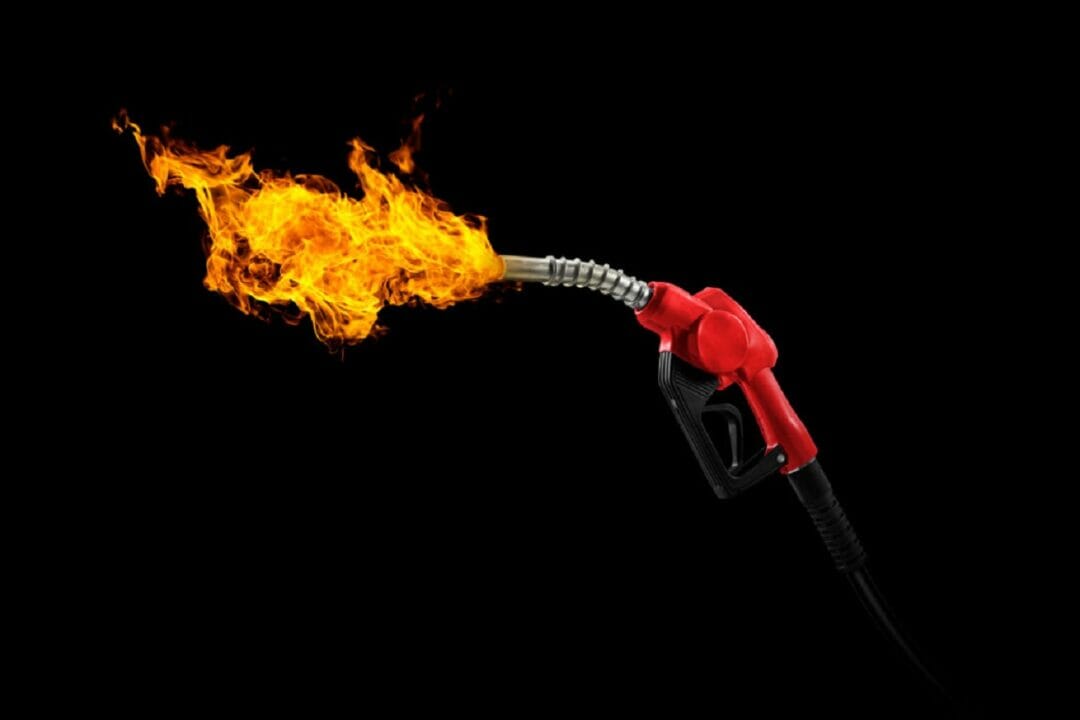
Scientists Develop The World’s First Fireproof Fuel, Promising Much More Safety Than The Liquid Fuels Currently Used In The Market.
Chemical engineers have developed the world’s first fireproof fuel, which only ignites with the application of an electric current. This way, it is possible to use a blowtorch on the fuel; if there is no electric current, it won’t burn!
Since it does not react to flames, the scientists’ fuel does not cause accidental fires during storage or transport, making it a much safer fuel.
How Does Fireproof Fuel Work?
According to Yujie Wang from the University of California, Riverside, the fuel that is normally used around the world is not very safe. It evaporates, can catch fire, and preventing that is quite difficult. Thus, it is much easier to control the flammability of this fuel and prevent it from burning when the voltage is removed.
-
An engineer designs a solar plane to fly on Mars at an altitude of 1,000 meters and a speed of 300 km/h, covering 16,000 kilometers in a Martian year, 900 times the distance traveled by the Ingenuity helicopter in three years on the planet before experiencing a rotor failure, and NASA is already funding the feasibility study.

-
A new phenomenon of contactless magnetic friction intrigues scientists and questions a theory that has been valid since the 17th century.
-
An impressive phenomenon in Northern Brazil causes rivers of different colors to flow side by side, revealing secrets about sediments, currents, and biodiversity.

-
While many schools are still struggling with the basics, a teacher in China went viral for having elementary school students build a two-stage rocket using plastic bottles, water, and pressurized air in a science class that caught the attention of the entire world.


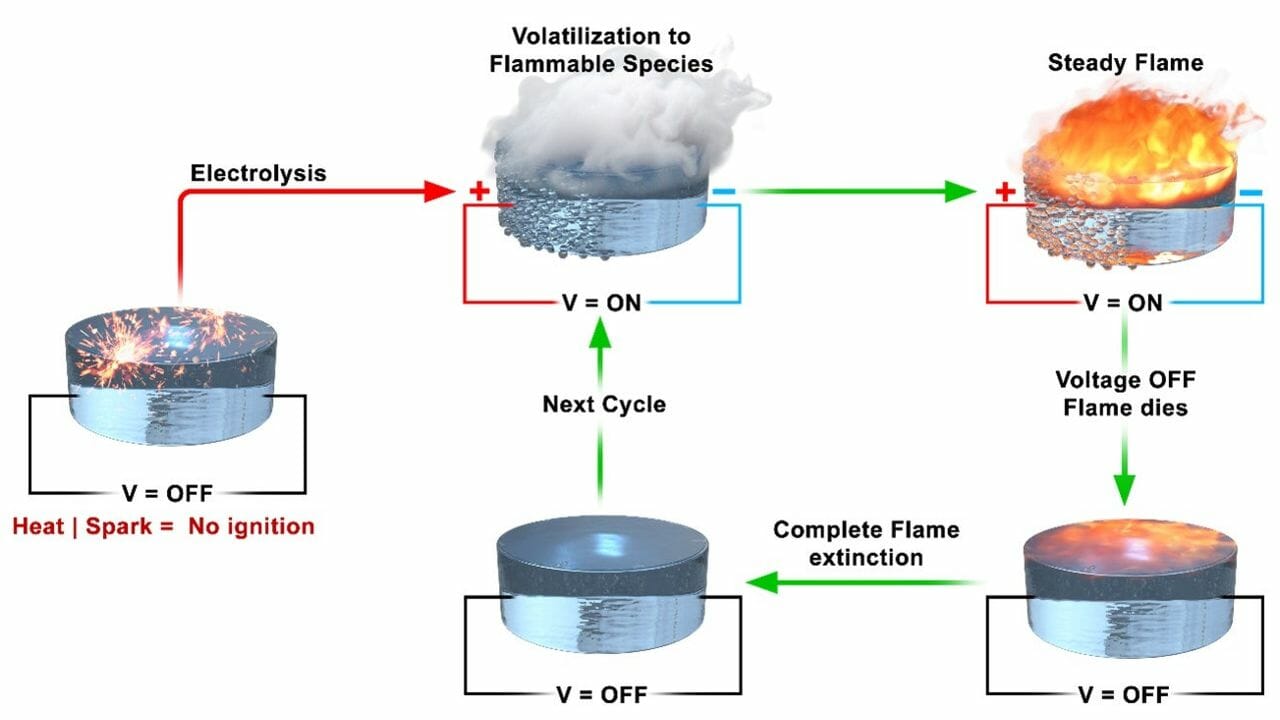
When a liquid fuel, such as ethanol, diesel, or gasoline, ignites, it is not the liquid itself that burns. Instead, it is the volatile molecules of the fuel that hover above the liquid that ignite upon contact with oxygen and heat. Removing the source of oxygen will extinguish the flame; however, this is difficult to do outside a motor, especially during an uncontrolled accidental fire.
Understanding The Process
According to the co-author of the discovery, Prithwish Biswas, if we throw a match into a puddle of gasoline on the ground, it is the vapor of the gas that is burning. You can smell the vapor and instantly know it is volatile. If it is possible to control the vapor, it is possible to control the burning vapor, Biswas adds.
The basis of the new fireproof fuel is an ionic liquid, which is a type of liquefied salt. According to Wang, it is similar to the salt we use to flavor food, which is sodium chloride. What is used for this project has a lower melting point than table salt, low vapor pressure, and is organic.
Scientists Modified The Formula Of The Ionic Liquid
The “trick” of the scientists was to modify the formula of the ionic liquid, replacing chlorine (Cl) with perchlorate (NaClO4), which was enough for the fuel to stop burning in front of a flame, as happens with normal fuel before the chemical modification. However, it took only the application of an electric field on the new fuel for it to burn normally.
According to Wang, once the current was turned off, the flame disappeared, and it was possible to repeat the process indefinitely by applying voltage, observing the evaporation, igniting the vapor for it to burn, and then extinguishing it. The scientists were excited to find a system that could start and stop so quickly.
Other Advantages Of Fireproof Fuel
Increasing the current to which the fuel is subjected results in larger flames with greater energy output. Thus, the technique could also function as a measurement or acceleration system in an engine.
For Professor Michael Zachariah, it is possible to measure combustion in this way, and adjusting the voltage acts like a dead man’s switch, a safety feature that automatically shuts down a machine if the operator becomes incapacitated.
An interesting property of the ionic liquid is that it can be mixed with conventional fuel and still maintain this behavior. However, further research is needed to understand what percentage can be mixed while still remaining non-flammable.
In fact, there are important questions that need to be answered before the fireproof fuel can be commercialized, the main one being the practical aspect, more specifically what modifications would be necessary in engines for them to use the new fuel.







Seja o primeiro a reagir!