





 Portuguese
  English
  Spanish
  4 min of reading
  0 comments


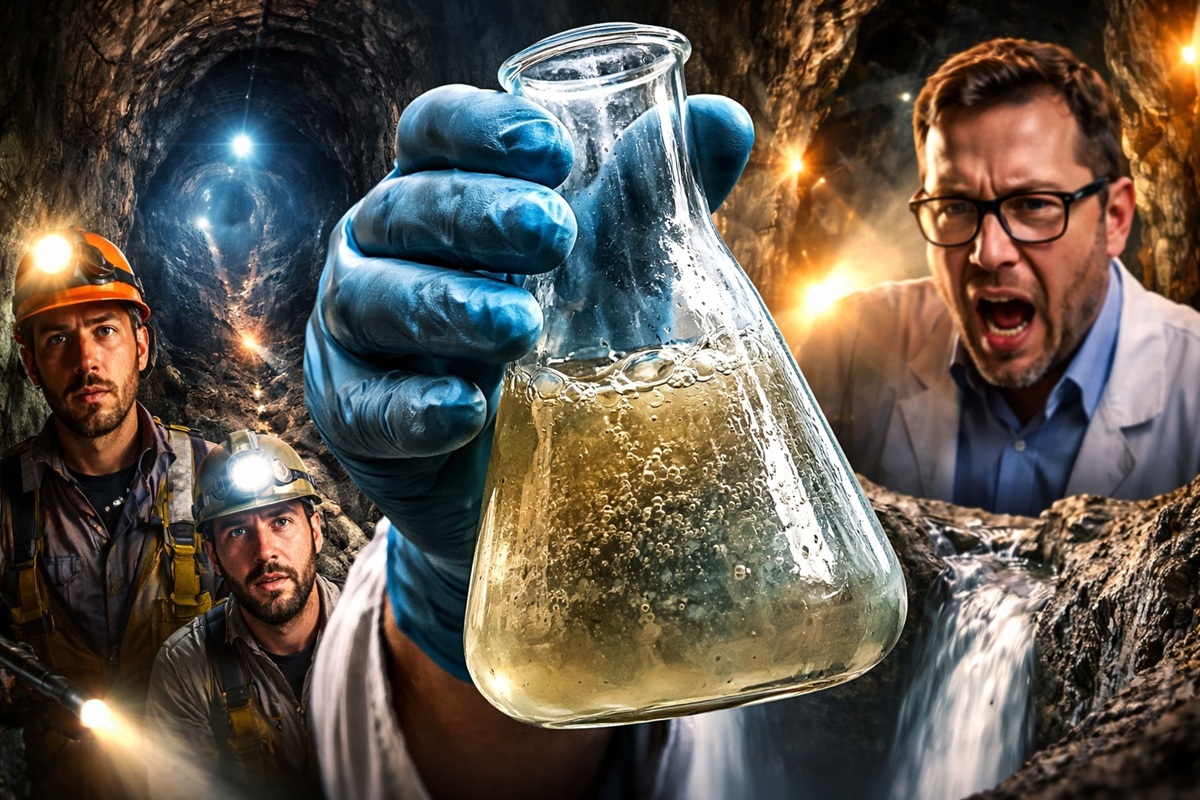
Discovery in 2013 at Almost 3 Kilometers Deep in a Mine in Timmins, Canada, the Oldest Water in the World Stayed Isolated for About 2.64 Billion Years and Revealed Clues About the Primitive Atmosphere of Earth and Possible Subterranean Environments Capable of Sustaining Microbial Life
In 2013, geologists identified the oldest water in the world in a deep fracture of a mine in Timmins, Canada. Sealed at almost 3 kilometers deep, the water had remained isolated for approximately 2.64 billion years.
Discovery of the Oldest Water in the World in a Mine in Canada
The discovery of the oldest water in the world occurred in the depths of a mine located in Timmins, in the province of Ontario, Canada. The liquid was trapped in a rock fracture situated about 3 kilometers below the Earth’s surface.
This region is part of the Canadian Shield, considered the oldest part of the North American crust. This geological environment preserves extremely ancient volcanic and sedimentary rocks that have remained relatively intact from erosion and seismic activity over billions of years.
-
Technology developed to protect military communications in the 1940s scrambled voices and today gives rise to the robotic sound that dominates current music.

-
If you look at the sky this Wednesday, you will see the Pink Moon shining at its peak at 10:11 PM, but before you get disappointed, know that the name has nothing to do with the color and instead refers to flowers that bloom at this time in the United States.

-
Discovery at USP reveals how Brazilian arnica can revolutionize the production of silver nanoparticles with less environmental impact.

-
Harvard scientists have created a tissue exoskeleton that does not look like an exoskeleton, with no rigid parts and reduced weight, using flexible cables and miniaturized motors to assist the ankle and hip, reducing the effort of walking by up to 23% in controlled tests.


According to researchers, these characteristics made the site ideal for investigating very ancient geological records. The preserved layers act as a natural archive that maintains evidence of the Earth’s history since extremely remote periods.
Chemical Analysis Revealed Extraordinary Age of the Water
The chemical composition of the oldest water in the world was analyzed in a study published in 2013 in the scientific journal Nature. The results indicated that the liquid formed under very ancient atmospheric conditions.
To determine the age of the water, scientists analyzed noble gases present in the liquid, especially xenon. These gases are chemically inert and rarely react with other elements, making them reliable markers for studying ancient geological processes.
The researchers compared the proportions of isotopes of these gases with the known evolution of the Earth’s atmosphere. This comparison allowed them to identify the so-called “gas fingerprint” of the water and estimate when it formed.
According to geologist Barbara Sherwood Lollar, a professor in the Department of Earth Sciences at the University of Toronto and one of the study’s authors, the analyses indicated that the water was isolated from the modern water cycle.
She stated that the data showed there was no modern component mixed in with the sample. This confirmed that the water had remained completely isolated for an extremely long period in the geological history of the planet.
Evidence Indicates Age of Up to More Than 2.6 Billion Years
The initial analyses indicated that the water was at least 1.5 billion years old. However, additional evidence suggested that it could be much older.
This occurred because the water contained gases that appear to have been released by the surrounding rocks and sediments over 2.6 billion years ago. This period corresponds to when many of the minerals present in the region were forming.
If this estimate is correct, the water would have been trapped underground since an extremely remote time in Earth’s history. At that time, the planet had very different conditions compared to today.
About 2.6 billion years ago, the Earth’s atmosphere contained little to no oxygen. Life existed only in the form of simple unicellular organisms, and there were no plants, animals, or complex cells.
Moreover, the continents had completely different configurations than they do today. This context helps to gauge how much the water found has remained isolated throughout the evolution of the planet.
Sherwood Lollar stated in an interview with IFLScience that, as far as she knows, the discovery continues to be of the oldest water in the world ever identified.
Old Water Can Sustain Subterranean Microbial Life
Another aspect noted by the researchers was the presence of chemical substances capable of sustaining forms of life. Even isolated for billions of years, the water contained compounds associated with the survival of microorganisms.
This feature suggests that microbial ecosystems may exist in environments completely isolated from sunlight and the atmosphere. In theory, these organisms could survive for very long periods using only subterranean chemical reactions.
The study indicates that similar environments could harbor forms of microbial life even under extreme conditions. These ecosystems could exist deep below the Earth’s surface, completely separated from the external environment.
Why Has No One Drunk the Oldest Water in the World
Despite the curiosity that the discovery sparked, geologist Barbara Sherwood Lollar stated that she has never drunk the oldest water in the world. According to her, the idea that she might have taken a sip emerged as a myth spread by the media.
The researcher explained that, during the work in the mine, there was water flowing and bubbling in some rock fractures. In such conditions, small droplets inevitably hit those nearby.
That was how she perceived the bitter and salty taste of the water. Even so, she made it clear that she never drank the liquid and would not recommend anyone do so.
Sherwood Lollar stated that the story of her drinking the water likely arose after a common question asked during interviews. When asked if anyone could drink that water, she replied that the taste would be unpleasant.
According to the geologist, the water can be many times saltier than seawater. For this reason, it is not considered potable and would not be suitable for human consumption.






-

-

3 pessoas reagiram a isso.