





 Portuguese
  English
  Spanish
  6 min of reading
  0 comments


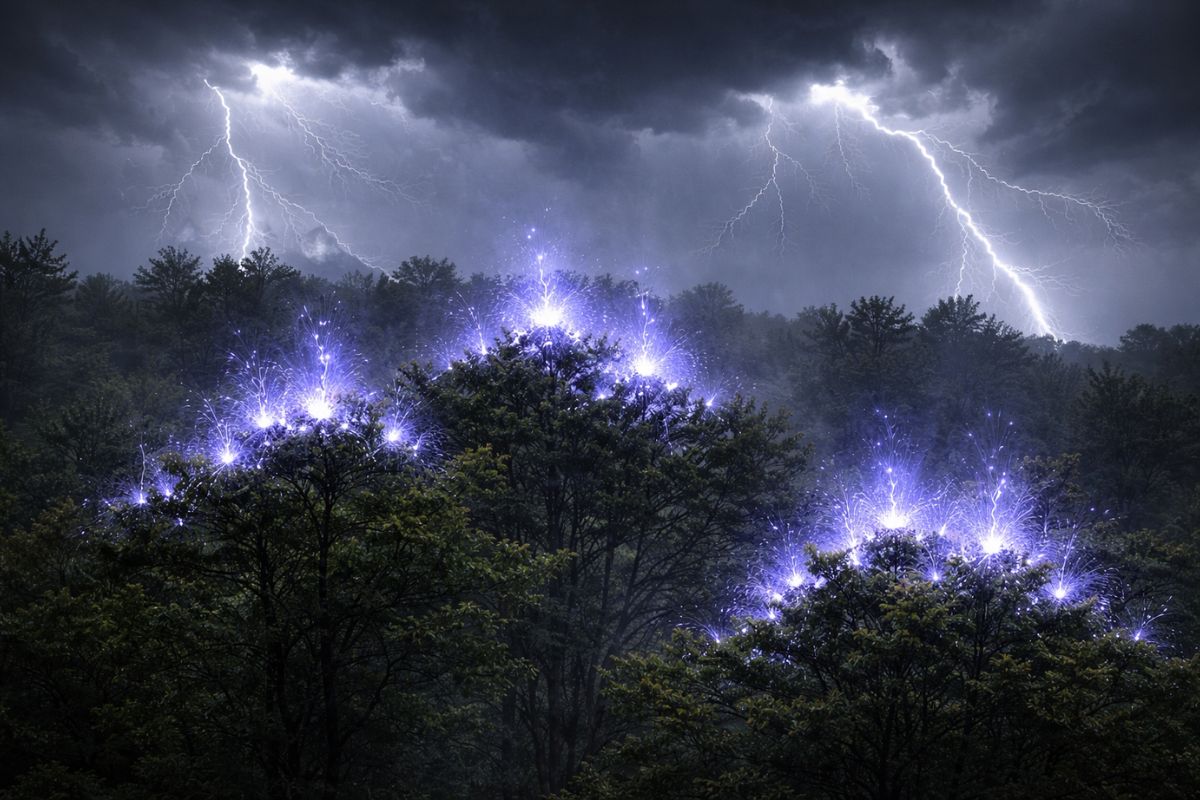
Study in Geophysical Research Letters Recorded Ultraviolet Sparks in the Canopies with UV Camera and Sensors in a Minivan. In Summer 2024, During a Storm in North Carolina, 90 Minutes Were Enough to Detect 859 Signals in Rapid Events of Electrical Corona, Possibly Relevant to Air Chemistry over Forested Areas.
The ultraviolet sparks that “appear” at the tops of trees during storms do not compete with the brightness of lightning; they operate on another plane: a world of tiny, fast discharges, invisible to the human eye, but now recorded directly in nature by cameras sensitive to ultraviolet radiation.
The record ends a long wait. For decades, electrical measurements in forested regions had suggested that something like this should occur, but direct evidence “in the field” was lacking. With the new records, meteorologist Patrick McFarland from Penn State University and lead author summarized the breakthrough: “we saw them; now we know they exist.”
What Are Electrical Coronas That Turn into “Ultraviolet Sparks”?

The technical name for the observed phenomenon is electrical corona: a discharge that does not form a complete lightning bolt but occurs when the electric field in the air becomes intense enough to begin ionizing molecules around sharp, irregular, or highly exposed objects such as leaves, thin branches, and the tips at the top of the canopies.
-
In France, a group of artisans spends 28 years building a medieval castle with 13th-century tools, without machines, without measuring tapes, and with almost zero carbon footprint, and the rediscovered techniques helped in the reconstruction of Notre-Dame.

-
Tourists on Everest were poisoned by guides who mixed substances in food to provoke false symptoms of altitude sickness while helicopter operators and hospitals charged inflated rescue fees to insurance companies.

-
Few people know this, but Neil Armstrong, one of the most famous NASA astronauts in history, survived the Korean War after jumping from the plane during his seventh combat mission aboard the USS Essex aircraft carrier of the United States.

-
Diving with a camera in Lake Furnas reveals a submerged city with an entire street, almost intact houses, a preserved bridge, a wood stove, a Kombi, and even a bus at the bottom of the largest lake in the Southeast.


During storms, negatively charged clouds induce positive charge in the ground. This “pull” creates a field that concentrates at the highest points in the landscape, and the top of the trees becomes an obvious candidate.
The air around the leaves can be ionized; when the molecules return to their normal energy state, they release small pulses of ultraviolet light—the ultraviolet sparks that the camera can see but the human eye cannot.
Why the Top of the Trees Becomes an “Amplifier” During the Storm
It’s not just height: it’s geometry. Canopies are a tangle of tips, edges, and thin surfaces, exactly the type of structure that favors the local intensification of the electric field. Instead of a single continuous discharge, what emerges are microevents that appear and disappear quickly, jumping between leaves and branches as the field changes throughout the storm.
This detail helps to understand why the phenomenon may go unnoticed without specific instrumentation.
The electrical corona, in this context, does not behave like an easy-to-identify single “flash”; it can occur in dozens of small episodes, distributed throughout the canopy, varying as the charged cloud moves and the electric environment oscillates.
How Researchers Managed to See What No One Else Sees
To observe the phenomenon under real conditions, the team set up a mobile system: a minivan equipped with atmospheric sensors, a electric field detector, and a ultraviolet camera mounted on the roof. The logic is simple and rigorous: measure the electric environment while simultaneously recording, in the UV spectrum, any emissions compatible with corona discharges.
In the summer of 2024, the team traveled to storm-prone regions of the United States until they managed to capture the record during a storm in North Carolina. In about 90 minutes of observation, 859 ultraviolet signals were identified, grouped into dozens of events of electrical corona.
The image this creates is less “a rare phenomenon” and more “a difficult-to-capture phenomenon”, because it depends on the alignment between storm, position, equipment sensitivity, and the exact UV range being monitored.
What the 859 Signals Indicate and What They Do Not Allow Us to Affirm
The number of 859 signals in 90 minutes gives a concrete dimension of what was seen in that specific episode: rapid occurrences, grouped into events, emerging and disappearing at the top of the vegetation. This answers, with data, a question that remained in the realm of suspicion: “does this really happen in real forests, outside the laboratory?” The observational answer is now yes.
At the same time, it is important not to stretch the result beyond what was measured. The researchers themselves assess that the phenomenon might be much more common than the records indicate because the equipment only captured a specific range of the ultraviolet spectrum.
In other words: what was recorded is likely a “window” of what exists—not a complete census. This technical limit changes the type of conclusion possible: it indicates the presence and dynamics of the phenomenon but does not finalize the frequency total across all storms and forests.
If It Were Visible, Why Would It Remind Us of “Thousands of Fireflies” in the Canopies?
The comparison with fireflies is not merely decorative: it translates the intermittent and distributed behavior of discharges. Instead of a single point of light, there would be multiple small and simultaneous glimmers, scattered throughout the canopy and flashing as the storm moves through the area.
This image also helps to understand why lightning does not “replace” the phenomenon. Lightning is a larger and highly energetic discharge; the ultraviolet sparks are discrete emissions linked to microdischarges of corona.
One event does not eliminate the other; they can coexist in the same electrical scenario, at different scales.
Why Ultraviolet Sparks May Interfere with Air Chemistry
A central point of the study is that these discharges produce highly reactive molecules. This matters because reactive molecules can participate in chemical chains in the atmosphere, influencing the formation of atmospheric haze and secondary pollutants.
Storms, then, may have a more direct and still poorly understood role in air quality in forested regions.
What is at stake here is not just the invisible “electric spectacle,” but the possibility that forests, storms, and atmospheric chemistry interact in a more intimate way than previously thought.
Even without concluding the exact size of this effect, the direct record of electrical coronas in the canopies reinforces that there is an active physical mechanism occurring at the moment the air is being electrically stressed by the storm.
And the Trees: Real Risk or Silent Adaptation?
The team also discusses a delicate issue: what this does to the vegetation itself. In the laboratory, experiments show that electrical coronas can burn the tips of leaves in a matter of seconds.
However, the laboratory is not the forest: in nature, the impact is still uncertain due to variables such as humidity, wind, rain, event duration, and each species’ ability to tolerate stress.
Still, there are hypotheses of damage associated with dehydration or solar stress after extreme events, and the discussion opens a practical line of inquiry: if the ultraviolet sparks are more common than can be measured today, forests may have developed natural adaptation mechanisms either through physical characteristics of the leaves or through physiological responses that reduce repeated damage over time.
The difference between “it can burn in the laboratory” and “what happens in the real canopy under rain and wind” is precisely where field research becomes decisive.
What Changes After the Phenomenon Was Directly Seen in Nature
For decades, the story was: electrical indications suggested coronas in the canopies, but direct observation had not occurred. Now, with ultraviolet cameras and sensors in the field, the question shifts to a new level.
It ceases to be “does it exist?” and becomes “how often does it occur, under what conditions, and with what consequences?”
From here, it makes sense to imagine studies that expand the observed range of ultraviolet, compare different types of forests, evaluate storms with distinct characteristics, and correlate electrical signals with chemical indicators of air.
The immediate gain is conceptual: storms do not produce only lightning; they can trigger microdischarges in the canopies that had previously been hidden due to a simple detail—they are invisible to the human eye.
Have you ever been near a wooded area during a strong storm and noticed a different smell in the air, sudden mist, or some “strange” effect in the environment?
Share where it was and how you described that feeling; your experience can help map how these ultraviolet sparks connect with what people notice in the real world.







-

-

2 pessoas reagiram a isso.