





 Portuguese
  English
  Spanish
  3 min of reading
  71 comments


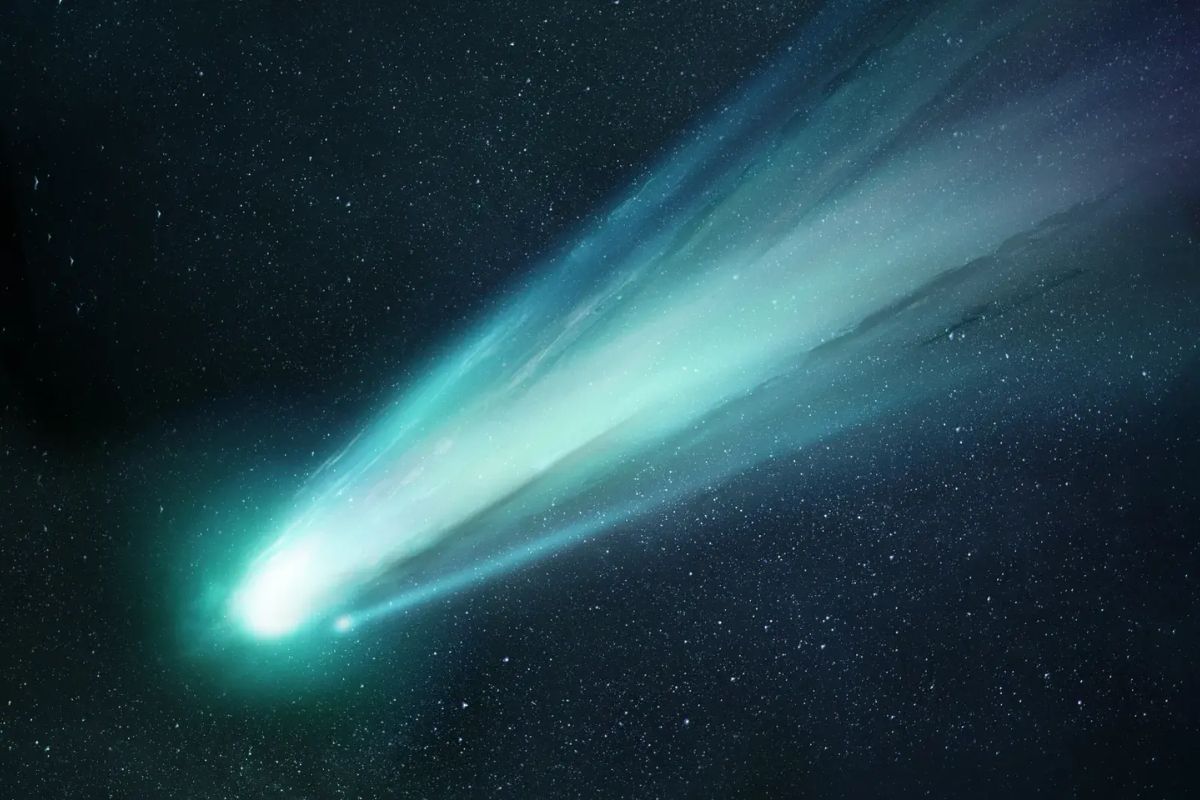


Comet 3I/ATLAS Exhibits Sudden Increase in Brightness and Intense Blue Color, Phenomenon That Surprises Astronomers and Raises New Hypotheses About Its Interstellar Origin
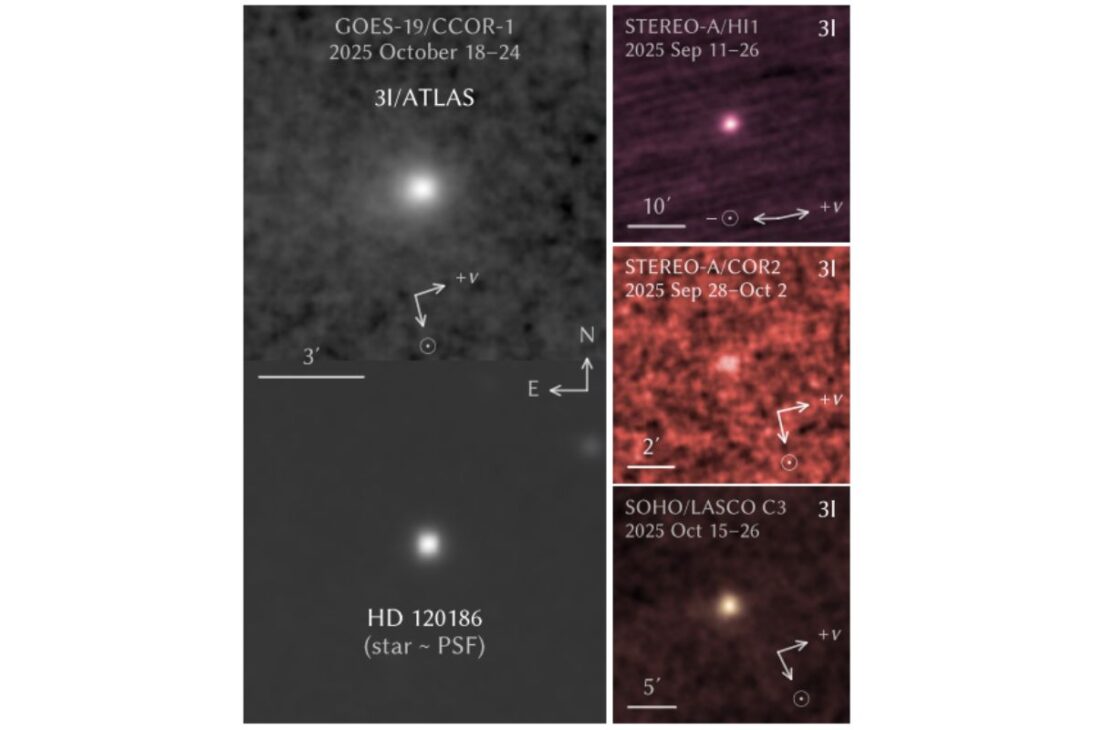
The comet 3I/ATLAS is at the center of an international scientific race. In just a few days, it has displayed a brightening and an unusual blue coloration, behavior that does not fit known models of cometary activity. The phenomenon has been recorded by several solar observation spacecraft, revealing new and intriguing brightness patterns.
According to preliminary analyses, the interstellar object discovered in July intensified its light as it approached the Sun. Normally, this type of behavior indicates the release of gases or fragmentation of the surface. However, the intensity and color observed suggest something more complex, involving atypical gaseous emissions or physical properties not yet understood.
The Brightness Escalation Observed in Recent Weeks
-
New Zealand builds a shimmering building that vibrates, featuring a 62-seat cinema, moving sculptures, and an environment where sound, light, and energy are felt in the body.
-
Two colored cubes of 2.5 m transform a public bathroom into a selfie spot in Western Australia, costing up to 75% less than traditional construction and helping to reduce vandalism in public spaces.
-
Santa Catarina produces up to 7 times more than it consumes in some sectors, and its century-old industries founded by grandparents and great-grandparents now compete on equal footing with Germany and the United States in the international market.

-
U.S. war giant weighing 9,600 tons and equipped with long-range missiles is sent to the Atlantic to protect global internet and hunt submarines.

Instruments on board the STEREO-A, SOHO, and GOES-19 probes detected a sudden variation in the photometry of the comet during September and October 2025.

According to researchers, 3I/ATLAS is expected to emerge from the solar conjunction brighter than before, possibly due to a visible emission of gases in high quantities.
In addition to the intensity, the bluish coloration has drawn attention.
The photometry from the images shows that the comet reflects light differently than cosmic dust patterns, indicating that a significant portion of the brightness may come from excited gases near perihelion, the closest point to the Sun in its orbit.
An Enigma That Challenges Known Explanations
Professor Avi Loeb from Harvard University described the blue hue of 3I/ATLAS as “very surprising.”
According to him, celestial bodies covered in dust tend to reflect reddish tones, as their surfaces are cooler than the solar photosphere.
The behavior of the comet, therefore, challenges the thermal and spectral expectations of cometary physics.
Loeb proposed to include the blue color as a ninth anomaly in the list of inexplicable properties of the object, which already exhibits an extremely aligned trajectory with the orbital plane of the planets and a tail oriented towards the Sun.
This phenomenon cannot be explained solely by observational geometry.
Hypotheses and Limits of Current Observations
Scientists have not yet confirmed the exact nature of the brightness increase.
Among the hypotheses are internal chemical reactions, sudden release of volatile ice, or reflections caused by exposed fragments during the close passage to the Sun.
None of these scenarios, however, fully explain the detected blue color.
Continuous analysis is expected to intensify in the coming weeks, as the comet moves away from the solar region and becomes visible again to ground telescopes.
New measurements are anticipated to help determine whether 3I/ATLAS is merely an atypical interstellar visitor or something that will require revision of current comet formation theories.
The comet 3I/ATLAS remains under close observation and continues to intrigue the scientific community.
If future observations confirm the persistence of the blue color and the anomalous increase in brightness, the case could become one of the most enigmatic records of modern astronomy.
Do you believe that 3I/ATLAS is just an unusual comet, or could there be something more behind its behavior?






Por favor não levantei polêmicas baseado em textos Bíblicos. Não use um pedaço de texto para criar um contexto.
Só para informação:
“A COR DO ABSINTO É VERDE DEVIDO A COR DO SEUS INGREDIENTES, QUE SÃO ERVAS VERDES”. QUANDO MUITO DIFERENTE DISSO, É TRANSPARENTE.
O terceiro anjo tocou a sua trombeta e uma grande estrela, que queimava como tocha, caiu do céu sobre um terço dos rios e das fontes de águas; o nome da estrela é Absinto. Um terço das águas tornou‑se amargo, e muitos morreram por causa das águas, pois se tornaram amargas. Apocalipse 8:11
Para quem não sabe, a cor do absinto é azul.
Boa piada!
Pelo que (vemos) aqui, e eu acredito que sim, há muito mais além por trás desse cometa atípico.