





 Portuguese
  English
  Spanish
  5 min of reading
  0 comments


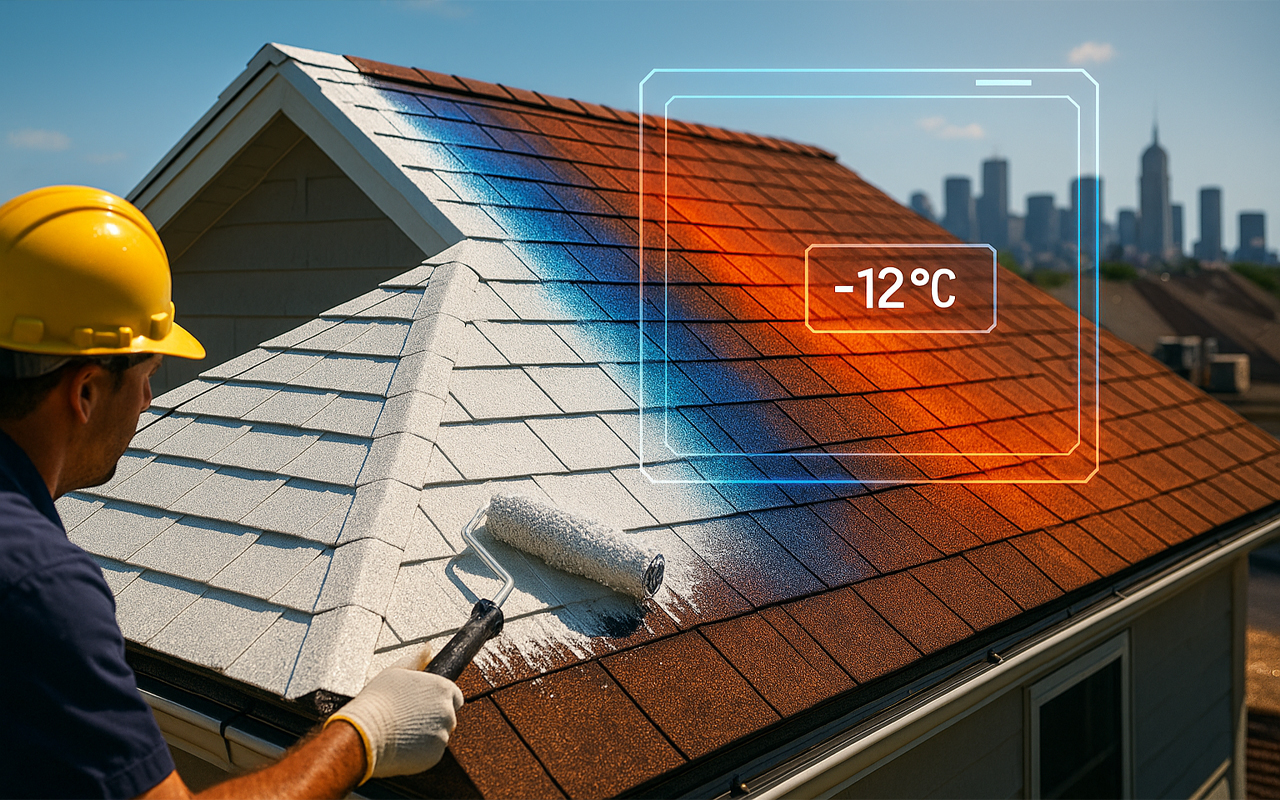
New Thermal Paint for Roofs, Designed with Artificial Intelligence, Reduces Solar Heating and Emits Heat to the “Cold Sky”, Indicating Energy Savings in Hot Climates, According to Article in Nature.
Researchers from universities in the United States, China, Singapore, and Sweden presented innovative materials for passive cooling, such as a new paint capable of keeping surfaces significantly cooler under intense sunlight. The study, published in Nature, details a method based on machine learning that accelerates the design of “thermal metaemitters.”
The proposal is to reduce the demand for air conditioning in buildings, also helping to mitigate the urban heat island effect. According to a report from The Guardian, there is a reduction of 5 °C to 20 °C in the temperature of surfaces compared to conventional paints, in addition to potential use in other sectors.
In press materials from the University of Texas at Austin, the authors highlight seven classes of metaemitters generated by the AI platform, with an estimated savings of 15,800 kWh per year in a four-story building located in a hot climate like Rio de Janeiro or Bangkok.
-
The oceans are darkening all over the planet – what is happening?
-
An engineer designs a solar plane to fly on Mars at an altitude of 1,000 meters and a speed of 300 km/h, covering 16,000 kilometers in a Martian year, 900 times the distance traveled by the Ingenuity helicopter in three years on the planet before experiencing a rotor failure, and NASA is already funding the feasibility study.

-
A new phenomenon of contactless magnetic friction intrigues scientists and questions a theory that has been valid since the 17th century.
-
An impressive phenomenon in Northern Brazil causes rivers of different colors to flow side by side, revealing secrets about sediments, currents, and biodiversity.


Experts remind us that passive cooling solutions are gaining traction because they can reduce consumption and load peaks, providing thermal comfort without relying solely on mechanical systems. The university and technical press have been following the advancement of the topic since July.
What Is the Thermal Paint Created with AI and How Does It Work
The “thermal paint” is a coating designed to reflect much of the sunlight and emit heat efficiently at wavelengths that escape through the atmosphere, a phenomenon known as radiative cooling, in other words, the paint is capable of throwing the heat back into space. Instead of adjusting formulas by trial and error, scientists used AI to invert the problem and generate optimized 3D architectures and compositions.
The method resulted in thermal metaemitters of different profiles: some with high solar reflectance, others with selective emissivity, and others that combine both properties. This flexibility allows the solution to be adapted to distinct climates, substrates, and applications, from residential roofs to electronic components.
In practical terms, the goal is to keep the surface cooler than the air under certain conditions, reducing the transfer of heat indoors. Technical reports indicate cooling of 5 °C to 20 °C compared to conventional paints exposed to the same sun, which, combined with adequate insulation, can alleviate the effort of air conditioning.
According to the universities, the AI platform accelerates the discovery cycle, shortening the time between simulation and laboratory testing. This paves the way for families of materials that would be difficult to find with traditional methods.
Measured Results and What to Expect in Energy Savings
Nature and official releases record that the AI approach generated materials with performance above the state of the art in proof of concept. In simulated scenarios for hot climates, applying the coating on the roof of a four-story building could save approximately 15,800 kWh/year of electricity. This is an indicative number that depends on design, occupancy, and usage.
For direct comparison, sources cite a typical air conditioner consuming something in the range of 1,500 kWh/year, but this value varies with capacity, efficiency, and habits. The important thing is the reduction of the building’s thermal load, which shortens the time the compressor is on and smooths demand peaks.
In practical tests covered by the press, surfaces painted with the new formulations remained substantially cooler under midday sun than commercial competitors. This signals potential comfort gains in indoor environments without altering architecture.
Still, it is worth noting that the numbers come from prototypes and simulations. Actual savings depend on solar orientation, color, and material of the roof, insulation, and local climate, requiring case-by-case analysis by professionals.
Beyond Roofs: Cars, Clothing, and Electronics
The research consortium points out that thermal metaemitters are not limited to buildings. There is interest in textiles with cooling for outdoor equipment, in vehicles exposed to the sun, and even in electronics that require better heat management. This versatility arises from the ability to “customize” optical-thermal properties with AI.
In vehicles, a coating with high reflectance and emissivity can reduce the temperature of the roof and dashboard, improving thermal comfort and decreasing the need to use air conditioning soon after parking in the sun. Future research should evaluate adhesion, abrasion, and aesthetic for automotive use.
In textiles, thin and breathable materials with infrared emissivity can favor heat dissipation from the body, with applications in PPE, sports, and industrial environments. Such applications are still undergoing validation, but they are already on the radar of research groups.
In the electronic sector, emissive surfaces help to manage hotspots without moving parts, which is of interest to companies seeking thermal reliability. This is an area where selective band engineering can be particularly valuable.
Market, Timelines, and Alternatives Already Available in Brazil
The authors describe the technology as a proof of concept in the academic phase. Before widespread commercialization, it will be necessary to demonstrate scalability, competitive cost, UV durability, adherence to standards, and sustained performance over the years. Partner institutions emphasize that there is potential, but no product launch date has been announced.
While the “AI paint” matures, consumers and building managers can resort to already known solutions, such as reflective paints with high solar reflectance, light-colored tiles, insulation blankets, and thermal barriers combined with good insulation. These measures are available on the market and have already shown benefits in hot climates.
Another rising field is that of evaporative paints that “sweat” water. Researchers from Singapore published results showing that a porous cementitious coating reflected 88 to 92% of sunlight and removed up to 95% of absorbed heat, with 30 to 40% reduction in air conditioning usage in local tests, even in high humidity. It is a complementary route to radiative cooling.









Seja o primeiro a reagir!