





 Portuguese
  English
  Spanish
  4 min of reading
  0 comments


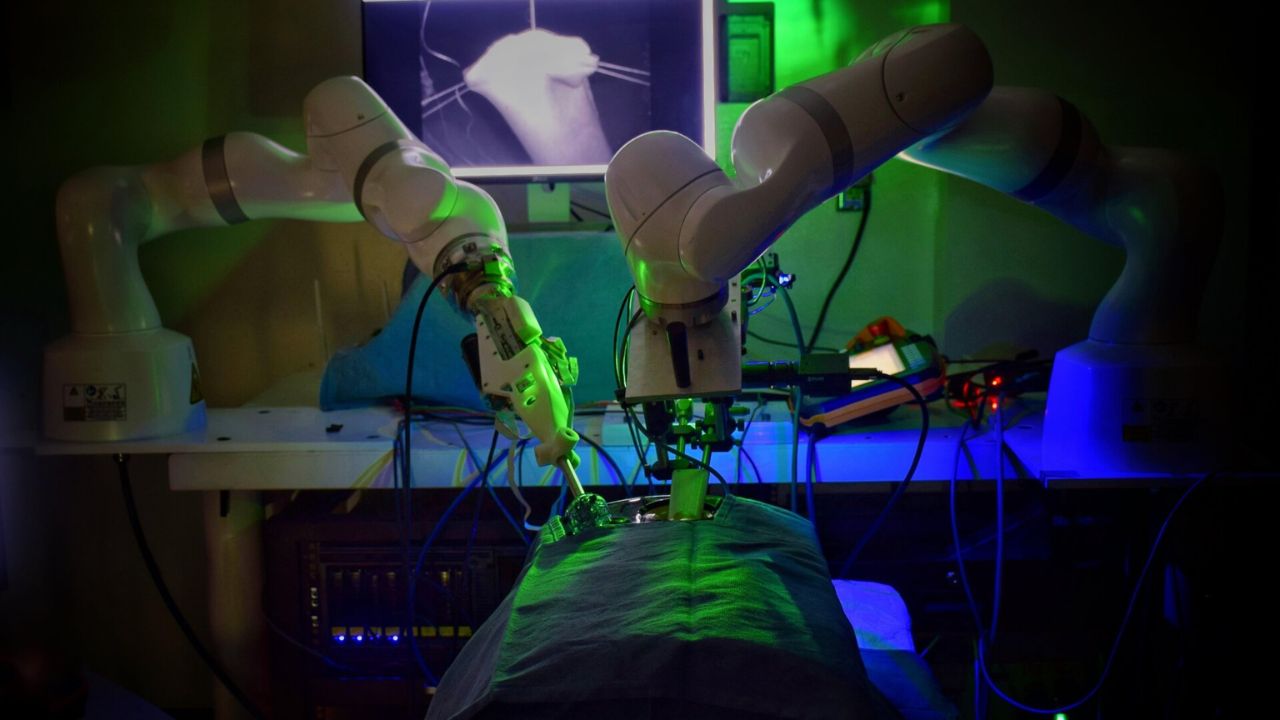
Johns Hopkins Scientists Reach Unprecedented Milestone: AI-Trained Robot Performs Laparoscopic Cholecystectomy on Live Animal Without Human Intervention
The boundary between man and machine has officially been crossed. What once seemed like a science fiction script is starting to gain ground within cutting-edge laboratories, experimental surgical rooms, and renowned scientific publications. An AI-trained robot autonomously performed the removal of an organ from a live animal — without human touch, without joystick, without scalpel wielded by a surgeon. Only voice commands and trial-and-error learning.
The Beginning of the Revolution: The First Cut Made by a Surgical Robot
The journey toward the “point of no return” began in January 2022, when the STAR (Smart Tissue Autonomous Robot), created by a team from Children’s National Hospital and Johns Hopkins University, performed its first minimally invasive operation: an intestinal anastomosis on a pig. The procedure was a milestone. Although it had human supervision and followed a strict surgical plan, the robot was able to suture tissue with a precision difficult to replicate even by experienced doctors.
At that time, scientists compared the challenge to “teaching a robot to drive on a road without signage, but with lines drawn on the ground.” STAR was only able to operate in controlled environments, with marked tissues, standardized lighting, and no surprises.
-
With around 6,000 residents on a single 9 km street, a village in Poland maintains a strong sense of community, cultivates strawberries and potatoes, and becomes the target of a false image created by artificial intelligence.

-
Sleeping at different times each day can be a bomb for your heart and even double your risk of having a heart attack.

-
Without help and without heavy machinery, a woman builds a house from scratch with stone, wood, and cement, erects a chimney, creates a complete leisure area, and transforms an empty lot into her dream home.

-
Couple transforms abandoned house after years of being closed; residence was overgrown with weeds, had a green pool, and a deteriorated structure in the interior of Rio de Janeiro.


The Surgery That Changed Everything: Robot Removes Gallbladder Without Human Help
Fast forward to 2024. In a new experiment published by Science Robotics, researchers from Johns Hopkins University presented the Surgical Robot Transformer-H (SRT-H), a surgical robot with a fundamental difference: it no longer requires direct human control. Powered by data similar to that used to train models like ChatGPT — videos of real surgeries, anatomical images, and voice feedback — the SRT-H completely autonomously removed the gallbladder from a live pig.
The pig was chosen for its internal anatomy similar to humans, making it standard for surgical testing. During the procedure, scientists simulated unpredictable situations: filled the abdominal cavity with blood, changed the angle of the cameras, distorted images. Still, the robot reacted in real-time. It corrected trajectories, adjusted movements, and responded to simple commands like “raise your arm” or “hold in the middle” — all without direct intervention from the researchers.
“It adapts to the unique anatomy of each patient and makes decisions in fractions of a second when the initial plan fails,” explained Professor Axel Krieger, project leader, in an interview with Science Robotics.
How the Surgical Brain of This AI Works
The SRT-H was trained based on reinforcement learning and large volumes of clinical data, including recordings of human surgeries and animal tests. The AI developed a kind of “surgical intuition” — a decision-making system based on visual patterns, tissue texture, and motor responses.
Unlike traditional medical robotics systems, like the Da Vinci (which relies on manual control by the surgeon), the SRT-H operates in an interactive and adaptive manner. It learns from commands, reacts to the environment, and updates its surgical conduct in real-time.
The Advancement That Leaves Doctors and Bioethicists on Alert
Despite the enthusiasm in academia, the experiment raised red flags in the medical and bioethical community. For the first time, an AI-controlled robot executed the extraction of an organ from a living being without any human interference — and this raises a series of moral and legal questions.
Are we ready to allow machines to make critical medical decisions? Who is responsible if something goes wrong? The robot? The programmer? The hospital? These questions remain unanswered.
The concern is not unfounded. In a recent article published by MIT Technology Review, experts warned of the risk of premature automation in environments where human lives are at stake, especially in countries with weaker medical regulation.
The Era of Surgical Robots Has Begun
Although clinical use in humans is still distant, developers believe the path is already laid. The goal is to create reliable and accessible surgical robots, capable of operating in remote locations, battlefields, or disaster zones — where there are no doctors available, but lives need to be saved.
In addition, the SRT-H joins a growing list of AI-based medical applications:
- Ambience, Microsoft’s medical assistant that automates clinical records;
- Algorithms capable of predicting genetic mutations associated with cancer with very high precision;
- Systems that can already estimate a patient’s life expectancy based on medical histories and behavioral patterns.
An Inevitable Future?
For many, the use of robots in medicine is just a matter of time. For others, it represents the risk of replacing human judgment with machine decisions that, no matter how well-trained, do not understand the ethical complexity of life.
The fact is that we have already allowed a robot to remove an organ from a living being without any help from a human — and this, like it or not, changes everything.









Seja o primeiro a reagir!