Portuguese
  Spanish


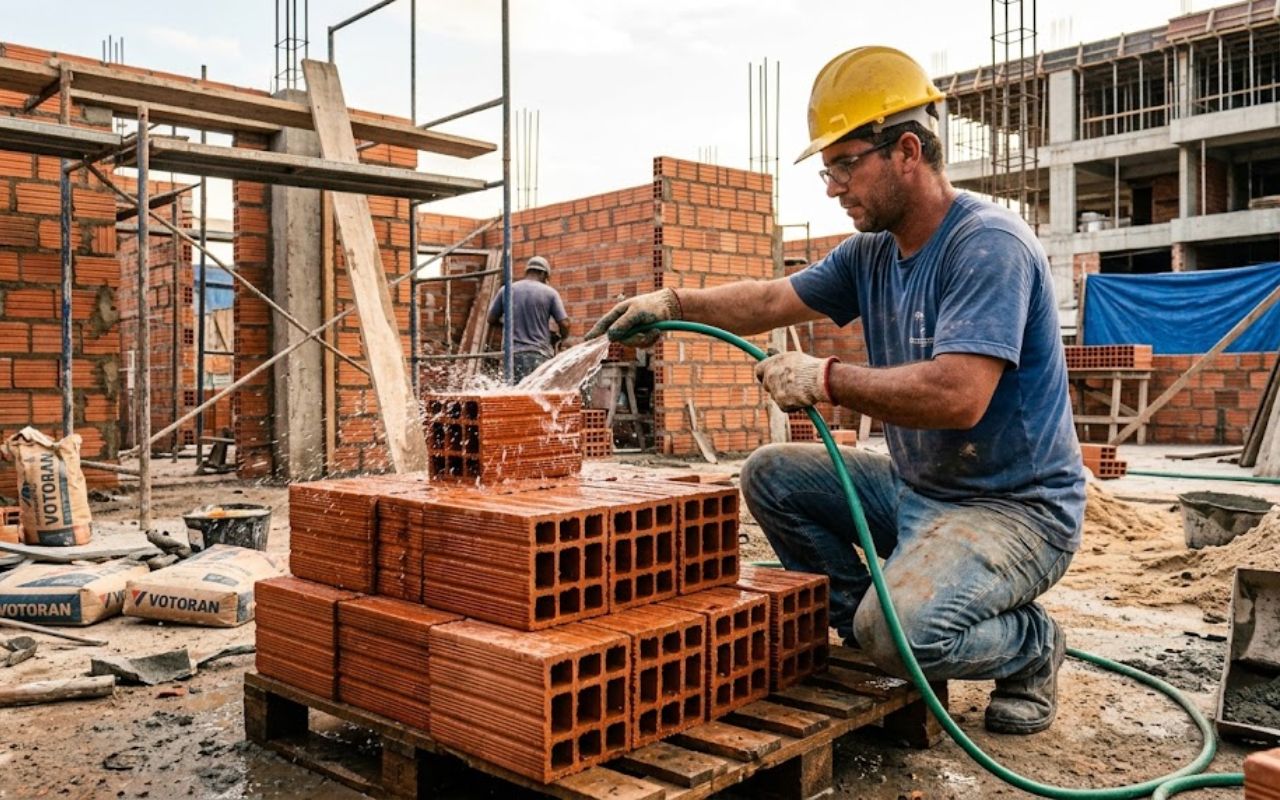

Understand why wetting brick is a fundamental technique in civil construction, ensuring better adherence of the mortar, fewer cracks, and greater durability of the masonry.
Before raising a wall, professionals in the construction industry take a precaution that may seem simple but makes all the difference: wetting bricks before laying them. This practice is carried out by experienced masons on projects of all sizes, especially in hot regions, and aims to improve the adherence of the mortar, prevent cracks, and increase the durability of the structure. This procedure takes place directly on the construction site, usually minutes before execution, and is essential to ensure quality, safety, and performance over time.
Why is wetting brick an indispensable technique in construction?
The technique of wetting brick is directly related to the composition of the material. Ceramic bricks have high porosity, meaning they absorb water easily. When used dry, they quickly “pull” the water from the mortar.
As a result, the mixture loses its ideal consistency. Furthermore, the adherence between the brick and the mortar is compromised, which can affect the wall’s strength.
-
China Constructs Four 20 km Tunnels in World’s Deepest Canyon for Mega Power Plant to Outperform Three Gorges and Power All of Britain

-
China’s Engineered Bamboo: The “Material of the Future” Stronger Than Steel and a Sustainable Wood Alternative

-
Egypt’s “New Nile”: 170 km Artificial River Aims to Turn Desert into Farmland, but Water Supply Concerns Loom
-
Unable to secure a mortgage as a self-employed single mother, she designed her own floating home from a 20-meter boat and now lives “off-grid” with her two children and solar panels on an English canal.


On the other hand, by wetting bricks in a controlled manner, the drying process occurs more evenly. This reduces internal tensions and significantly improves the performance of the masonry.
Improves adherence and eases work
Another important point of this technique is its direct impact on the execution of the work. When the brick is slightly damp, the mortar remains more plastic and easier to work with.
This facilitates alignment, leveling, and adjustment of the pieces during construction. Consequently, the final result tends to be more precise and uniform.
Additionally, wetting bricks contributes to a more efficient bond between the materials. This increases the stability of the wall and reduces structural failures over time.
Fewer cracks: one of the main benefits of wetting brick
Among the most relevant advantages of this technique is the reduction of cracks. When the mortar dries too quickly, small cracks often appear in the joints.
By wetting bricks, the drying occurs gradually. Therefore, internal tensions decrease, and the risk of cracks also falls.
This helps preserve the integrity of the masonry. Additionally, it reduces the need for early maintenance.

Wetting brick prevents detachments and improves resistance
Another important benefit is the reduction of the risk of detachment. In walls where adherence is inadequate, parts of the structure may loosen over time.
With the correct application of the wetting technique, the cohesion between the elements increases. Thus, the structure becomes more resistant and stable.
This effect is even more evident in critical areas, such as corners and wall intersections. In these regions, the reinforcement of adherence makes a significant difference.
Finishes adhere better with the wetting brick technique
The quality of the base directly influences the finish. Therefore, wetting bricks also impacts the performance of plasters and ceramic finishes.
A well-executed wall provides better adhesion for these materials. As a result, there is a lower risk of peeling or surface failures.
Additionally, the final finish tends to have greater durability. This reduces costs for future repairs.
How to correctly apply the wetting brick technique?
Although simple, the technique requires attention. Ideally, the brick should be only damp, never soaked.
Excess water can harm the adherence of the mortar. Additionally, it can increase the drying time.
Therefore, it is common to wet the pieces in advance and let them drain in a ventilated area. On construction sites, buckets, hoses, or even shallow tanks are used.
The practice of wetting bricks is even more necessary in hot and dry regions. Under these conditions, water evaporation occurs more quickly.
This can compromise the performance of the mortar. Therefore, controlling moisture becomes essential.
Furthermore, the technique is especially recommended for ceramic bricks and blocks with high absorption. In the case of concrete blocks, the recommendations may vary.
Following technical guidelines is essential
Although it is a common practice, wetting bricks should follow specific guidelines. Each material may have different characteristics.
Therefore, it is important to respect the manufacturer’s recommendations. This way, it is possible to ensure the best performance of the mortar and the structure.
In addition to the mason’s experience, the correct use of the technique helps to avoid future problems. This includes cracks, detachments, and finishing failures.
Result: more quality and less rework on the job
When applied correctly, the technique of wetting bricks brings significant gains to construction. The mortar adheres better and cures more evenly.
As a result, walls become more resistant and durable. Additionally, there is a reduction in rework and maintenance.
Therefore, even though it is a detail often overlooked, wetting bricks is an essential step to ensure quality, safety, and savings in any construction project.
See: