





 Portuguese
  English
  Spanish
  5 min of reading
  19 comments


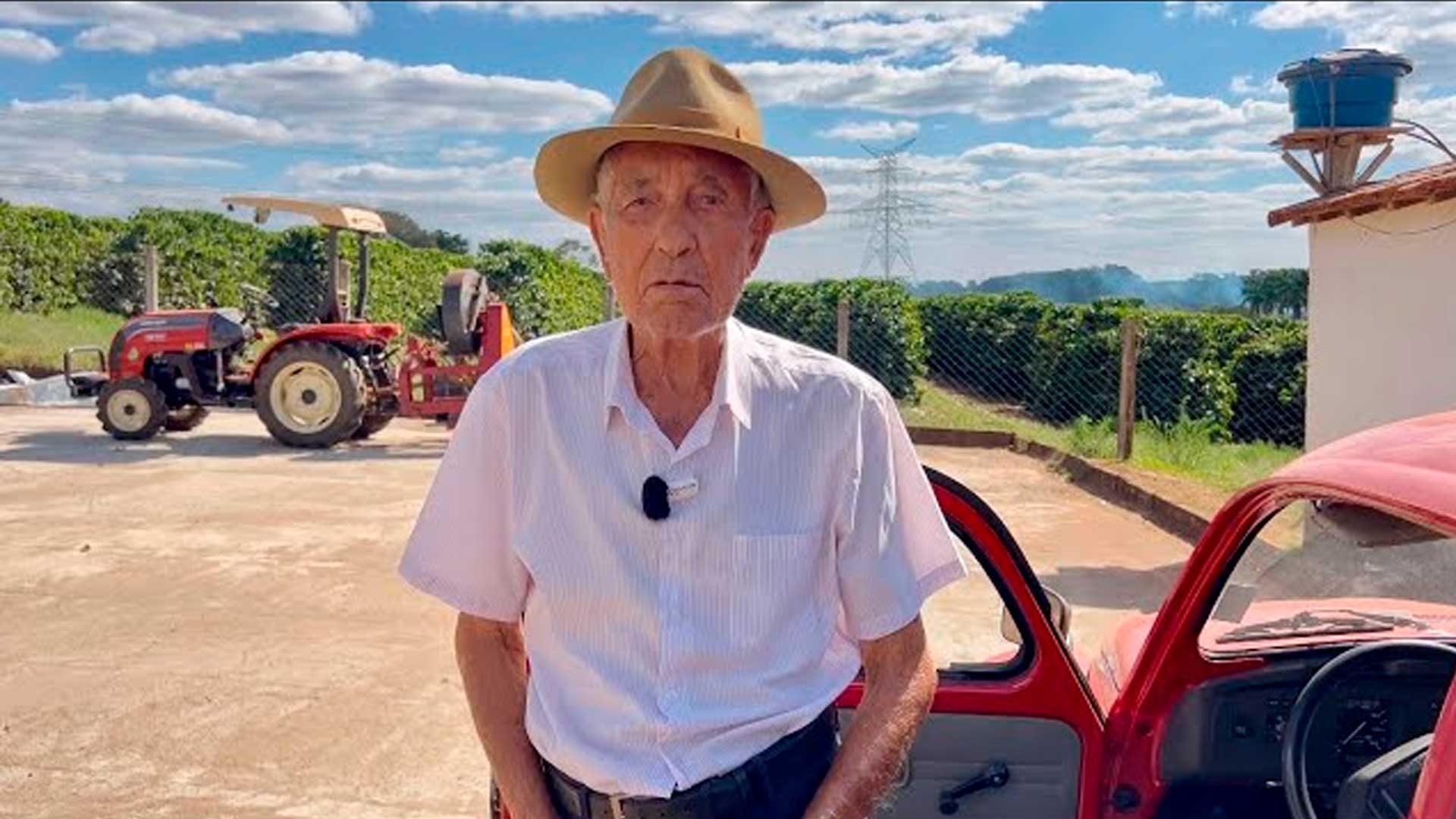


A farmer born on July 29, 1925, remains active in the routine of the farm and arrives driving his own car. The record shows a morning of conversation, coffee drying on the porch, and memories of work since youth.
The meeting takes place in Itamogi, in the South of Minas Gerais, in a typical rural property setting, with a porch, shed, and crops. In the video circulating on social media, the farmer Manoel, known as Seu Neném, arrives driving and quickly becomes a topic of conversation because he insists on repeating that he still goes to the farm every day.
The date of birth is clearly mentioned in the conversation, July 29, 1925, which puts the centennial on July 29, 2025. Between jokes, he shows his teeth, claims they are natural, and responds with short, straightforward phrases, as someone who has lived enough to not need to embellish anything.
What stands out is not just the old car or the age, but the way he moves through the space with familiarity. He points out what he has built, comments on fences, lumber, walls, and water tanks, and speaks about coffee as someone who knows the right point just by looking.
-
He started running at 66 years old, broke records at 82, and is now a subject of study for having a metabolic age comparable to that of a 20-year-old, in a case that is intriguing scientists and inspiring the world.

-
Oldest tree on the planet reappears after 130 years of searches: Wattieza, 385 million years old, was 10 meters tall and had no leaves or seeds; Gilboa fossils in New York solved the mystery in 2007.

-
A 48-square-meter house assembled in hours with 4,000 bricks made of recycled plastic that does not absorb moisture, has natural thermal insulation, and costs less than 90,000 reais in a complete kit.

-
Luciano Hang revealed that Havan’s air fleet has already accumulated more than 20,000 landings, 10,000 flight hours, and 6 million kilometers traveled, and he says that without the planes, the company would never have grown so quickly.


The interview progresses like a neighborly visit, with grandchildren nearby, sugarcane cut on the spot, and simple questions. In the midst of this daily life, a story of work and family emerges, functioning as a portrait of an entire generation from rural Minas Gerais.
Itamogi and the Farm Where Coffee Still Sets the Rhythm of the Day

Itamogi is a municipality in South Minas Gerais, a region where agriculture is the economic basis, and coffee production stands out in local institutional information.
The setting of the video matches this context, coffee on the porch, conversations about drying, and the old way of assessing the grain’s point. For those living in coffee-growing regions, this detail is not folklore; it is a technique passed down by eye and hand.
Sebrae has already described Southwestern Minas as a significant area in the state’s coffee culture, listing municipalities that include Itamogi and Monte Santo de Minas, neighbors in the same productive dynamic.
A Century of Work, Losses, Memory, and the House That Was Full on Sundays
In several passages, Seu Neném returns to the subject of work as if it were part of his identity, not just a phase. He recalls activities in the field, talks about milk, cheese, and times when the house was full, especially on Sundays.
The family appears as the axis of the narrative; he mentions nine children, says they are alive, and discusses the unity as a result of upbringing. The grandson reinforces the idea of legacy, describing the grandfather as a school and support, someone who taught practical life on a daily basis.
There is also the hard part, stated without dramatization, when he mentions that after the death of his wife, “he lost meaning” and that “God knows.” The sentence is short but changes the tone and helps to understand why the farm can also be routine and refuge.
When he points to old constructions and tools made by himself, the story becomes more than just about longevity. It becomes about permanence, those things that stand for decades, like the barn mentioned as being 70 years old and the wood he claims is still firm.
And in the midst of all this, he offers the maxim that serves as a “recipe” for getting far: speak the truth and keep secrets. It functions as both a joke and a philosophy because it summarizes discipline, coexistence, and self-control in few words.
Driving at 100 Years, Autonomy, and the Rules That Change with Age
The image of the centenarian driving reignites an inevitable discussion: to what extent does driving represent autonomy and when does it become a risk that requires more vigilance? In Brazil, the validity rules of the driver’s license change with age, and drivers aged 70 years or older fall into a shorter renewal interval, with renewals every three years, in addition to relevant medical requirements.
There are also recent measures for automatic renewals for “good drivers” that do not apply to those aged 70 or older, precisely because of this additional care.
Brazil with More Centenarians and What the Statistic Does Not Show
The case of Seu Neném gains attention at a time when the number of centenarians in the country has increased. Data from the 2022 Census processed by IBGE show 37,814 people aged 100 or older, and the growth compared to 2010 is significant.
However, the statistics do not explain daily life. They do not say who wakes up early, who still works, who has a support network, who lives in the countryside or the city, nor what the person has lost along the way.
In the video, what appears is a set of factors that usually sustains active old age: routine, purpose, family bonds, and an identity built through doing. Even when he says he forgets some things, it is clear that he retains lucidity for what matters in daily life.
The most interesting part may be this: old age is not seen as a mandatory pause, but as a constant negotiation between the limits of the body, desires, and care. It is here that family enters, who celebrates but also observes, guides, and needs to decide when to intervene.
The Legacy of Seu Neném and the Question That Remains for the Interior of Brazil
When he teaches how to “wash” coffee and talks about the grain’s point, what is at stake is more than just technique. It is the transmission of knowledge that is not in manuals but in practice repeated for decades, just as the farm teaches when to plant, harvest, and wait.
The grandson describes this as an inheritance—the grandfather taught the father, who taught the children, and so on. It is a silent chain that supports families in the countryside and gives meaning to work even when the world changes.
Therefore, Seu Neném’s story is not just that of a 100-year-old man driving a Fusca. It is about a way of life that insists on remaining, and for that reason, it forces us to discuss what care is and what control is.
Do you think that driving in old age is a right that should be preserved as much as possible or a risk that the family should cut before something serious happens? In your opinion, what is the limit between protecting and taking away the autonomy of someone who still feels capable? Leave your comment and say how this decision should be made within the household.









Eu falo por mim, ja diriji muito nesta vida a trabalho pela empresa quê trabalhei por quase 40 anos.
Cansei de dirigir hoje não gosto mais de
Diriger.
Tenho 65 anos ainda trabalho, sou mestre de obras, vou pr trabalho enfrento o trânsito caótico da minha cidade tudo de moto mais carro,não gosto mais de dirigir.
Seu Neném (Manoel de Souza) é meu tio, irmão mais velho do meu pai João de Souza( in memorian)… o Tio Nenêm é um exemplo de fortaleza, homem íntegro.. excelente agricultor e maravilhoso pai de familia. Me orgulho dele!!
Em 1° lugar, Deus abençoe seu neném, pela longevidade, se ele é lúcido e tem discernimento para dirigir na área rural , qual problema?, porém tem que ser acompanhado e avaliado pela família e analisar qual seu limite de risco com a sua dirigibilidade.