





 Portuguese
  English
  Spanish
  7 min of reading
  1 comment


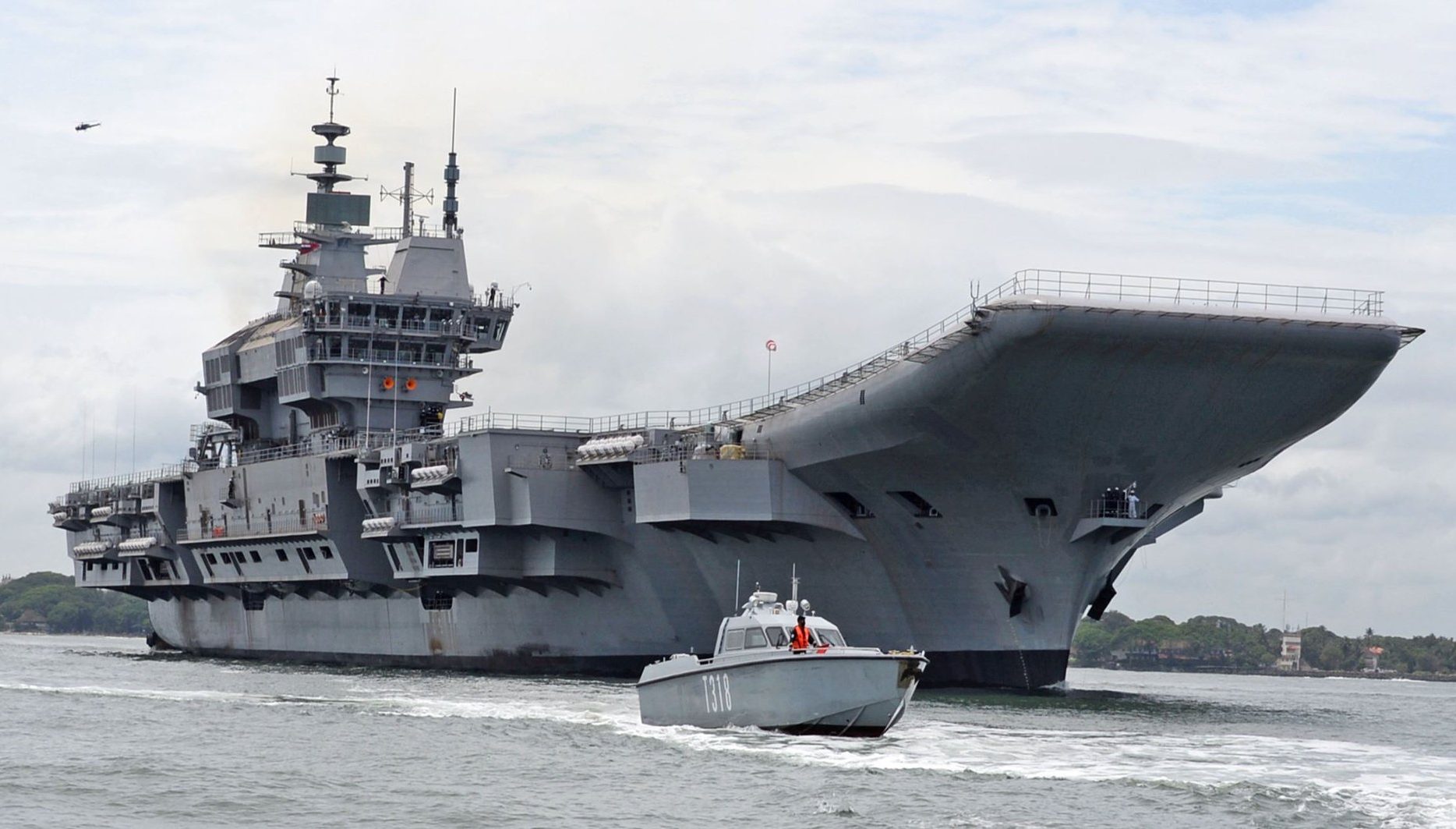


INS Vikrant: How India Took 23 Years and Over US$ 3 Billion to Build Its First National Aircraft Carrier and Enter the Restricted Group of Countries Capable of Designing Aircraft Carriers
In 1971, during the war between India and Pakistan, the Indian Navy engaged in combat in the Arabian Sea with only six warships. Even with this relatively small force, the outcome was devastating for Islamabad. The naval operations known as Operation Trident and Operation Python sank ships of the Pakistan Navy, destroyed port facilities in Karachi, and established an effective naval blockade against the eastern coast of Pakistan.
The centerpiece of that campaign was the aircraft carrier INS Vikrant, a ship acquired from Britain in 1957 and originally built for the Royal Navy during World War II. Operating embarked aircraft, the ship allowed India to project naval power far beyond the reach of its destroyers and frigates.
Five decades later, the name Vikrant would again take center stage in Indian naval strategy. The difference is that this time, the ship would not be imported from a foreign shipyard. The new aircraft carrier INS Vikrant (IAC-1) was entirely designed in India, built at the Cochin Shipyard Limited in Kerala, and outfitted with steel and systems produced within the country itself. The project took 23 years to complete and ended up costing about 13 times more than the initial budget, making it one of the largest industrial programs in Indian naval history.
-
Brazilian city neighboring Paraguay becomes a ‘magnet’ for people seeking quality of life and high standards with exceptional growth and commutes of up to 15 minutes.

-
A rare storm transformed part of the Gulf into an unlikely scene of hail, extreme rain, and tornado risk in the middle of the desert, with volumes that exceeded the annual average in a single day.

-
Brazil catches the world’s attention with ships powered by ethanol and biodiesel that have lower emissions, an unprecedented certification with advantages in chartering, and a revolution in cabotage.
-
A couple who only has Sundays free has built a hand-dug pool, a hamburger joint, a dance hall, and a playground in their own home without hiring a mason, and even with breaks due to accidents and the pandemic, the work has never truly stopped.

Project 71: India’s Strategic Decision to Build a National Aircraft Carrier
The decision to develop an Indian national aircraft carrier arose at a time of military tension. In May 1999, during the Kargil War, then-Defence Minister of India George Fernandes officially authorized the development of the so-called Indigenous Aircraft Carrier, internally known as Project 71. The initial projected budget was 1,725 crores of rupees, and the timeline estimated that the ship would be ready in eight to ten years.

The Indian government formally approved the project in January 2003. At that point, the technical specifications had already evolved. The planned displacement of the ship increased from 32,000 to 37,500 tons, allowing it to accommodate the Russian MiG-29K fighter jet, chosen as the main combat aircraft of the future air wing of the aircraft carrier.
The shipyard responsible for construction would be Cochin Shipyard Limited, the largest shipyard in India. While it had experience in building commercial vessels, the yard had never produced a military aircraft carrier.
Construction of the INS Vikrant: Modular Engineering and Industrial Challenges
The keel of the INS Vikrant was laid on February 28, 2009 by then-Defence Minister A. K. Antony. At the time of the ceremony, 423 modular structural blocks, weighing over 8,000 tons, had already been fabricated. The ship was built using naval modular construction techniques, in which large sections of the hull are produced separately and then joined together.
Overall, the Vikrant was assembled from 874 individual steel blocks, allowing different parts of the ship to be produced simultaneously before final integration into the main hull.
This construction method is widely used in modern shipbuilding because it reduces assembly time and improves structural accuracy.
Delays in the Construction of the Vikrant Aircraft Carrier Multiplied Project Costs
The original schedule called for launching in 2010, starting tests in 2013, and commissioning in 2014. In practice, the project suffered successive delays. One of the main issues was the delay in the delivery of the main gearboxes, fundamental components of the naval propulsion system. The lack of these parts caused interruptions in several construction stages.
At the same time, the Indian Navy faced another complex project: the refit of the Soviet aircraft carrier Admiral Gorshkov, acquired from Russia in 2004. The initial contract, valued at US$ 1.5 billion, ended up costing US$ 2.35 billion after contract revisions and technical disputes.
The hull of the Vikrant was removed from the dry dock for the first time in December 2011, still without many of its internal systems installed. The official launch took place in August 2013. In 2016, the Indian Audit Office released an audit pointing out planning failures, administrative delays, and schedule management issues. The project cost, which was 1,725 crores of rupees in 1999, had reached 19,341 crores in 2014.
Commissioning of the INS Vikrant: The First Aircraft Carrier Fully Built in India
The sea trials of the INS Vikrant began in August 2021. After a series of evaluations of navigation, propulsion, and air operations systems, the ship was finally commissioned in September 2022 by Prime Minister Narendra Modi, at the Cochin Shipyard in Kochi.
The final cost of the project ranged between 20,000 and 23,000 crores of rupees, equivalent to approximately US$ 2.5 to 3.1 billion.
While the price is significantly lower than the cost of Western nuclear aircraft carriers — which can exceed US$ 12 billion — the project still represented an increase of around 13 times the original estimate.
Technical Characteristics of the INS Vikrant Aircraft Carrier
The INS Vikrant (IAC-1) measures 262 meters in length and 62 meters in width, with a displacement of 45,000 tons at full load.
The ship is powered by four General Electric LM2500+ gas turbines, distributed across two propeller shafts and capable of generating 88 megawatts of power. This energy would be sufficient to power approximately 5,000 homes. The maximum speed of the aircraft carrier is 28 knots, with an operational range estimated at 7,500 nautical miles.
The ship accommodates around 1,700 crew members, distributed across 2,300 internal compartments. The structure includes accommodations designed for women officers as well — an important advancement for the integration of female sailors into the Indian Navy.
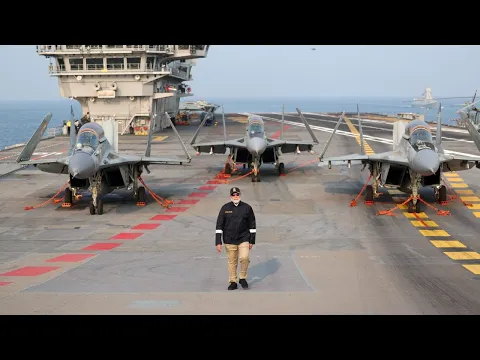
Internally, the ship features about 8 kilometers of corridors, along with a hospital that has 16 beds, two operating theaters, and over 270 night landing aid lights for aircraft. The flight deck spans 12,500 square meters, equivalent to about two and a half hockey fields.
STOBAR System and Embarked Aircraft of the Indian Aircraft Carrier
The INS Vikrant utilizes a STOBAR (Short Take-Off But Arrested Recovery) configuration, which combines short take-off with a ski-jump ramp and cable-assisted landing. This configuration allows operation of up to 30 embarked aircraft, including:
- MiG-29K fighters
- Kamov Ka-31 early warning helicopters
- MH-60R Seahawk helicopters for anti-submarine warfare
This combination transforms the aircraft carrier into a mobile platform for naval power projection in the Indian Ocean.
The Special Steel Developed for Building the Vikrant Aircraft Carrier
One of the major industrial challenges of the project was the steel used in the hull and deck. Initially, the plan was to import special naval steel. However, the Indian Navy decided to develop domestic production.
The result was a partnership between:
- Defence Metallurgical Research Laboratory
- Steel Authority of India Limited (SAIL)
Two types of naval steel from the DMR-249 series were created:
- DMR-249A for the hull
- DMR-249B for the flight deck
Approximately 30,000 tons of steel were produced in the steel plants of Bhilai, Bokaro, and Rourkela.
This was the first ship of the Indian Navy built entirely with domestic steel.
National Content of the Project and Impact on India’s Defense Industry
The national content of the INS Vikrant reached approximately 76%. Among the locally produced systems is the combat management system, developed by Tata Advanced Systems, the first system of its kind created by a private company for the Indian Navy.
Over 100 small and medium enterprises participated in the supply chain. According to the Indian government, the project generated 2,000 direct jobs and around 13,000 indirect jobs.
India Joins the Restricted Group of Countries Capable of Building Aircraft Carriers
Before Vikrant, only five countries had proven capacity to design and build aircraft carriers with their own technology:
- United States
- United Kingdom
- France
- Russia
- China
These are also the five permanent members of the UN Security Council. With the commissioning of Vikrant in 2022, India became the sixth country in the world with this capability, being the only one outside the P5 group.
Operation Sindoor and Mobilization of the Vikrant Battle Group
In May 2025, a terrorist attack in Pahalgam, Kashmir, killed 26 people. India responded by launching Operation Sindoor on May 7. The INS Vikrant was deployed to the Arabian Sea in 96 hours.
The naval group included:
- up to 10 escort ships
- 7 destroyers equipped with BrahMos missiles
- 7 stealth frigates
- about 6 submarines
In total, 36 first-line naval assets were mobilized. According to Indian authorities, the Pakistani fleet remained in port throughout the operation.
The Next Indian Aircraft Carrier: Project IAC-2
The experience from Project 71 is being used to develop the next Indian aircraft carrier, known as IAC-2. The ship is expected to maintain a displacement close to 45,000 tons, but may incorporate electromagnetic catapults (EMALS) similar to those used by the U.S. Ford-class carriers.
The goal is to increase the national content of the project and reduce reliance on foreign suppliers. The Vikrant took 23 years to complete, but the naval and defense industry created around the project now provides an industrial base that can accelerate the next programs.
India, which for six decades had to purchase its aircraft carriers abroad, has begun to master the technology necessary to design and build them within the country.









Serán 45.000 toneladas. Vaya error en el titular