





 Portuguese
  English
  Spanish
  5 min of reading
  6 comments


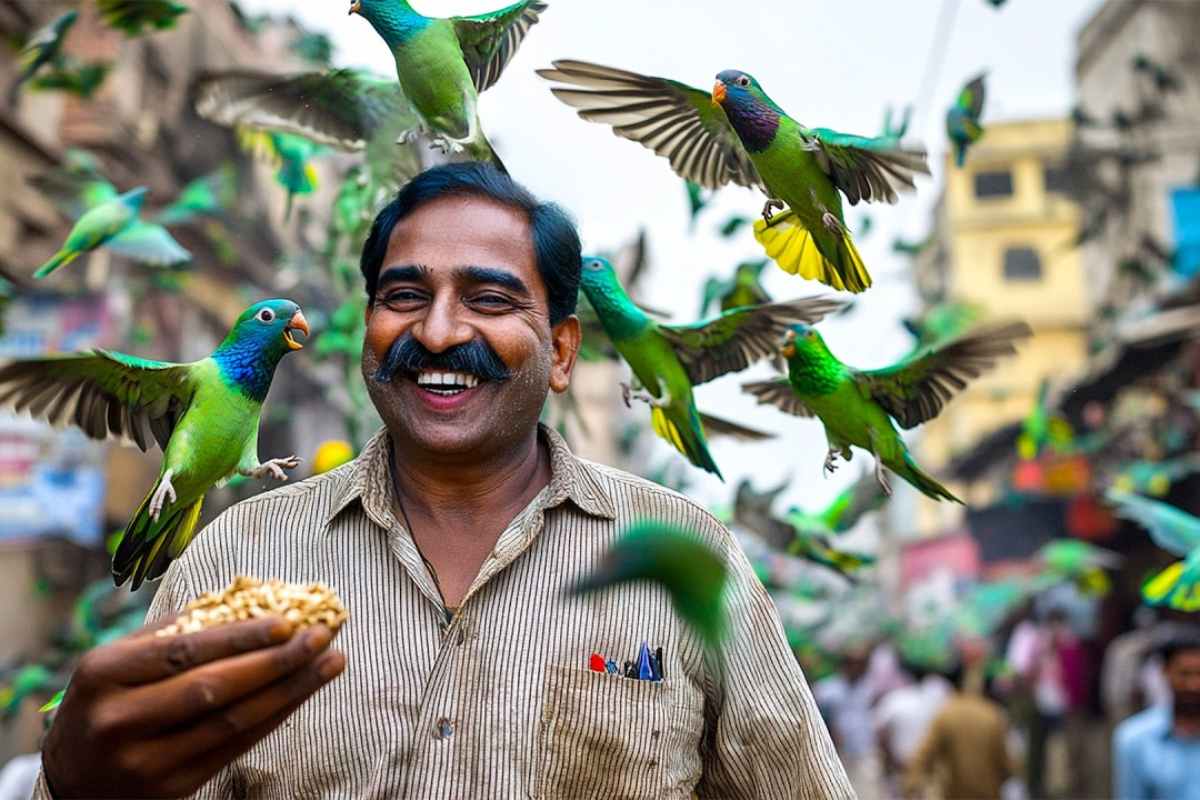


With Nearly Twenty Years Of Nonstop Routine, Joseph Turns His Own Roof Into A Daily Refuge For Thousands Of Parakeets, Spends 40% Of His Income On Bags Of Rice And Coordinates Two Large Meals A Day, Rain Or Shine In Chennai, India, Always At The Same Time, Without Failing A Single Day.
The numbers are scary, but they are real. Every day, at dawn and at dusk, 35 kilos of rice are carefully spread on the terrace, while about 6,000 parakeets land in perfect rows, waiting for their turn to eat. At 66, the camera technician known as the “birdman of Chennai” has transformed a regular backyard into one of the largest urban bird feeding spots in India.
The habit started quietly after the 2004 tsunami hit the state of Tamil Nadu. Some birds appeared on Joseph’s roof looking for food, he responded with small handfuls of rice, and over time, the scene grew in scale and commitment. Nearly two decades later, flocks of parakeets cover the entire roof, and the daily routine of the resident revolves around keeping this mechanism alive, even at his own expense.
A Roof Taken Over By Parakeets Every Day

From afar, the building looks ordinary.
-
With emergency diversion to abandoned mining craters, engineers save villages from a devastating flood that was advancing through the desert and threatening to destroy entire communities in a matter of hours.
-
It seems simple, but it enriches: from R$ 500 to R$ 6,000 per piece and up to 10 days of handcrafted production, how is the couple from Praia Grande making a high income with hyper-realistic miniatures and turning a hobby into a money-making machine?

-
Artisanal well erupts with water in the sertão of Bahia, revealing a surprising flow with six active fissures underground and changing the landscape in the Bahian semi-arid region.
-
NASA published a photo taken from space of a mountain range in the interior of Goiás, and the whole world wanted to know what it was: beneath it lies the largest hot water spring on the planet, with temperatures reaching 70 degrees in the middle of the Cerrado.

Up close, the terrace has turned into a natural grandstand, occupied by rows of thick wooden boards where Joseph aligns small mounds of white rice.
It is on this improvised structure that thousands of parakeets land at the same time, organized, almost silent, as if following a choreography repeated for years.
The birds do not arrive by chance. Before the food is distributed, they can already be seen gathered on neighboring buildings, waiting for the invisible signal of the meal.
When the rice is in place, the air changes sound: the roof is completely covered by green feathers, quick beaks, and a continuous noise of wings, while the city continues its routine below.
For those watching for the first time, the scene may seem exaggerated, but for Joseph, it is just another normal day with his parakeets.
The Heavy Cost Of 40% Of His Income On Rice

None of this is sponsored. All the rice used to feed the parakeets comes out of Joseph’s pocket, who directs about 40% of his income to maintain the ritual of two daily meals.
In practical terms, this means buying rice in bulk, day after day, year after year, just to sustain flocks that do not belong to any breeding and do not generate a direct financial return.
For a camera technician with a regular routine, giving up almost half of his budget to feed birds is a radical decision.
Still, Joseph has maintained his commitment for about fifteen years without interrupting the sequence, even on rainy days, extreme heat, or personal difficulties.
He does not mark days off, holidays, or “rest days” in the parakeets’ schedule.
If the clock approaches the scheduled time, the priority is one: to ensure that the roof is ready to receive the green swarm.
35 Kilos Of Rice At Dawn And Another 35 At Dusk
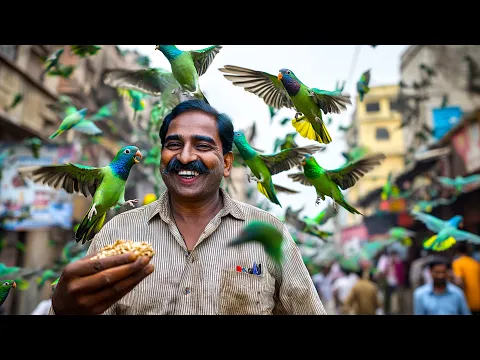

The daily logistics are simple in theory, but heavy in practice. It’s 35 kilos of rice at sunrise and another 35 kilos before sunset, always served quickly to not miss the attraction point of the flocks.
Joseph goes up to the terrace before six in the morning to prepare the first round, distributing the mounds of food in lines so that everyone can access the food without chaotic crowding.
At the end of the day, the process repeats itself.
A little before sunset, the roof is set up again as an aerial cafeteria, with the same care in arranging the boards and the mounds of rice.
In a few minutes, the parakeets descend in masses, cover the terrace in green, and clean up almost all the available grains.
The cycle ends until the next dawn, when everything starts again, with no room for improvisation or delay.
The Discipline Of A Man And The Clock Of The Parakeets
Over the years, the parakeets have started to synchronize their routine with Joseph’s.
There is an expected time, a known route, a roof that has become a fixed point on the invisible map of urban birds in Chennai.
The behavior shows the level of predictability that the resident has managed to create: if Joseph is late, the birds wait, circle the neighboring buildings, and return as soon as they see movement on the terrace.
For him, the scene is not just a visual spectacle but an emotional commitment.
Joseph treats the flocks as an extended family, with thousands of “children” scattered across the city sky.
The return does not come in numbers, nor in contracts, but in the daily image of birds landing, feeding, and leaving healthy.
It is this repeated picture that, according to him, makes the day worthwhile.
From An Ordinary Roof To A Symbol Of Devotion To Animals
The story of the resident of Chennai began with a few birds looking for food after a climatic tragedy and has transformed into an urban ritual accompanied by neighbors and occasional visitors.
What stands out is not just the volume of rice or the number of parakeets, but the consistency: nearly twenty years providing meals twice a day, without any recorded interruption, always with the same calmness and the same repeated gesture of scattering the grains on the terrace.
Joseph does not present himself as an activist or as a character in an official animal protection campaign.
He acts individually, silently, taking on a high cost and a heavy daily workload to maintain a direct relationship with the fauna that has adopted the building as a meeting point.
The result is a clear example of how a personal choice can modify the behavior of an entire population of parakeets in an urban environment.
In your place, would you have the courage to dedicate 40% of your income for so many years just to feed parakeets on the roof every day?








Claro que gestor maravilhoso
Ser humano especial é diferente da gente simples mortal. Assim seja o grande benfeitor das pequenas aves em busca de alimentos.
Você é especial, muito especial.
DEUS não escolhe os capacitados,capacita os escolhidos.
Esse camarada deve ter algum parafuso solto, só pode👆👆👆🤔🤔🤔
Parafuso”solto”, tem vc, bezalel. Isso se chama “AMOR”