





 Portuguese
  English
  Spanish
  6 min of reading
  0 comments


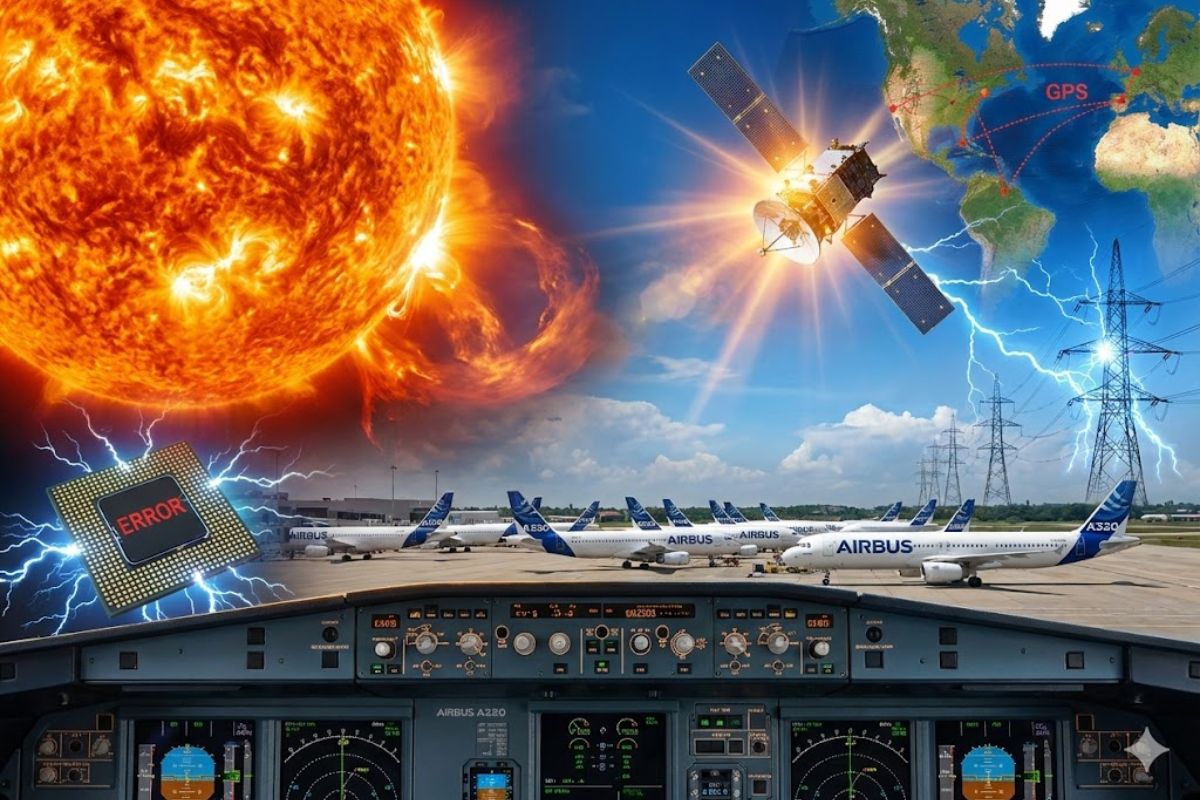
Technical Shutdown of 6,000 Airbus A320 to Fix ELAC Computer Failure Reveals How a Simple G1 Geomagnetic Storm Can Cause Bit Flips, Corrupt Critical In-Flight Systems, Bring Down Satellites in Orbit, Impact Civil and Military GPS, and Strain Already Overloaded Electric Grids on a Global Scale with Economic Impacts.
The decision to ground around 6,000 Airbus A320 worldwide to update the ELAC computer software has exposed, in a rare and explicit way, an uncomfortable vulnerability: it only takes a “minor” solar storm classified as G1 to alter the behavior of a critical system on board. The incident did not just affect a single airline or specific route; it forced Airbus and EASA to coordinate a global intervention for one of the most widely used aircraft families on the planet.
Behind this seemingly technical preventive measure lies a broader message. The more advanced, miniaturized, and efficient the chips that control airplanes, satellites, GPS, and electric grids become, the less energy is required to disrupt their operation, and the more our infrastructure becomes dependent on the “mood” of the Sun. The case of the Airbus A320 thus turns into a case study of how the next major systemic failure can begin with a single inverted bit.
What Brought Down the Airbus A320 on Paper and Sent 6,000 Airplanes to the Shop

The trigger for the massive review was an incident that occurred on October 30 involving an Airbus A320 from JetBlue, flying from Cancun to Newark.
-
Expedition 501: Scientists drill into the ocean floor and discover a giant reserve of fresh water hidden beneath the sea, extracting nearly 50,000 liters and revealing an invisible system that could reshape the map of water scarcity.

-
Archaeologists find an intact tomb over 2,500 years old, with more than 100 preserved objects, weapons, jewelry, and human remains never touched.

-
Volcanic lava transforms into threads as fine as human hair that travel over 30 kilometers by wind and fall like cutting rain on roofs and backyards in Hawaii and Iceland.

-
NASA issues a warning for the feared Godzilla El Niño that could change the planet’s climate in 2026 with extreme warming of the Pacific capable of causing devastating droughts in some regions and historic floods in others simultaneously.


Without any commands from the pilots, the aircraft suddenly pitched its nose down in a maneuver reminiscent of a stall.
An investigation by Airbus identified the culprit: a high-energy neutron, generated by the interaction of solar wind with the atmosphere, struck a memory cell of the ELAC, the computer that controls elevators and ailerons.
The energy was enough to change the voltage of a microscopic transistor and turn a “0” into a “1.”
This phenomenon, known as bit flip, caused the L104 version of the software to interpret the situation as a real aerodynamic risk.
The ELAC reacted exactly as it was programmed: to “save” the aircraft by pitching down to gain speed, even though, in practice, there was no stall at all.
The problem, therefore, was not with the hardware itself, but in the software logic, which had no robust mechanisms to discard corrupted data.
The now-mandatory update for thousands of Airbus A320 aims precisely to reinforce this logical immunity, so that a single bit altered by radiation cannot trigger such an aggressive response.
Not all aircraft are affected, but the scale of the campaign shows how a microscopic error in a specific code can have global repercussions.
The Invisible Cost of Moore’s Law Inside an Airbus A320
Three decades ago, transistors in aviation systems were relatively large components, requiring more voltage to change states and thus were less sensitive to energetic particles.
Today, the microprocessors that equip an Airbus A320, like those in cars and smartphones, operate at the nanoscale, with increasingly lower voltages.
This means, in practice, that the energy required to “kick” a transistor from 0 to 1 has dropped to the point where a simple G1 solar storm is enough to cause effects previously expected only in extreme events, like the famous Carrington Event of 1859.
The same Moore’s Law that multiplied performance and reduced power consumption now exacts a price in vulnerability.
The incident involving the Airbus A320 makes it clear that this cost is not theoretical.
A pulse of radiation that goes unnoticed by those looking at the sky can alter the internal state of a chip and, consequently, the behavior of a complex system.
The more layers of automation stack upon this delicate silicon, the greater the risk of a rare error transforming into an unexpected maneuver, false alarm, or abrupt shutdown.
Before the Airbus A320, a Precedent Called Qantas 72
Aviation veterans quickly recalled another case: Qantas Flight 72, in 2008, operated by an Airbus A330, which experienced two abrupt descents over the Indian Ocean.
Passengers were thrown against the cabin ceiling, and the incident became part of the modern aviation safety nightmare catalog.
At that time, the Australian Transport Safety Bureau concluded that one of the aircraft’s inertial reference units had been struck by cosmic rays, causing the system to “see” an angle of attack of 50 degrees, completely incompatible with reality.
The logic of protection kicked in with erroneous data and produced the opposite of safety.
The difference today is one of scale.
There are many more airplanes in the sky, greater dependence on automation, and a Solar Cycle 25 that is proving to be more active than expected.
What in 2008 was a warning restricted to one model and a set of sensors now extends to a fleet of thousands of Airbus A320, with direct impacts on airports, air traffic, and passenger confidence.
From Airbus A320 to Satellites: When the Sun Brings Down Entire Constellations
The incident involving the Airbus A320 is not the first reminder that the Sun directly interferes with technological infrastructure.
In 2022, a relatively modest solar storm increased the density of the air in low orbit, slowing down newly launched Starlink satellites by SpaceX.
Of the 49 satellites, 38 were lost, not due to electronic failure, but due to thermodynamic effects in the atmosphere.
Satellites, by definition, are even more exposed to solar radiation than airplanes.
Communication systems, sensors, and solar panels are constant targets of energetic particles and geomagnetic storms, which can cause everything from orbital changes to permanent failures in critical components.
In 2003, on “Halloween night,” a series of solar storms caused an interruption of about 30 hours in WAAS, a GPS precision augmentation system operated by the FAA.
In that scenario, civil dependence on GNSS was still less than it is today.
If a similar interruption occurred in the era of transportation apps, real-time logistics tracking, and bank synchronization via GPS, the impact would be much broader.
What If the Next Carrington Event Strikes a World Full of Airbus A320 and Data Centers?
The most unsettling aspect of the report on the Airbus A320 is the relatively modest origin of the problem: a G1-level geomagnetic storm, classified as “minor” on a scale that goes up to G5, “extreme.”
If a low-intensity event is already capable of flipping bits and activating protection logics, what would happen in a new Carrington Event?
In 1859, currents induced by a massive solar storm paralyzed telegraph networks and even caused sparks in equipment.
Today, our baseline is different: constellations of GPS, interconnected electrical networks, submarine fibers, data centers, and densely automated commercial aviation, with thousands of Airbus A320 and other models guided by sensors, computers, and external signals.
In an extreme scenario, we would not be talking only about the software update of 6,000 aircraft, but the possibility of partial loss of GNSS constellations, physical damage to high-voltage transformers, and interruption of global transportation for days or weeks.
The Sun, which has always been treated as a stable boundary condition, indeed enters the operational risk matrix.
How to Reduce Risk Without Abandoning Technological Gain
The answer does not lie in forgoing miniaturization but in hardening the layers of protection around the most critical systems.
In aircraft, this means everything from redundancy architectures to software capable of detecting and discarding clearly inconsistent readings, like the one that affected the ELAC in the case of the Airbus A320 from JetBlue.
In satellites and electrical networks, the discussion includes more robust designs, controlled shut-down protocols during intense storms, and integration between space weather monitoring centers and infrastructure operators.
The episode involving the A320 shows that, even in a G1 event, it is worth reviewing algorithms and protection logics before an isolated failure turns into a tragedy.
We have built a civilization supported by a thin layer of silicon that is extremely sensitive to the space environment, while our star follows an activity cycle that we cannot control, only observe.
If today the consequence was a global update campaign for thousands of Airbus A320, tomorrow the challenge may be to coordinate, in a matter of hours, the defense of satellites, aircraft, electrical grids, and financial systems in the face of a much larger storm.
Knowing that a simple G1 storm has already been capable of grounding 6,000 Airbus A320 for software correction, do you think governments and companies are taking the risk of space weather on technological infrastructure seriously, or are they still treating the Sun as a “theoretical” problem distant from daily life?






-

-

2 pessoas reagiram a isso.