





 Portuguese
  English
  Spanish
 4 min of reading
  0 comments


Casa de Pedra Has Opening of 197 Meters Revealing Giant of the Atlantic Forest and New Global Landmark of Brazilian Speleology Confirmed by USP Now After Large Historical Scientific Expedition
The largest cave mouth on the planet is in Brazil and, now, this is no longer just an estimate. Researchers from the University of São Paulo (USP) have confirmed, after a scientific expedition, that Casa de Pedra, located in the Ribeira Valley, interior of São Paulo, has an opening of 197.1 meters in height.
The work was accompanied by the program Fantástico, which showed the behind-the-scenes of this journey marked by technology, physical effort, and constant risks.
Closed to the public since 2003, the cave is back in the spotlight not as a tourist attraction, but as a natural heritage of global scale, capable of redefining Brazil’s place on the speleology map.
-
Surrounded by the sea, the airport will have a system to prevent airplanes from falling into the water; technology will be installed in Ilhéus (BA), with an investment of R$ 70 million.

-
With a cost per shot close to zero, the DragonFire laser could change naval warfare in 2027 and provide British ships with nearly unlimited defense against drones.

-
A British startup creates tires that generate electricity in electric vehicles when passing over potholes, speed bumps, and cracks.

-
Scientists have created robots made with living cells that have their own nervous system, swim on their own, explore the environment, and self-organize without any genetic engineering, and now they want to do the same with human cells.


A Giant Hidden in the Atlantic Forest
Those who approach Casa de Pedra are faced with a colossal arch that already impresses at first sight.
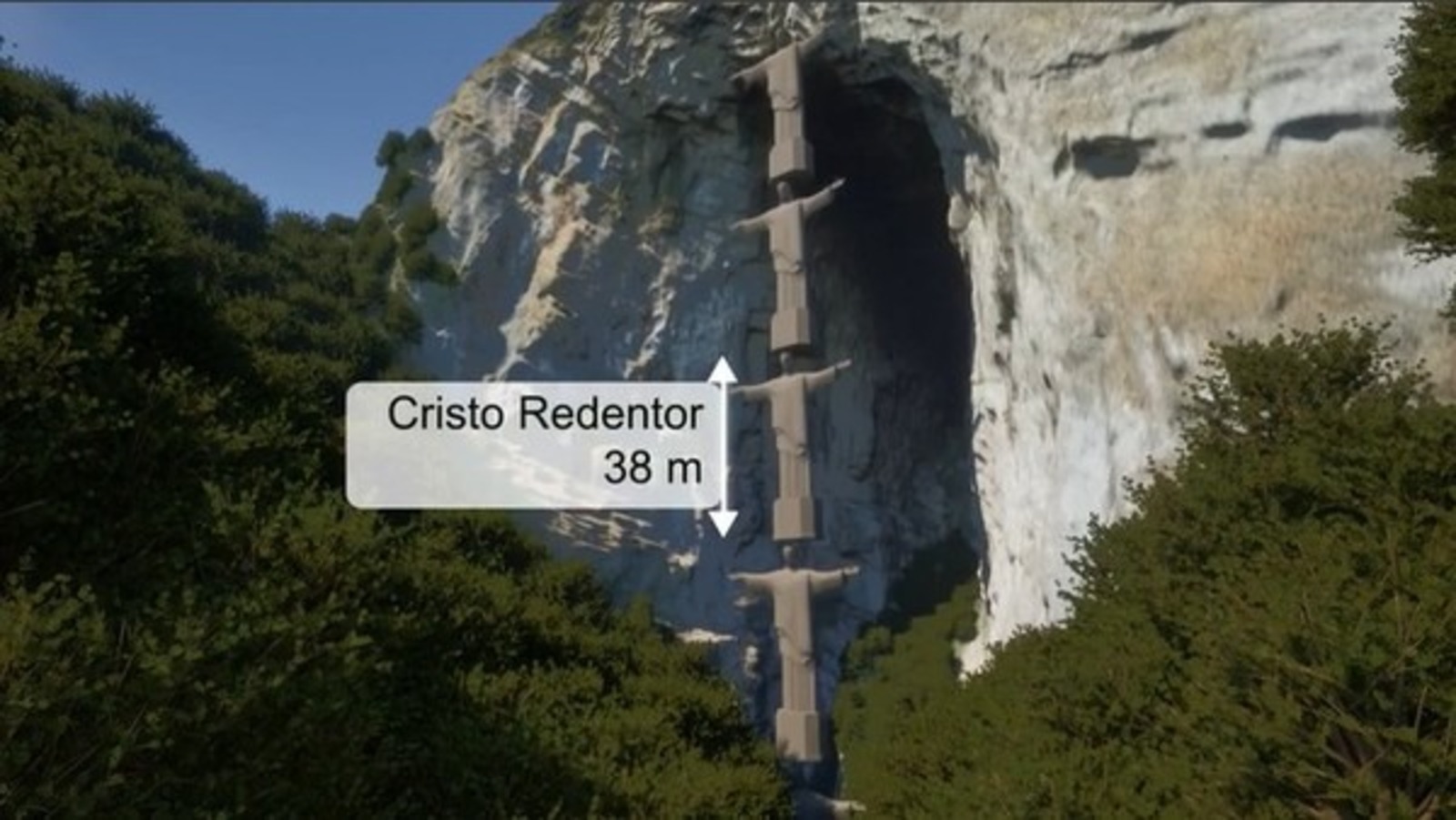
The survey conducted with drone and high-precision laser revealed that the opening is equivalent to stacking five Christ the Redeemers, a comparison that helps to gauge the magnitude of the formation.
“This number places it among those rare things that you don’t see every day, which nature manages to gift us,” says Nicolás Strikis, a researcher at the Geosciences Institute of USP, in an interview with Fantástico.
The region where the cave is located is part of PETAR (High Ribeira Tourist State Park), which houses over 400 cataloged caves. Still, none approach the scale of Casa de Pedra.
Three and a Half Hours of Hiking and Challenges
Reaching the largest cave mouth on the planet requires willingness. The Fantástico team accompanied geologists Nicolás and Vanessa from USP on a trail considered difficult.
Mud, streams, steep climbs, and heavy loads are part of the journey, which lasts about three and a half hours.
Among the equipment being transported, a box carried by two people drew attention.
Inside it was the system responsible for changing the story of the cave: a drone equipped with a laser capable of mapping the structure with scientific precision.
During the journey, the Atlantic Forest reveals its biodiversity. Arapongas, bush pigs, jaguars, and jaguarundis have been recorded in the region, reinforcing the preserved nature of the surroundings.
A Question That Lasted 36 Years
Since 1989, there has been an estimate for the size of the opening of Casa de Pedra, made using ropes.
The method, although ingenious for the time, had limitations since ropes stretch and human weight can interfere with measurement.
Now, the drone flew over the entrance emitting 1.92 million laser points per second. Each point helped form a detailed 3D model, eliminating uncertainties.
“It’s a Brazilian natural heritage. We can only preserve what we know,” explains the USP team, according to Fantástico.
Beauty That Also Represents Danger
The grandeur of Casa de Pedra comes with risks. A river runs throughout the internal expanse of the cave, and crossing it requires walking almost three kilometers over wet stones and in sections where the water reaches the chest.
In 2003, a water spout hit a group during the crossing. A guide and a tourist died, and the area was closed to tourism.
Residents report that when it starts to rain, conditions can change in minutes. In 2024, the USP team narrowly escaped a sudden flood.
Constant Monitoring and Concerning Data
Every two months, Nicolás and Vanessa return to the cave to monitor the water level. Sensors have recorded heights exceeding 2 meters, and at times the strength of the current has been enough to bend equipment.
This information feeds discussions about a possible controlled reopening, perhaps restricted to the dry months, between April and September, and with more stringent safety protocols.
For now, visitors can only reach the mouth of the cave, which for many is already a monumental experience.
A Title Without Competition
There are deeper caves or larger halls in the world, like Sơn Đoòng in Vietnam. However, when the criterion is the height of the entrance, none surpasses the Brazilian one.
Some large openings mentioned in China and Venezuela are not considered true caves, or do not have official measurements and geological consensus. At Casa de Pedra, the confirmation is clear: 197.1 meters in height.
Brazilian Heritage of Global Scale
For Nicolás Strikis, the discovery changes the way the world sees the Ribeira Valley. “They will then look at the state of São Paulo, at Casa de Pedra, as a place you need to put on your travel itinerary of things you need to know,” he stated to Fantástico.
As studies continue and debates advance, the cave remains closed, guarding not only a record but also stories, challenges, and a natural legacy that began to be unveiled decades ago.
With information from G1.








-

-

-

-

12 pessoas reagiram a isso.