





 Portuguese
  English
  Spanish
  7 min of reading
  0 comments


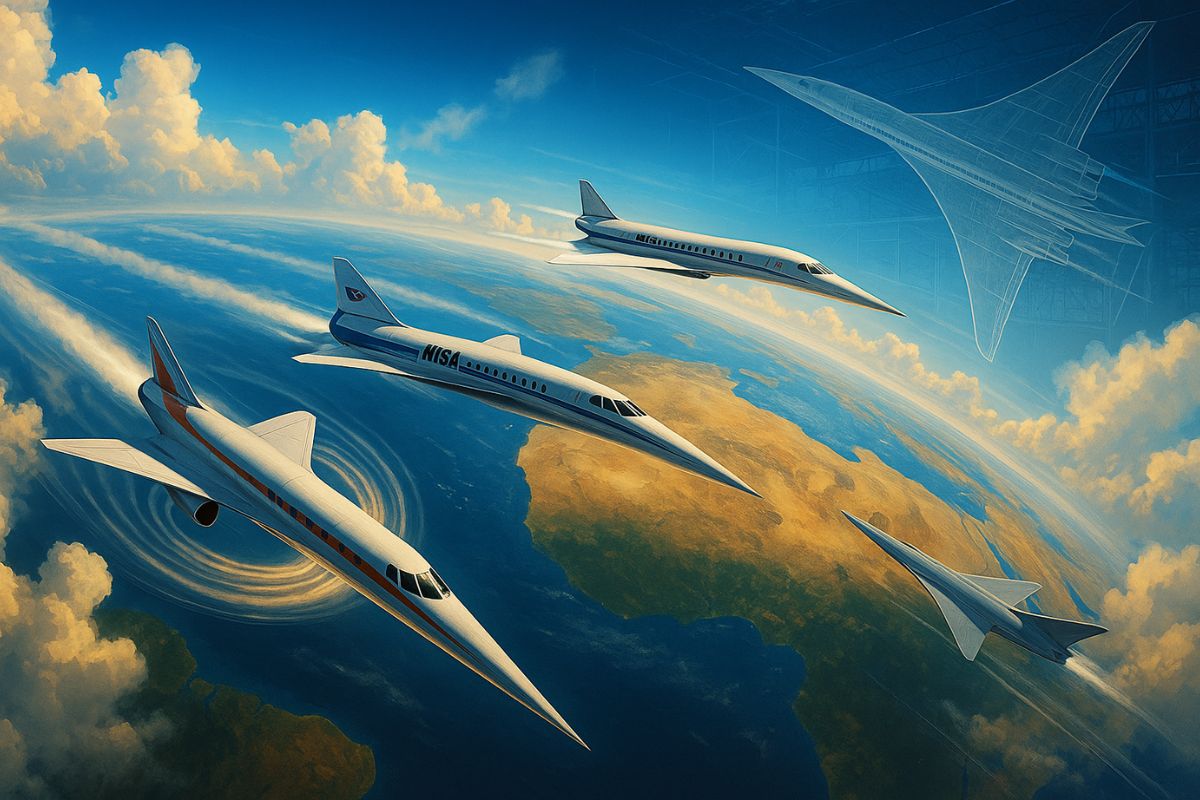
With Supersonic and Hypersonic Planes in Testing, the New Generation of Jets Aims to Cross Oceans in Minutes, Correct the Errors of the Concorde and Reposition Aviation as a High-Speed Vector
The aerospace industry is experiencing a rare moment where technology, ambition, and competition align around a single goal: a new generation of jets capable of reducing intercontinental travel to just a few hours or even minutes. Among flight prototypes, wind tunnel concepts, and classified military programs, the sector is working to break through physical, regulatory, and economic barriers that were exposed during the Concorde era.
At the same time, agencies like NASA, defense giants like Lockheed Martin, and private companies like Boom and Venus Aerospace are fueling a quiet race. This new generation of jets combines low-noise supersonics, hypersonic designs from Mach 6 to Mach 9, and hydrogen-powered commercial concepts, in a scenario where speed once again becomes a strategic differential, and not just a niche luxury.
How the New Generation of Jets Repositions Speed in Aviation
The central bet of this new generation of jets is simple in ambition and complex in execution: to make high speed a scalable, safe, and regulatory-compliant solution.
-
Expedition 501: Scientists drill into the ocean floor and discover a giant reserve of fresh water hidden beneath the sea, extracting nearly 50,000 liters and revealing an invisible system that could reshape the map of water scarcity.

-
Archaeologists find an intact tomb over 2,500 years old, with more than 100 preserved objects, weapons, jewelry, and human remains never touched.

-
Volcanic lava transforms into threads as fine as human hair that travel over 30 kilometers by wind and fall like cutting rain on roofs and backyards in Hawaii and Iceland.

-
NASA issues a warning for the feared Godzilla El Niño that could change the planet’s climate in 2026 with extreme warming of the Pacific capable of causing devastating droughts in some regions and historic floods in others simultaneously.

In the past, the Concorde proved that it was possible to cross the Atlantic in just a few hours, but it failed to balance operational costs, environmental impact, and a sustainable business model.
Now, the supersonic and hypersonic programs are working on three main fronts: reducing sonic boom to allow flights over populated areas, drastically increasing fuel efficiency, and designing aircraft that combine high speed with consistent commercial or military operation.
It’s not just about flying faster, but proving that this new generation of jets can survive in the real world, outside of laboratories and test hangars.
X-59: The Supersonic That Tries to Silence the Boom
The X-59, developed by NASA in partnership with Lockheed Martin, is one of the clearest symbols of this new generation of jets.
It has been specifically designed to tackle the problem that condemned supersonic flight over land: the sonic boom.
The aircraft features an extremely elongated fuselage and a design aimed at redistributing the shock wave when breaking the sound barrier, reducing the noise perceived on the ground to about 75 decibels, comparable to the shutting of a car door.
With a projected speed of around 1,488 km/h, the X-59 is not a conventional airline jet, but a technological demonstrator.
The goal is clear: to generate enough data to convince regulators to revise restrictions on supersonic flights over populated areas.
If the thesis is validated, it opens the way for part of this new generation of jets to operate not only over oceans but also on routes over continents, something unimaginable since the height of the Concorde.
Hypersonics: From the SR-71 Lineage to Projects Targeting Mach 9
In the military and experimental field, the new generation of jets advances beyond supersonic and enters the hypersonic range.
Lockheed Martin is working on the SR-72, the conceptual heir to the SR-71 Blackbird, aiming for operational goals around Mach 6, five to six times the speed of sound.
While the project is shrouded in secrecy, the public description is of a hypersonic reconnaissance platform, aimed at gaining strategic advantage in terms of range, response time, and penetration capability in sensitive zones.
Here, there’s no focus on passengers or commercial cabins, but the development of materials, aerodynamic profiles, and propulsion systems fuels the entire technological ecosystem.
At the most ambitious frontier of this new generation of jets, concepts like the A-HyM Hypersonic Air Master emerge, envisioning a commercial aircraft operating at Mach 7.3, around 9,000 km/h, with a titanium and carbon fiber structure, estimated capacity for about 170 passengers, and using hydrogen as fuel.
For now, it’s an advanced engineering exercise, without a production line, but it signals how far the sector is willing to project the future.
Venus Aerospace, in turn, presents the Stargazer M4, a reusable hypersonic jet with a range of 5,000 miles, conventional takeoff, ascent to 110,000 feet, and a target speed of Mach 9.
The stated promise is to enable global travel in about two hours, supported by propulsion systems tested with technology linked to NASA.
The Shadow of the Concorde Over the New Generation of Jets
Any discussion about the new generation of supersonic jets inevitably encounters the Concorde.
The Franco-British aircraft flew commercially from 1976 to 2003, becoming an icon of luxury and speed but accumulating severe limitations: few seats, expensive operation, complex maintenance, and, by the end of its career, technological obsolescence compared to the new generation of subsonic widebodies.
Two events accelerated the end of the program: the Paris accident in 2000, with 113 fatalities, and the global aviation downturn following the September 11, 2001, attacks.
With weakened demand and costs difficult to justify, British Airways and Air France retired the fleet after nearly 50,000 flights.
The message for the new generation of jets is clear: it’s not enough to be fast; it must be economically rational, environmentally defensible, and operationally robust.
The current challenge is to avoid repeating an elitist and fragile model that relies on extremely high fares and a limited passenger base.
Boom Supersonic and the Commercial Return of Speed
Among commercial projects, Boom Supersonic positions itself as one of the central names of this new generation of jets.
The XB-1 prototype, already in testing, has been dubbed the “child of the Concorde” and seeks to demonstrate in practice aerodynamic and operational viability for a supersonic passenger aircraft developed in the United States.
The commercial version, named Overture, aims to operate at approximately Mach 1.7 and already has purchase intentions from global airlines.
The company estimates more than 600 potential routes, offering significantly shorter flight times than a Boeing 747 on intercontinental routes.
The project attempts to combine lessons from the past with present demands: working with more efficient fuel, exploring routes over oceans where the sonic boom is not a regulatory issue, and at the same time, seeking adherence to modern sustainability criteria.
Commercial Hypersonics: Promise or Well-Founded Fiction?
Concepts like the A-HyM Hypersonic Air Master and the Stargazer M4 currently occupy an intermediate zone between advanced engineering and a vision for the future.
They are part of the same narrative of the new generation of jets, but still depend on answers to critical questions regarding structure, temperature, fuel, safety, and operational cost.
Reducing a route like London – New York to something close to 45 minutes, as conceptually proposed, involves dealing with intense aerodynamic heating, energy management at extreme levels, certification standards that do not yet exist, and above all, public acceptance of flights at regimes far beyond what commercial passengers are accustomed to.
Even so, the mere fact that these studies are on the agenda, with speed estimates between Mach 7.3 and Mach 9, indicates that the discussion about the future of aviation is no longer limited to turbofan efficiency and cabin layout, but places speed back as a strategic axis.
Regulatory, Environmental, and Market Obstacles
For this new generation of jets to stop being a set of prototypes and renders and become a fleet reality, three layers of challenges impose themselves simultaneously.
The first is regulatory: supersonic flights over land remain heavily restricted, and programs like the X-59 exist precisely to produce data that supports a potential rule change, without compromising the acoustic comfort of communities on the ground.
The second is environmental: high speeds generally imply greater energy consumption and emissions concentrated at critical altitudes.
Projects that fail to address this point may face strong resistance in a scenario of aggressive decarbonization targets.
The third is economic and market-oriented: the new generation of jets needs to prove that it can balance fare, occupancy, and operational cost sustainably, something the Concorde failed to do in the early 2000s.
The interest of airlines in models like Overture is a positive sign, but does not close the debate.
A New Cycle of Ambition for Aviation
Despite the uncertainties, one point is already clear: aviation has started to dream big again, and the new generation of jets puts speed back at the center of the discussion on global mobility.
Among silent supersonics, military hypersonics, and hydrogen-powered commercial concepts, the sector is experiencing a research and development cycle comparable to the major leaps of the 20th century.
Whether all these projects will actually reach global routes is still an open question.
But, for the first time since the end of the Concorde, crossing oceans in minutes has ceased to be mere science fiction and has returned to be considered, with reasonable seriousness, in the planning tables of agencies and manufacturers.
For you, if the ticket cost the same as a traditional flight, would you board a plane from the new generation of supersonic or hypersonic jets in the first years of operation?









-

-

-

-

-

-

30 pessoas reagiram a isso.