





 Portuguese
  English
  Spanish
  6 min of reading
  2 comments


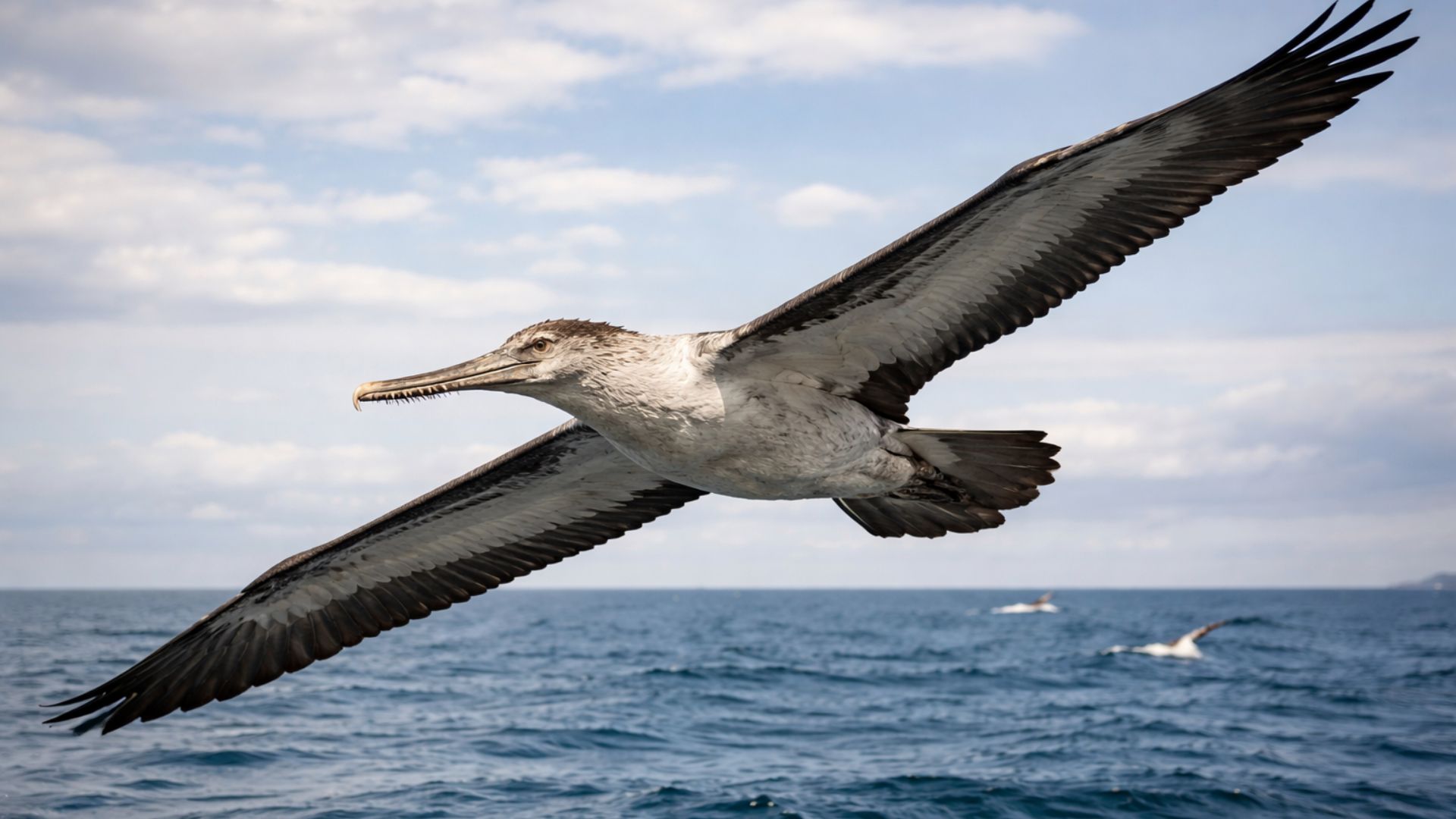


Estimated Wingspan of 6.4 Meters and Beak with “Pseudoteeth” Make Pelagornis Sandersi One of the Most Impressive Extinct Birds Ever Described, with Fossils in the United States and Study Published in 2014 Pointing to Rare Gliding Flight Limits.
An extinct seabird, with an estimated wingspan of about 6.4 meters and a beak marked by bony structures that look like teeth, has become one of the largest fliers ever described by science.
This is the Pelagornis sandersi, a species identified from fossils found along the coast of Charleston, South Carolina, in the United States, and described in an article published by the scientific journal Proceedings of the National Academy of Sciences, known by the acronym PNAS.
The size attributed to the species places it at a level that far exceeds the size of the largest flying birds today, such as large albatrosses.
-
The Mediterranean has become the target of the largest underwater archaeological mission ever coordinated by UNESCO: eight countries have joined forces to map shipwrecks and protect a historic corridor.

-
In France, a group of artisans spends 28 years building a medieval castle with 13th-century tools, without machines, without measuring tapes, and with almost zero carbon footprint, and the rediscovered techniques helped in the reconstruction of Notre-Dame.

-
Tourists on Everest were poisoned by guides who mixed substances in food to provoke false symptoms of altitude sickness while helicopter operators and hospitals charged inflated rescue fees to insurance companies.

-
Few people know this, but Neil Armstrong, one of the most famous NASA astronauts in history, survived the Korean War after jumping from the plane during his seventh combat mission aboard the USS Essex aircraft carrier of the United States.


Wingspan of Pelagornis Sandersi and What the Study Points Out
The most cited data in the literature comes from what the researchers classified as a conservative estimate of wingspan, around 6.4 meters.
In the same work, the authors report that the species is represented by a skull and substantial post-cranial material, which allowed them to test through modeling what flight profiles would be compatible with an animal of this size.

The article also highlights that, at least in these calculations, the Pelagornis sandersi exceeds theoretical limits previously proposed for modern gliding birds, which sparked interest in understanding how such an animal stayed in the air.
Fossils in Charleston and the Path to Scientific Description
The story of the fossil has an unusual detail: the bones that would support the formal description of the species were found decades before the scientific publication.
Reports about the discovery indicate that the material was recovered in 1983, during excavations related to construction works near Charleston Airport.
The set would have remained under institutional custody for years before receiving detailed analysis, during which different specialists had contacted the pieces prior to the formal description.
“Pseudoteeth” in the Beak and Why the Bird Did Not Have Real Teeth
The “smile” of the Pelagornis sandersi, often highlighted in reconstructions, does not correspond to real teeth like those of mammals.
The group to which the species belongs is known as Pelagornithidae, often referred to as “pseudo-toothed” or “false-tooth” birds.
In this case, the projections along the beak are bony extensions of the maxilla and the mandible, resembling teeth and functioning in the capture and retention of slippery prey in the marine environment.
This difference is important because, according to museum descriptions and explanatory materials, the loss of one of these structures would correspond to breaking a part of the beak bone, rather than losing a replaceable tooth.
Gliding Flight, Aerodynamic Performance, and Size Limits

The study that described the species explored exactly a sensitive point in flight biology: how to reconcile extreme size with aerodynamic performance.
The research analyzed parameters that, in current birds, help predict gliding efficiency and energy expenditure, such as wing proportions and body mass estimates.
The publication itself notes that the modeled results indicate lift-to-drag ratios and gliding performance close to the upper limit observed in living birds, suggesting high efficiency for long-distance travel, with intense use of gliding flight.
In practical terms, this reinforces the idea of an animal adapted to cover large distances over the ocean with energy efficiency, a pattern similar to what is observed in large modern seabirds, albeit on a smaller scale.
Comparison with Albatrosses and the Impact of the “Impossible Number”
The comparison with current species is one of the elements that make the case more understandable to the lay audience.
Large albatrosses are often used as a reference because they are specialists in gliding and have wingspans of several meters, but, in the case of the Pelagornis sandersi, the estimate of about 6.4 meters places the species in a range approximately twice that of the largest wingspans usually cited for living birds.
In popular reconstructions, this difference is often shown with side-by-side silhouettes, a visual resource that helps to scale the impact of the find.
Pelagornithidae in the Paleontological Record and the Oligocene Period
The paleontological record of the group Pelagornithidae is not restricted to a specific location, and researchers have documented representatives across different regions of the planet and over broad intervals of geological time.
In the case of Pelagornis sandersi, the scientific work classifies it in the Oligocene, a period that spans tens of millions of years ago and coincides with the approximate age of 25 million years often associated with the find in outreach materials.

When contextualizing the fossil’s age, the literature also emphasizes that these large gliders coexisted with oceans and climates different from today’s, which influences the type of environment in which they could feed and fly.
Hollow Bones, Strength, and the Challenge of Estimating Mass and Proportions
Besides the size, the anatomy of the bones is part of the reason why the species gained prominence.
In flying birds, hollow bones and internal structures that combine lightness and strength are expected characteristics, and museums that display or discuss the specimen often emphasize the relative fragility of these pieces compared to the solid bones of terrestrial animals.
For scientific research, this connects to a practical challenge: each preserved element needs to be interpreted carefully to support estimates of mass and body proportions, as small variations in these numbers can alter the results of flight simulations.
What Is Still Lacking to Clarify About Pelagornis Sandersi
The institutional sources associated with the material make it clear that there are still gaps regarding the biology of the species.
There are descriptions indicating that research on Pelagornis sandersi continues, partly because new pelagornithid fossils may require revisions on the internal evolutionary relationships of the group and also because understanding the skeleton beyond the skull, including details obtained through techniques like tomography, may refine what is known about locomotion and adaptations.
This point is important to separate what is known from what remains under investigation: the existence, approximate age, presence of “pseudoteeth”, and estimated wingspan are information published in work and institutions, but fine details of behavior and ecology, when not explicitly appearing in the sources, cannot be presented as facts.







Além do erro no gráfico do pelagornis, o do albatrós também não bate. Pelo gráfico a envergadura dele seria de cerca de 2,4m.
A envergadura real do gráfico é muito maior do que os 6,4m. Ela chega aos 8m. A conta não está fechando