





 Portuguese
  English
  Spanish
  5 min of reading
  29 comments


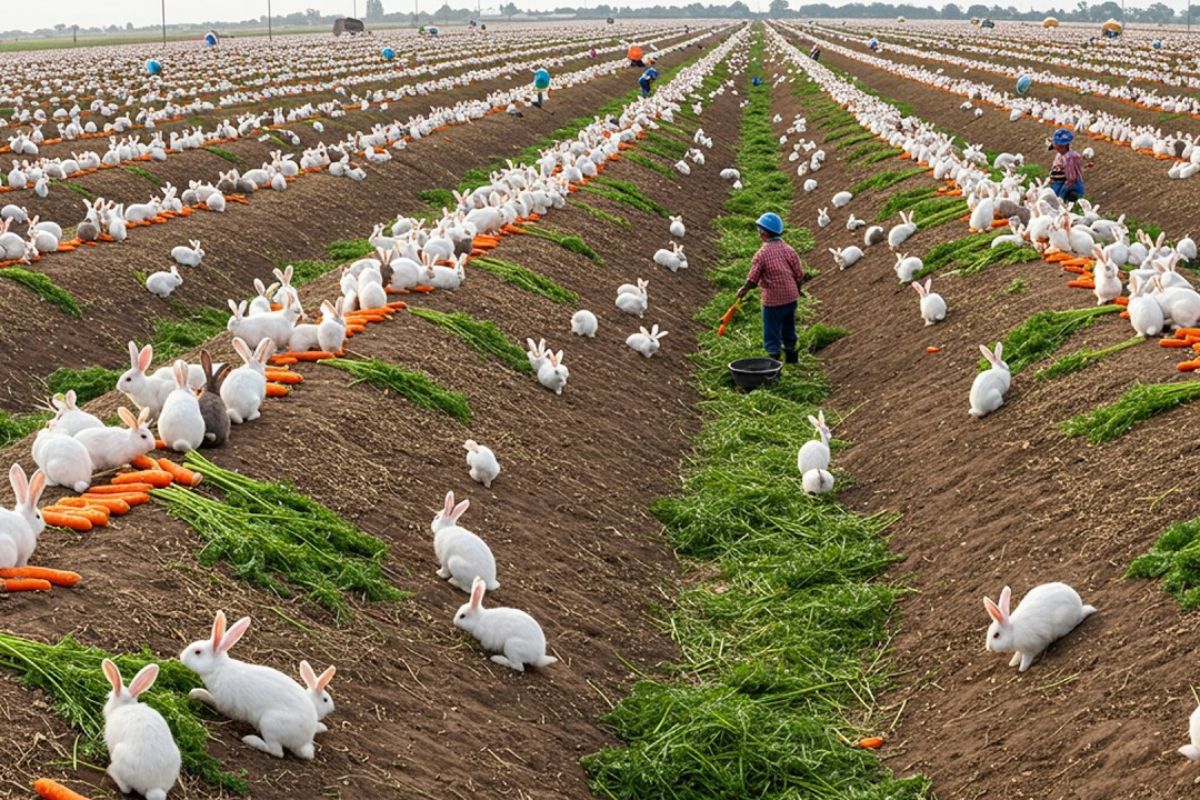


Raised On An Industrial Scale, Rabbit Farms Combine Strict Management, Standardized Feeding, And Automated Processing To Deliver High-Value, Traceable Meat From Barn To Slaughterhouse, In A Production System Designed For Global Volumes And Consumers Obsessed With Clean Protein, With Strict Sanitary Standards And A Daily Monitored Routine
Rabbit farms have ceased to be merely a response to pest control and have solidified as a structured part of the animal protein agribusiness. In modern models, a single system can deliver between 10,000 and 50,000 commercial rabbits per year, meeting a growing demand for foods considered clean, low in fat, and high in protein value.
Throughout the production chain, the animal is treated as an industrial asset, with a focus on productivity, carcass standardization, and maximum utilization of by-products. From daily management to closed-line processing, the goal is to maintain supply regularity and quality predictability, with stocks prepared to supply various distribution channels, from the food industry to niche gastronomy.
From Ecological Pest To An Agribusiness Asset

In the past, the expansion of rabbits in countries like Australia was seen as an ecological disaster, associated with crop destruction and pressure on natural ecosystems.
-
Attracting around 250,000 people a year, a lighthouse 200 meters from the sea, on a 60-meter high cliff, on the North Sea coast in Denmark, becomes one of the most impressive examples of how nature can threaten historical buildings.

-
The narrowest house in the world is only 63 centimeters wide, but inside it can accommodate a bathroom, kitchen, bedroom, office, and even two staircases.
-
In the middle of the sea, these enormous concrete and steel structures, built by the British Navy to protect strategic maritime routes, look like they came straight out of a Star Wars movie.

-
For years, no one could cross a neighborhood in Tokyo because of the tracks, but an impressive solution changed mobility and completely transformed the local routine.


The same characteristic that fueled the problem, however, has become the foundation of the current business model: the ability for rapid and continuous reproduction.
By structuring rabbit farms in a controlled environment, producers have transformed this biological potential into a predictable flow of animals ready for slaughter.
Instead of uncontrolled populations in the fields, the focus has shifted to warehouses, pens, and planned structures, where parameters such as density, growth, and slaughter weight are closely monitored.
How Commercial-Scale Rabbit Farms Operate

In industrial operations, rabbit farming is organized into well-defined cycles, with two main fronts: reproduction and fattening.
The foundation consists of selected breeding stock, kept in separate facilities from the animals intended for slaughter.
Reproduction can occur through natural mating or through artificial insemination, where the semen is first evaluated in a laboratory before being applied to the females.
This model allows for lineage control, performance standardization, and maintenance of a stable breeding group, focusing on weight gain, feed conversion, and carcass quality.
As the kits grow, they are moved to fattening sections, where the objective is to grow the batch to a commercial weight, typically just over 2 kilograms per animal.
Each stage is treated as a segment of the production line, with performance goals and sanitary indicators constantly monitored.
Continuous Reproduction, Strict Management, And Controlled Nutrition
The logic of rabbit farms is to maintain a continuous flow of market-ready animals.
Therefore, reproductive management is planned so that births, weaning, and fattening proceed without significant interruptions.
From the second month of life, rabbits enter an accelerated growth phase, receiving a balanced feed rich in nutrients, complemented by clean water provided by automated systems.
Simultaneously, fruits and vegetables are included in the diet at specific times to ensure a supply of natural vitamins and aid digestion.
This design allows for controlling weight gain rate, intestinal health, and body condition, reducing losses and maximizing the number of animals reaching the target weight between the third and fourth months.
When the batch reaches the desired weight range, the transition to slaughter is immediate, avoiding feed waste and loss of efficiency.
Slaughter In A Closed Line And Standardization Of Rabbit Meat
At the processing stage, the industrial logic becomes even more evident.
The slaughter is done in a closed production line, with sequential steps for stunning, bleeding, evisceration, and carcass division.
Each function is isolated and executed in a specific area, reducing risks of cross-contamination.
The internal organs are separated critically. Kidneys and other components considered premium can go to value-added channels, while the carcass is processed into specific cuts or whole packaging.
Each unit receives identification with lot number, production date, and expiration date, allowing traceability from the field to the point of sale.
This rabbit meat, described as clean, low in fat, and rich in protein, is integrated into menus focused on healthy eating, low-fat diets, and preparations that explore more delicate textures.
Simultaneously, parts of the animal can be transformed into ready-made dishes or undergo more elaborate culinary treatments, expanding the use in contemporary gastronomy.
Black Chicken: Another High-Value Protein Niche
In the same realm of special proteins, the black chicken appears as a bird treated almost like a superfood, associated with high protein, collagen, and rare micronutrient content.
In dedicated systems, flocks totaling hundreds of thousands of birds per year are raised to meet specific markets and traditional medicine.
The production cycle begins with incubation in a controlled environment, with adjusted temperature and humidity and regular turning of the eggs until hatching.
The chicks are kept under infrared heating and, when they gain strength and plumage, move to larger barns, where they receive nutrient-rich granulated feed.
Upon reaching standard weight, the birds proceed to processing under strict hygiene conditions.
Once cleaned, they can be used in herb soups, stews with mushrooms, or sautéed dishes with vegetables, always focusing on preserving natural sweetness and nutritional value.
In several Asian countries, the black chicken is already a culinary symbol and a cultural marker associated with functional food.
What The Future Holds For Rabbit Farms And Special Proteins
The combination of industrial-scale rabbit farms, closed processing, and niche meats like black chicken suggests a scenario in which animal protein is treated as an engineered product, with emphasis on traceability, sanitary standards, and market segmentation.
At the same time, pressure for animal welfare, productive transparency, and sustainability is expected to gain weight in consumer decisions.
For the industry, the challenge is to maintain productivity and predictability without compromising rigorous controls and clear information for those at the end of the line.
For consumers, the question is to understand where the meat that reaches their plate comes from and which production models they are willing to support.
In a billion-dollar, expanding market, how these choices are made should directly influence the future of rabbit farms and other special proteins.
In your view, are rabbit farms and the production of niche meats like black chicken a necessary response to global protein demand, or do they still raise more questions than confidence?






Morei na Espanha e depois do frango vem o coelho como proteína mais barata, mas aqui no Brasil um coelho custa até 70,00 e o frango inteiro 15 ou 16,00 ou seja neste país tudo é mais difícil é uma palhaçada que só ferra o consumidor.
Mas aonde que é isso???
Estranho creio que esse site não seja confiável com essa reportagem!
Estranho, que nada no Brasil é confiável!
Se propagarem que capim é mais saudável, irão impor imposto nas alturas.
Típico de Moçambique….aqui não se produz nada e os impostos são bem altos.