





 Portuguese
  English
  Spanish
  5 min of reading
  0 comments


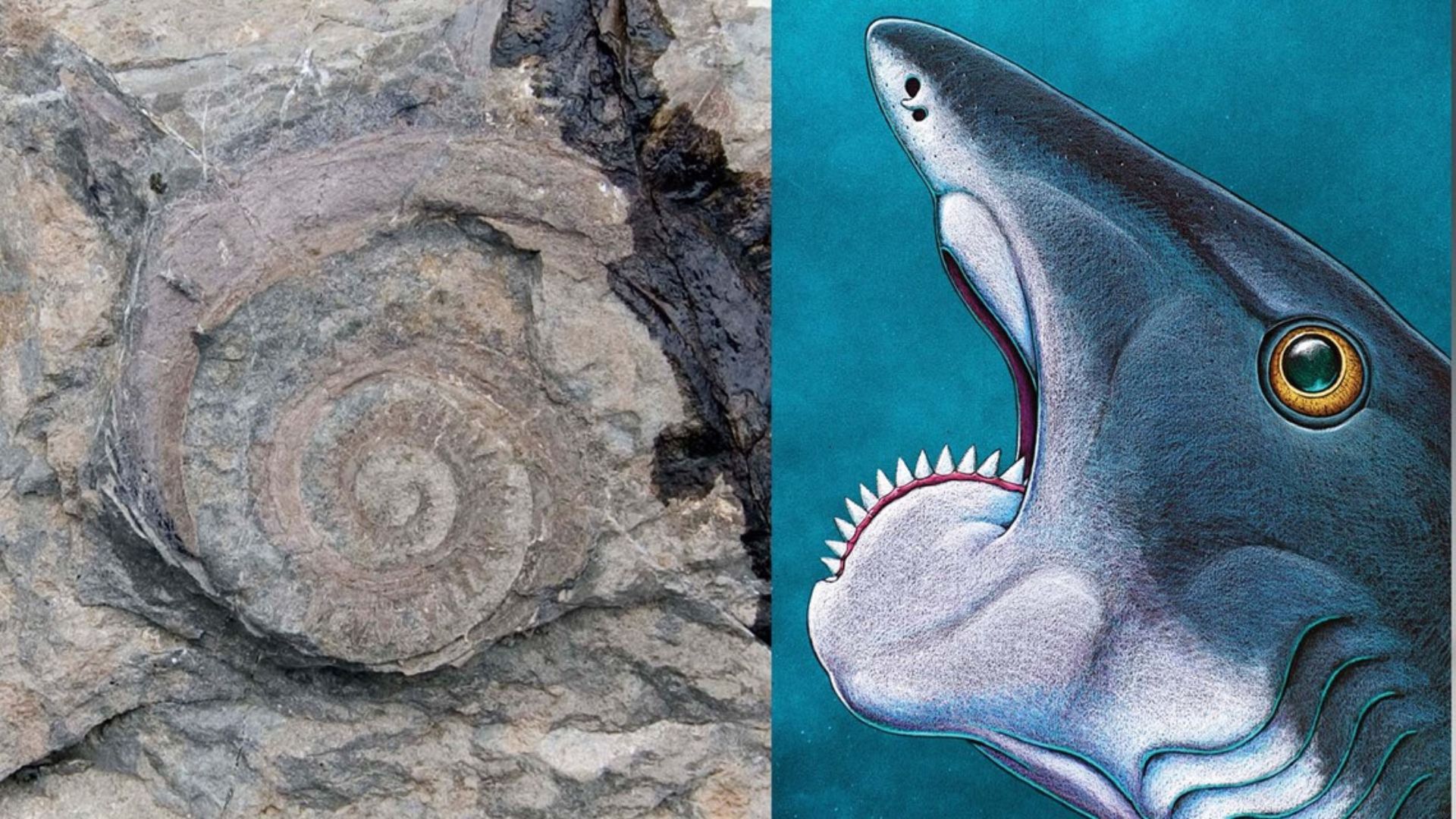
Spiral Dental Structure Preserved in Permian Fossils Led Researchers to Revise Historical Interpretations About Anatomy, Feeding and Evolutionary Position of an Extinct Cartilaginous Fish Known Almost Exclusively by Its Teeth.
A spiral-shaped fossil, studied since the late 19th century, has returned to the center of scientific debate after analyses based on computed tomography and three-dimensional reconstructions linked the structure to the jaw of an extinct cartilaginous fish that lived before the rise of dinosaurs.
This animal is known as Helicoprion, an extinct genus primarily identified by spiral dental structures, called tooth whorls, found isolated in marine deposits and preserved without most of its body.
According to records from scientific collections, some of these specimens have about 56 centimeters in diameter in the outer portion of the spiral, a dimension that contributed to the attention received since the first formal descriptions.
-
Untouched for 2,200 years, the tomb of China’s first emperor hides up to 100 tons of mercury, lethal traps designed to kill invaders, and a mystery so dangerous that archaeology still refuses to uncover it.

-
With 220 meters, 721 feet, and 25 thousand gross tons, the world’s largest sailing cruise ship sets a record before its debut and promises to reinvent luxury at sea with giant sails and futuristic engineering.

-
A Brazilian city is being invaded by the sea, buildings are leaning, and the solution could cost R$ 200 million with support from BNDES to prevent flooding, modernize drainage, and protect more than 200,000 residents within 5 years.

-
Lula’s government puts R$ 1 billion on the table to revitalize watersheds with 60 projects, including the São Francisco and Parnaíba rivers, sanitation, navigation, urban drainage, pollution control, and actions in strategic areas of Furnas.

The age assigned to these fossils ranges between 270 and 290 million years, a span that covers part of the Permian period and positions Helicoprion in marine ecosystems long before the diversification of modern sharks.
Historical Interpretations and Limitations of the Fossil Record
For decades, the main difficulty was not only in identifying the animal but also in interpreting the function and anatomical location of the spiral, as the initial finds consisted almost exclusively of the mineralized dental structure.

Given the absence of complete skeletons, the scientific literature has recorded differing interpretations over time, including proposals that positioned the spiral in the tail, in fins, or as an external structure without direct connection to the jaw.
According to specialists, this diversity of interpretations reflects the limitations imposed by a fragmented fossil record, dominated by isolated pieces and lacking sufficient anatomical context for more precise conclusions.
Tomographies Reveal Position of the Spiral in the Jaw
A significant advancement occurred in 2013, when a study published in a scientific journal presented computed tomography images of a rare specimen, preserved with mineralized cartilages and parts of the jaw in three dimensions.
Based on this material, the authors reconstructed the anatomy and identified the spiral located in the central region of the lower jaw, following the jaw arch and supported by cartilages.
From this evidence, researchers interpreted the structure as part of a continuous dentition system, in which new teeth would form and progressively integrate into the spiral over the animal’s life.
In this arrangement, older teeth would remain in the outer portions of the spiral, while the newer ones would occupy inner positions, as described in the study.
Evolutionary Classification and Relation to Other Cartilaginous Fish
This pattern of dental growth is cited in the literature as one of the reasons for Helicoprion being classified in an extinct group of cartilaginous fish distinct from modern sharks, with closer affinities to the branch that includes current chimeras.

Even with the position of the spiral better defined, researchers emphasize that Helicoprion remains poorly known in terms of general anatomy, as most of the fossil record continues to be restricted to dental whorls.
The fossils attributed to the genus have been found in different regions of the world, with significant records in areas such as Idaho, USA, in addition to documented occurrences in deposits in Russia and other regions with Permian marine rocks.
Incomplete Preservation and Measurement Challenges
In several cases, the very preservation condition hinders detailed measurements, as there are specimens partially exposed or still encased in rock, making more precise analyses dependent on laboratory preparation or scanning techniques.
Aside from the debate about the anatomical position, the functional interpretation of the spiral has also been approached with caution by researchers.
According to the published reconstructions, the structure would not function as a loose element, but as an integrated part of the jaw, with teeth arranged in sequence and compatible with the closing mechanics of the mouth.

Images obtained through tomography indicate that the spiral occupied a large part of the oral cavity, which implies specific anatomical adaptations to accommodate the set without compromising jaw function.
Methodological Advancements and Limits of Conclusions
The study also describes the presence of supporting cartilages, interpreted as important components for the stability of the jaw during the use of the teeth.
This evidence helped reduce interpretations not supported by anatomical data, providing a three-dimensional basis that relates the spiral directly to the preserved jaw structure.
Despite this advancement, the authors themselves point out that there are still clear limits to what can be stated with certainty, since broader body characteristics are not preserved.
A recurring example cited in the literature is the total size of the animal, often a subject of public interest, but which cannot be uniquely defined from the available dental whorls.
According to studies, the relationship between the diameter of the spiral and the body length depends on anatomical parameters that were not preserved consistently in the fossil record.
Persistent Uncertainties and Scientific Gaps
What can be stated with greater certainty is that jaws associated with some of the largest whorls exhibit significant dimensions, with estimates based on comparisons with better-preserved specimens from related groups.

The scientific trajectory of Helicoprion is often cited as an example of how isolated structures can generate prolonged debates about anatomy and evolutionary relationships when the body context is limited.
In this case, the uncertainty arises from the combination of a highly characteristic dental structure, a predominantly cartilaginous skeleton, with a low likelihood of fossilization, and a record composed mainly of loose pieces.
The use of computed tomography is identified by researchers as a methodological landmark, allowing for the visualization of internal details without the need to destroy the fossil.
Still, studies emphasize that resolving several issues depends on the discovery of new materials that preserve other parts of the body.
Note on gap: there is no secure confirmation, based on the most widely accepted scientific publications, of a unique and definitive value for the total body length of Helicoprion, as the most common fossils are isolated dental whorls and specimens with complete jaws are rare.






-

-

-

-

-

15 pessoas reagiram a isso.