





 Portuguese
  English
  Spanish
  5 min of reading
  0 comments


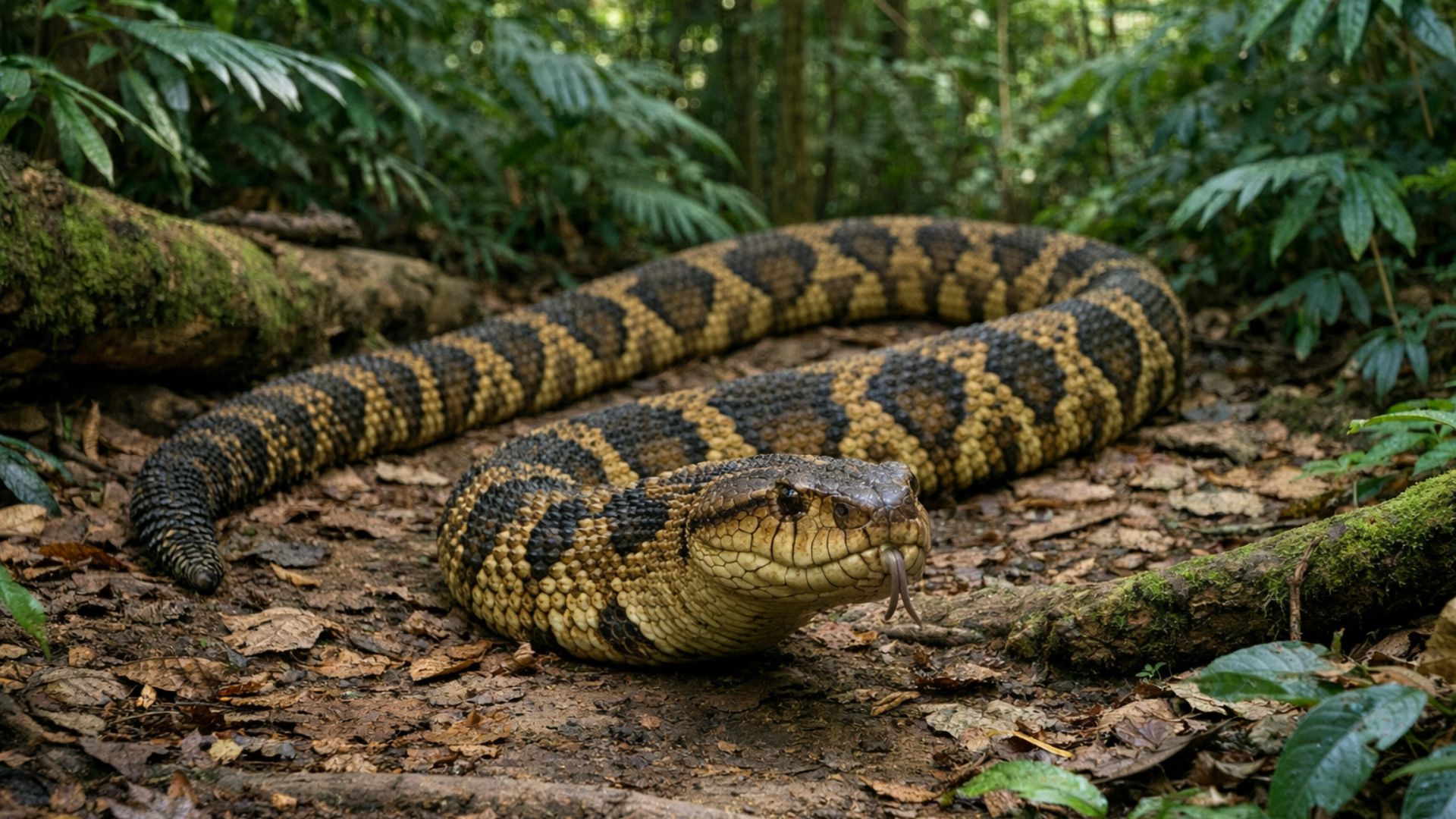
Brazilian Large Snake Combines Extreme Size, Unusual Appearance, and a Rare Reproductive Behavior Among Vipers, Being Recognized by Scientific Institutions as the Largest Venomous Snake in the Americas and One of the Most Impressive of the South American Fauna.
The surucucu-pico-de-jaca is cited by Brazilian reference institutions, such as the Butantan Institute, as the largest venomous snake in the Americas.
The species is known to exceed 3 meters in length, to have scales that resemble the texture of jackfruit skin, and to exhibit an unusual reproductive trait among vipers present in the country: instead of giving birth to fully formed young, it lays eggs.
In Brazil, the Ministry of Health also classifies the surucucu-pico-de-jaca among snakes of medical importance due to its association with laquetic accidents, a poisoning situation that requires hospital care and specific antivenom use when indicated.
-
A Brazilian millionaire couple restores a farm over 150 years old in the interior of São Paulo and transforms the historic property with Portuguese tiles, antique furniture, and new spaces into a refuge that blends tradition, comfort, and sophistication.

-
Submerged city in a lake in Minas reveals intact streets, preserved vehicles, and houses after more than 60 years, impressing divers.

-
Yellowstone has started to rise again in an area of the caldera, and the movement rekindles fears surrounding the U.S. supervolcano, as scientists monitor the deformation and try to understand what is happening underground.

-
Woman arrested after receiving $1.2 million due to banking error and not returning the amount.


Extreme Size and Unique Position Among Vipers
The name “surucucu-pico-de-jaca” is popularly used for snakes of the genus Lachesis, recognized in herpetological literature as the largest vipers in the western hemisphere.

In practice, size is the first detail that breaks public expectation.
Even though it is a venomous snake, a group frequently associated with smaller and more discreet animals, the surucucu appears in scientific records and institutional reports as a long, robust-bodied reptile, capable of rivaling medium-sized constrictor snakes in length.
A scientific review available in an international biomedical article database compiles historical records of specimens measuring over 3 meters and also cites larger numbers in older reports.
These data help explain why the animal occupies a unique position among snakes in the Americas.
Scales That Resemble Jackfruit and Defensive Behavior
The appearance that earned it the nickname “pico-de-jaca” is not an exaggeration.

The Butantan Institute describes that the scales of its body resemble the skin of the fruit, a direct reference to the relief and pattern that, seen up close, produce a striking visual effect.
This feature, combined with tones that range from beige, brown, and orange, with darker spots along the back, makes the species easily recognizable in well-documented photographic records.
Another detail mentioned by Butantan is the presence of differentiated scales at the tip of the tail.
These scales can be vibrated against leaves and forest floor debris, producing a warning sound.
The behavior functions as a warning signal, used before any direct confrontation.
Forest Habitat and Low Frequency of Encounters
Despite its size, the surucucu is not described by scientific institutions as an easily found animal.
The Butantan Institute characterizes the species as a specialist in remaining hidden, with life habits compatible with closed forest environments.
The combination of discreet behavior and habitat helps explain a recurring fact in institutional sources: accidents involving surucucu are less frequent than those caused by jararacas.
Butantan points out that the preference for humid regions with less human presence contributes to reduce encounters with people.
Where Does the Surucucu-Pico-de-Jaca Live in Brazil

In Brazil, the distribution associated with the common name “surucucu-pico-de-jaca” appears linked to preserved forest areas.
The Butantan Institute describes occurrences in much of the Amazon and also in sections of northern Atlantic Forest.
The Ministry of Health summarizes the habitat as the Amazon rainforest and remnants of the Atlantic Forest.
This context helps explain why the species does not form part of the daily life of most urban populations.
Rare Reproduction Among Brazilian Vipers
The reproductive rarity mentioned in the title is based on technical descriptions.
The Butantan Institute states that the surucucu is the only oviparous viper in Brazil.
Within the group of vipers present in the country, it is the only one that lays eggs instead of giving birth to young.
The eggs are deposited in natural cavities, such as fallen trunks, exposed roots, and burrows in the ground.
Birth involves a typical mechanism of oviparous reptiles: the hatchling breaks the shell using a temporary “egg tooth”, which is lost shortly afterward.
The scientific literature on the genus Lachesis also points to records of parental care, with females remaining close to the clutch for protection.
Feeding and Ecological Role
According to the Butantan Institute, the surucucu has terrestrial and nocturnal habits.
Its diet is primarily based on mammals, especially small to medium rodents.
This information helps dispel the idea that large venomous snakes rely on unusual prey to survive.
In the forest environment, rodents represent a food source compatible with the size and hunting strategy of the species.
Venom, Risks, and Medical Attention
The relationship with venom is one of the points of greatest public interest.

The Butantan Institute describes that the venom of the surucucu has multiple actions, affecting tissues, coagulation, and systemic functions.
Among the described symptoms are intense pain, swelling, changes in coagulation, and decreased blood pressure.
A scientific review of the genus Lachesis reinforces that, although cases are less frequent, laquetic poisoning can be severe.
The Ministry of Health states that the only effective treatment, when indicated, is the specific antivenom, administered in a hospital environment.
The Butantan Institute informs that it produces antivenom intended for the treatment of accidents involving snakes of the genus Lachesis.
Scientific Updates and Species Classification
In recent years, the surucucu has also begun to appear in scientific discussions regarding classification.
The Ministry of Health cites Lachesis muta and Lachesis rhombeata when discussing laquetic accidents.
In 2024, Brazilian researchers published studies indicating that the population associated with the Atlantic Forest was described as Lachesis rhombeata, while the Amazonian population remains as Lachesis muta.
These taxonomic updates do not change the central fact recognized by scientific institutions: the surucucu still ranks among the largest venomous snakes in the Americas.






-

-

-

-

-

54 pessoas reagiram a isso.